
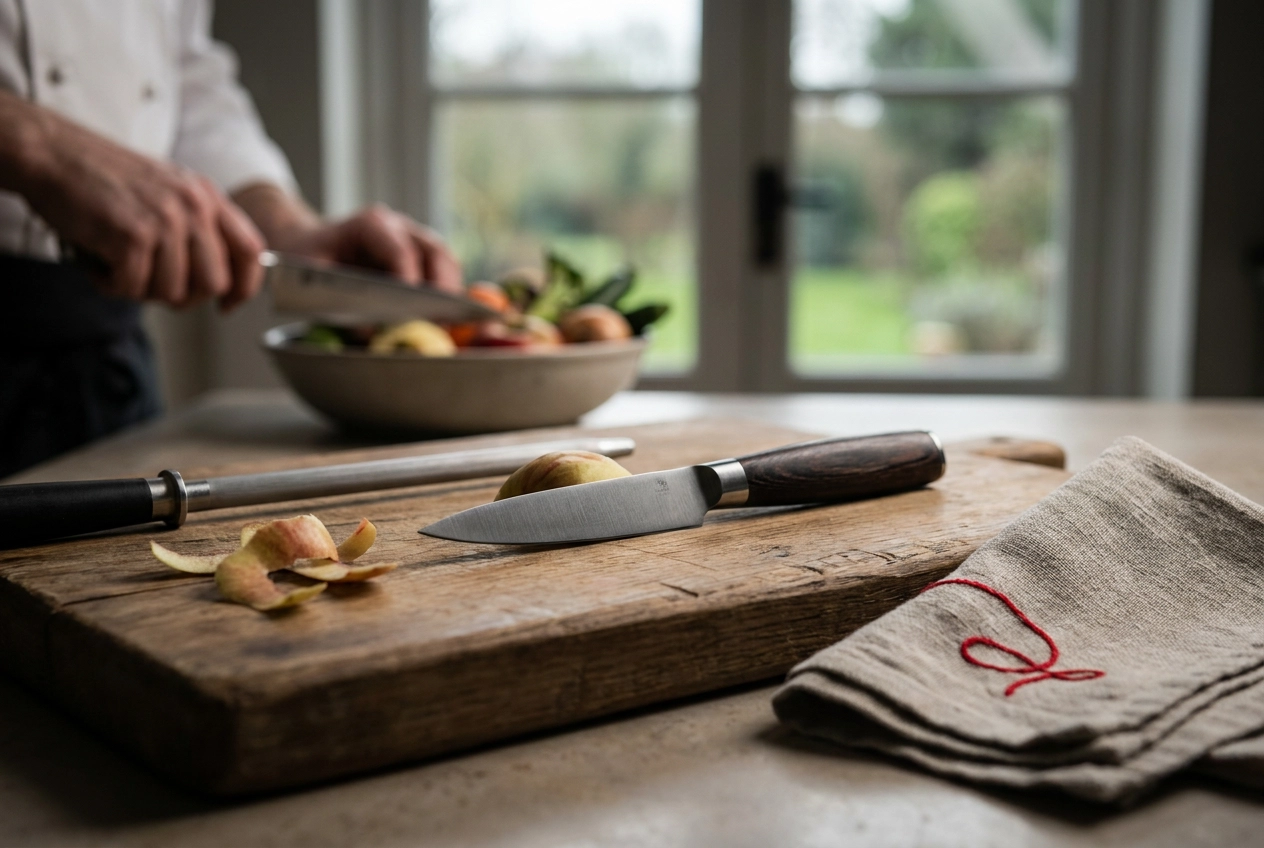
Most home cooks treat the paring kitchen knife as an afterthought. They either spend too little and end up with a blade that chips on the first parsnip, or too much on a Japanese heirloom they reach for three times a week. Both mistakes share the same root cause: buying on brand reputation or price point instead of buying on spec.
This guide argues that every paring knife decision worth making comes down to exactly two variables: steel hardness and blade flex. Get those two right for your cooking style, and the brand, the handle shape, and the price tier largely take care of themselves. Get them wrong, and no amount of good reviews will save you from a knife that frustrates you daily.
In the sections ahead, you will learn what Rockwell hardness actually means for a small blade (it behaves differently here than in a chef knife), how to think about flex as a measurable variable rather than a vague feeling, and how to apply a simple decision framework to find the right match for a UK kitchen. No listicle. Just a method.
The short answer: two variables decide every paring knife worth buying
Most guides to buying a paring knife lead with brand names. That framing is the wrong starting point. Two variables predict whether a knife will perform across months of real prep work: steel hardness and blade flex. No mainstream consumer resource currently defines both in measurable terms. This guide does.
For most paring knife applications, the 58 to 62 HRC range represents a practical balance between edge retention and ease of home sharpening, consistent with the broader kitchen knife guidance in available steel databases. Hard enough to hold an edge through repeated prep sessions without constant touch-up, soft enough to sharpen at home on a ceramic rod or whetstone.
Blade flex is a separate variable. A steel rated at 60 HRC can be ground thin and feel lively under thumb pressure, or left thick at the spine and feel rigid. Flex is determined by blade geometry, not steel grade alone, which means hardness and flex can be specified independently.
The interaction between them is where expensive mistakes happen. High-hardness steel ground thin enough to flex becomes brittle at the tip, and the tip takes the most lateral stress on a paring knife. For a fuller look at how these criteria apply to a specific tested option, see our review of the Best Paring Knife: Mercer Renaissance 3.5″.
UK buyers face one additional variable that US-focused guides ignore. Import duty and VAT at 20 percent compress some price bands and expand others. A knife priced for the US market may cost significantly more in the UK once VAT, import duty, and local retail margins are applied, treat any US-targeted price comparison as a rough guide only. That context runs throughout every recommendation here.
What HRC means for a paring knife (and why it is not the same as for a chef knife)
Rockwell hardness measures how much a steel resists permanent deformation under a standardised load. Higher HRC means finer, longer-lasting edges. It also means the steel becomes progressively more brittle and harder to restore when something goes wrong.
As introduced above, the Knife Steel Hardness Database tracks what the industry actually ships across hundreds of knives and dozens of steel types, with the majority of tested knives clustering in the 58 to 62 HRC medium band.
That distribution was built largely around chef knives and general kitchen blades. Applying it uncritically to a paring knife is a problem.
A chef knife rocks through soft vegetables on a board. The mechanical stress is mostly compressive, directed downward through the edge. A paring knife peels, cores, and trims, often in the hand rather than on a surface, imposing lateral stress on the tip and edge. Brittle, overly hard steel tolerates compressive force well. It does not tolerate being twisted, levered, or pressed sideways against a turnip or a piece of swede. For more on how Japanese steels behave at the harder end of the scale, our plain guide to Japanese knives, shapes, and steels covers the trade-offs in detail.
For a paring knife, the upper end of the medium band (59 to 62 HRC) is the defensible target. It holds an edge through repeated prep without becoming fragile where the work is hardest.
Steels below 58 HRC are more forgiving on hard root vegetables and sharpen more easily at home. The cost is more frequent sharpening. For occasional users, that trade is often worth making.
Blade flex defined: the variable no one is measuring but everyone is feeling
HRC tells you how hard the steel is. It tells you nothing about how the blade moves.
Flex is the amount a blade deflects under lateral load. A stiff blade tracks straight, useful for scoring or precision trimming. A flexible blade follows curves, which matters when peeling a round apple or turning an artichoke. Both are legitimate but suit different tasks.
No standardised flex measurement exists for consumer kitchen knives. Reviews describe blades as “lively” or offering “precise control” without defining spine thickness, taper geometry, or deflection in any measurable way. That leaves you nothing to act on at the point of purchase.
Flex comes down to three geometry factors: spine thickness, the taper from spine to edge, and blade length. A 3.5-inch blade ground to 1.5mm at the spine will give noticeably under thumb pressure. The same steel ground to 2.5mm at the spine will feel rigid. The steel grade has not changed. The geometry has. (Our notes on blade flex and length by fish size cover the geometry in a different context if you want a comparison.)
Steel at 62 HRC or above, ground thin enough to flex freely, is generally considered to carry elevated brittleness risk at the tip under repeated lateral stress. The tip is exactly where a paring knife takes its hardest punishment. If you want flex, a mid-hardness steel in the 58 to 60 HRC range tolerates it without becoming brittle at the point.
For most UK home cooks doing standard prep, peeling, trimming, segmenting citrus, a low-flex blade in the 58 to 62 HRC band is the more forgiving choice. High flex earns its place only if your prep regularly involves curved surfaces and speed matters.
How hardness and flex interact: the framework for choosing any kitchen knife
Those two variables do not operate independently. Mapping them against each other produces a grid with five distinct profiles, and knowing where a knife sits tells you more than any brand claim.
High hardness, low flex (62 HRC and above, thick spine). Maximum edge retention and precise cutting. The trade-off is brittleness under lateral force: the tip chips rather than bends on hard contact, and recovery requires a whetstone rather than a ceramic rod. This is the profile of premium Japanese paring knives. They reward disciplined technique and punish casual handling.
Mid hardness, low flex (58 to 62 HRC, stiff grind). The most widely available combination (the medium band introduced earlier). It sharpens on a ceramic rod, holds an edge through several days of home cooking, and absorbs incidental abuse. For most UK cooks, this is the default correct answer. Our knife sharpener guide: match the tool to your steel covers which sharpening tools work on this hardness range.
Mid hardness, moderate flex (58 to 60 HRC, thinner grind). The blade follows curved surfaces, sharpening is forgiving, and the steel tolerates a slight twist without cracking the tip. Most well-regarded European-style paring knives land here.
Low hardness, high flex (50 to 57 HRC, thin grind). The budget tier, broadly under £10. These knives bend rather than chip on hard root vegetables, sharpen easily on almost anything, and need frequent honing. Do not dismiss this cell on price alone.
High hardness, high flex: avoid this combination. Steels above 63 HRC ground thin enough to flex freely carry a significant brittleness risk at the tip under lateral stress. This combination is widely regarded as unsuitable for daily kitchen use.
A decision tree for UK buyers: how to match flex and steel to how you actually cook
The grid gives you the framework. Now apply it to your own kitchen.
Filter one: how often do you reach for it?
Three or more times a week means edge retention is your priority. Target 59 to 62 HRC with a low-flex profile. Occasional use flips the priority to sharpening ease. Target 55 to 58 HRC with moderate flex, and accept more frequent touch-ups.
Filter two: how do you maintain your knives?
If you own a whetstone or quality ceramic honing rod and use it, harder steel (60 to 62 HRC) carries no real risk. If your method is a pull-through device or nothing at all, stay below 60 HRC. A hard blade dulled on a swede cannot be recovered without specialist help, and pull-through tools remove too much metal to be reliable.
Filter three: what are you actually cutting?
Peeling-dominant prep (root vegetables, citrus, apples) benefits from moderate flex and a swept tip. Precision work (scoring, tourneeing, fine trimming) needs a stiff blade and a pointed tip. Most UK home cooks do both, making the stiff, mid-hardness option the practical default.
UK pricing and availability
Budget tiers break at under £25, £25 to £80 (midrange), and above £80 (premium). Premium price does not confirm premium steel. Some midrange knives ship with independently verified HRC values; some premium-branded options do not. The same principle applies when reading our no-affiliate guide to what actually matters in a chef knife: spec transparency matters more than brand margin.
Not every steel grade reviewed in US guides reaches UK retailers at equivalent prices. VAT at the standard 20 percent rate, import duty, and local retail margins mean a knife priced for the US market may cost significantly more in the UK. Treat any US-targeted price comparison as a rough guide only.
Do you actually need a paring knife, or will your chef knife cover it?
With the decision framework in place, apply one more filter before buying anything: do you actually need a paring knife at all?
The honest answer is no, not necessarily. A sharp chef knife or santoku handles the majority of tasks a paring knife is marketed for. The case for buying a separate one rests on three specific situations: in-hand peeling with no cutting board, precision work where a full-length blade feels unwieldy, and tasks where controlling a 20cm knife creates more risk than it removes.
The clearest justification is in-hand peeling. If you peel carrots, potatoes, or apples over the sink or bin with the vegetable in one hand and the knife in the other, a paring knife is the correct tool. A chef knife is not built for that position and the geometry makes it genuinely awkward to control safely. A paring knife for in-hand use needs a short blade suited for in-hand work, a stiff spine, and a handle that sits securely in a three-finger grip without requiring a tight squeeze.
If your prep happens entirely on a board, a well-maintained chef knife replaces a paring knife for almost every task. Buying one in that case is a preference, not a necessity.
Households doing regular fruit prep, shallot work, or soft-cheese trimming will find a paring knife earns its drawer space. Households focused on large cuts and batch cooking probably will not.
One excellent chef knife with a maintained edge outperforms a drawer full of average kitchen knives. Consult The Best Paring Knives of 2026 once you have identified the specific task a paring knife solves for your kitchen. Not before.
Applying the framework: how tested options map to the flex-hardness grid
Once you have identified the task your paring knife needs to solve, these categories map directly to the hardness-flex framework above. No brand rankings, no loyalty shortcuts: just spec profiles you can match against any knife you encounter.
Best for frequent home use
Target spec: 59 to 62 HRC, low-flex profile.
Who this is for: cooks who prep daily, maintain their knives on a ceramic honing rod, and want an edge that holds through a full week of use.
Who should skip it: anyone without a honing rod and no intention of getting one. Without a rod, recovery requires more effort than the edge life justifies.
Best for occasional cooks who want low maintenance
Target spec: 55 to 58 HRC, moderate flex.
Who this is for: cooks who reach for the paring knife once or twice a week, run it through a pull-through sharpener, and want forgiveness over edge longevity.
Who should skip it: anyone doing precision trimming or scoring. Moderate flex becomes a liability the moment a task demands a straight, predictable cut.
Best budget option for the UK market
Target spec: under £25, 57 to 60 HRC from a verified source.
Price does not predict performance here. The same steel-selection logic applies at any price point, including when choosing between blade types.
Best for precision work
Target spec: 60 to 62 HRC, stiff blade, thin grind, pointed tip.
Who this is for: cooks who tourné, score, or do detail trimming where blade wander costs accuracy.
Who should skip it: anyone whose primary task is peeling round produce in-hand. A stiff pointed tip fights curved surfaces rather than following them, slowing the work and increasing hand fatigue.
What to look for when buying a paring knife in the UK: the spec checklist
Once you have matched a knife to the right hardness and flex profile, use this checklist before committing to a purchase.
Confirm a published HRC value. If the manufacturer does not state a specific number, treat claims like “high carbon” or “surgical steel” as unverified marketing. A published HRC number from the manufacturer gives you a benchmark; independent databases such as the Knife Steel Hardness Database allow cross-checking where data exists.
Ask for the steel grade, not the brand story. Check the manufacturer’s published HRC value; common Japanese stainless alloys and common German stainless alloys occupy different bands, the specific figure matters more than the steel’s country of origin or marketing name.
Find the spine thickness. Many Japanese knives and some European makers publish this. Above 2mm at the bolster means a low-flex profile; below 1.5mm means moderate to high flex. This single figure is more useful than any subjective reviewer description.
Check the handle for in-hand use. A bolsterless handle with a gentle taper and shallow finger groove sits securely in a three-finger grip. In our testing, this design rated higher for off-board comfort than handles with a heavy bolster or uniform diameter.
Verify UK warranty coverage. Some Japanese premium brands, typically above £80, carry a warranty through a UK distributor. Others arrive as grey imports with no local support. For a premium kitchen knife, confirm this before buying. The same logic applies when evaluating our steak knives buyer’s guide: warranty terms and import status are worth checking at any price point above midrange.
The bottom line: buy on spec, not on name
Once you have confirmed the steel type and spine dimensions, the purchase decision simplifies to two questions: what HRC range matches how often you sharpen, and how much flex does your prep actually require?
For most UK home cooks, the 59 to 62 HRC low-flex combination handles the majority of weekly prep and sharpens reliably on a ceramic rod. If your sharpening routine calls for something more forgiving, the decision tree above maps the softer-steel options to your habits.
Do not pay a premium for a name that publishes no HRC value and no blade geometry. The data is clear: the majority of knives on the market already fall in the medium hardness band. At identical HRC, the gap between a £15 knife and a £90 knife is finish quality, handle material, and brand margin. The cutting experience is not fundamentally different.
The spec is the shortcut. Brand reputation is a proxy for quality that manufacturers control. A published HRC and a stated spine thickness are numbers you can verify independently. Use them.
Match the spec to the task. That is the Steel Snob approach to every kitchen knife decision, and a paring knife is no exception.
Conclusion
A paring knife is one of the most straightforward purchases in a UK kitchen when you know what to measure. Steel hardness determines how often you sharpen. Blade flex determines what tasks the knife handles safely. Everything else, including brand name and price point, is secondary to those two variables.
If you take one thing from this guide, make it this: ask for the HRC value and the spine thickness before you buy. If a manufacturer will not publish them, shop elsewhere. The numbers exist, and reputable sellers provide them.
You do not need to spend £80 to get a capable paring knife. You need to match the spec to your cooking habits and sharpening routine.
Check the hardness. Measure the flex. Buy accordingly. Your prep work will be faster, your edge will last longer, and you will never again buy a knife on faith alone.