
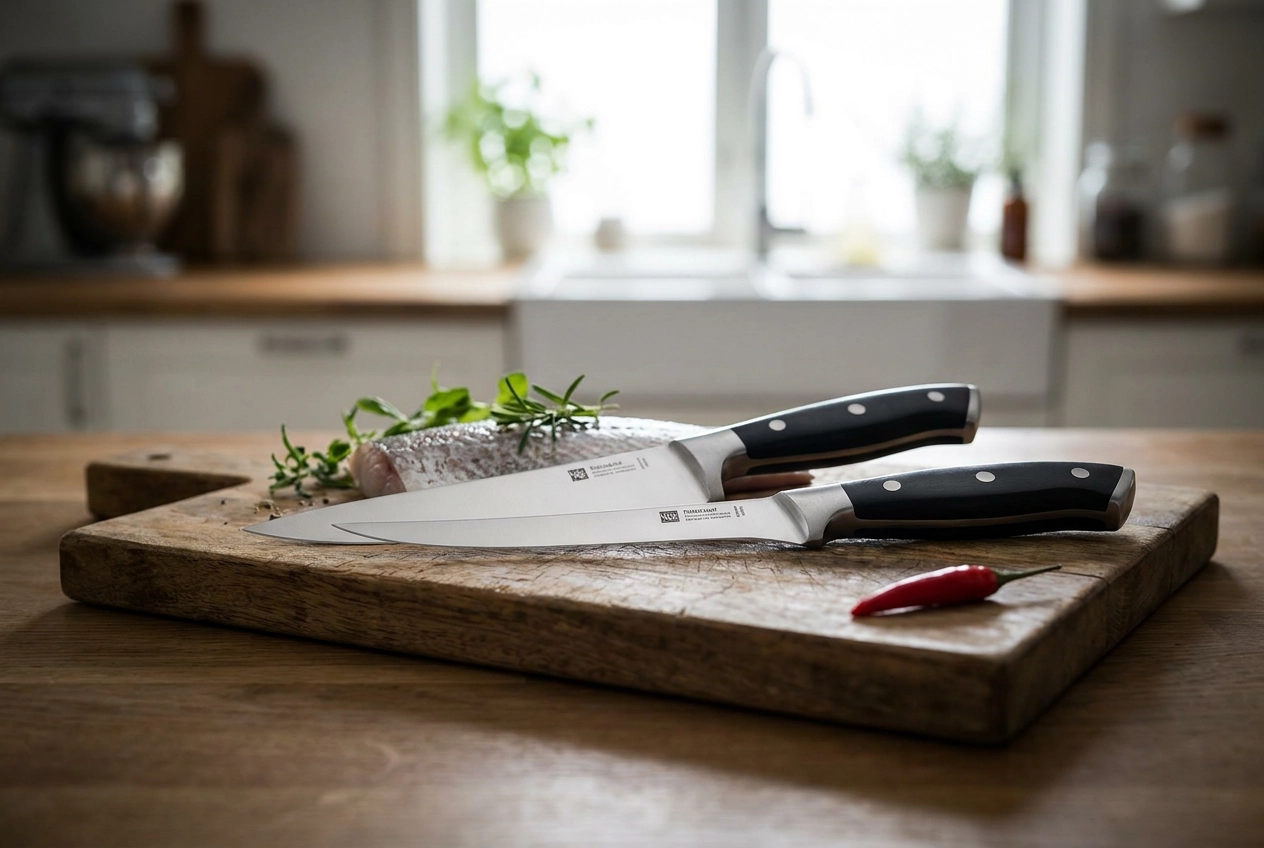
Most cooks have stood in a kitchen store, held a boning knife in one hand and a fillet knife in the other, and thought: what is actually the difference? The blades look nearly identical. The price tags are similar. The product descriptions blur together. So one gets chosen at random, and months later, someone wonders why their chicken fabrication feels awkward or their salmon fillets keep tearing.
The boning knife vs fillet knife question is one of the most searched in the knife category, and it deserves a straight answer. These two tools share a narrow profile but diverge in meaningful ways: blade rigidity, steel flexibility, edge geometry, and the specific forces each is built to handle. Those differences show up immediately once you put either knife to its intended task.
This guide maps exactly where they differ, where one can cover for the other, and which knife belongs in your kitchen based on what you actually cook. You will walk away with a clear understanding of both tools and a specific purchase recommendation you can act on today.
The short answer
Buy a boning knife if you primarily work with meat and poultry. Buy a fillet knife if fish dominates your cutting board. If you cook both at moderate volume and want a single tool, a semi-flexible boning knife is the most practical compromise.
Both are narrow, pointed, and built to separate meat from bone, which is exactly where the confusion starts.
The differences are not cosmetic. Rigidity, blade geometry, and steel specification each reflect what the knife has to do against bone and connective tissue. A boning knife needs to resist lateral force. A fillet knife needs to bend with it. Those are opposing design requirements, and they produce genuinely different tools. For a broader breakdown of what to look for before buying, the Steel Snob guide on what to look for when buying a boning knife vs fillet knife covers the full criteria.
This piece defines each knife plainly, maps the differences that matter at the cutting board, identifies where one can substitute for the other and where it cannot, and closes with a direct purchase recommendation by cook type.
What each knife actually is
A boning knife has a narrow blade running 5 to 7 inches, a relatively stiff spine, and a straight edge that finishes in a slightly curved, sharp tip. That tip is shaped to puncture into a joint and track along a flat bone face. The spine rigidity is the design point: when you are separating a chicken thigh at the joint or pulling silverskin off a pork shoulder, the blade needs to absorb lateral force without deflecting. Any unwanted flex at that moment costs you control.
A fillet knife is thinner, longer (typically 5 to 9 inches), and built to bend. The edge carries a more pronounced upward curve, and the tip is finer and more swept. That geometry exists so the blade can follow a fish’s rib cage or curved spine in a continuous stroke, bending against the contour rather than fighting it. The flex is not a compromise; it is the mechanism. A blade that yields to the bone structure keeps the tip tracking accurately and leaves less flesh behind.
The distinction comes down to this: one knife resists deflection, the other is designed to deflect.
One variant complicates the picture early: the flexible boning knife. It sits between a fully rigid boning blade and a true fillet knife, with moderate flex suited to mixed protein work. It is a legitimate middle-ground tool, but it is also a frequent source of buyer confusion, so it is worth naming now. Our boning knife FAQs address it in more detail.
The differences that actually matter
Those surface similarities, same narrow profile, same pointed tip, are where the overlap ends. The real separation comes down to five things.
Rigidity vs. flexibility. This is not a feel preference. It follows directly from spine thickness and grind geometry. A boning knife has a thicker spine and is ground flat or convex, resisting deflection under lateral load. A fillet knife has a notably thinner spine and is hollow-ground, making it flex intentionally. Thinner steel plus a hollow grind equals a blade engineered to bend.
Steel spec and hardness. German stainless boning knives are tough and chip-resistant when the blade meets a joint. Japanese high-carbon options hold a finer edge but are vulnerable to micro-chipping under lateral stress. Fillet knives used in wet or salt-exposure conditions favor corrosion-resistant stainless grades suited to a wet, low-force environment.
Blade geometry and edge curvature. The boning knife tip is built for controlled puncture and scraping along flat bone faces. The fillet knife tip is finer and more curved, designed to start a cut under skin without tearing flesh. The fillet knife’s pronounced belly drives a long draw stroke; the boning knife’s straighter edge supports short, precise push-and-pull cuts around cartilage.
Handle design. Fillet knife handles favor a pinch grip that lets the wrist rotate freely as the blade flexes. Boning knife handles are shaped for a full-hand grip, transmitting downward force without the hand shifting. If you are uncertain which knife fits your work, our frequently asked questions on fillet knife selection covers the most common purchase scenarios.
What a boning knife is used for
Those spec differences translate directly into a specific list of tasks.
Poultry is the primary use case. Deboning a whole chicken, separating thighs from the drumstick, and working around the wishbone all demand a blade that holds its line under lateral resistance. The stiff spine lets you push the tip into a joint socket and lever cleanly. A fillet knife flexes at exactly the moment you need purchase against bone.
Red meat trimming is the second core job. Silverskin on a pork loin or lamb leg does not yield to a flexible edge. You need a blade that tracks flat against the membrane without bowing. The same applies to fat cap work on beef chuck, where a controlled edge outperforms a flexible one at every stroke.
Cartilage and ligament work amplifies the rigidity requirement. When the tip hits resistance, a stiff blade transfers force into the cut. Significant flex deflects instead, losing control and creating a safety problem.
Fish is a secondary application, not the designed one. A stiff or semi-flexible boning knife can pull pin bones from a large salmon fillet and manage basic prep on thicker fish. The results are acceptable, not optimal. For yield and precision on fish, a dedicated fillet knife wins.
The semi-flexible variant deserves a direct mention. It has enough give to navigate curved cuts on pork shoulder or lamb without sacrificing control at the joint. For a home cook doing mixed protein work on a single-tool budget, it is the most practical choice, handling everything a rigid blade handles while managing fish prep at a competent level. Pair it with the right sharpener: the knife sharpener guide: match the tool to your steel explains which sharpener format works for the steel your blade is made from.
What a fillet knife is used for
The fillet knife is purpose-built for fish. Its defining job is removing flesh from the rib cage and spine in a single drawing stroke that follows the skeleton’s curve without lifting the blade. That continuous cut separates a clean fillet with maximum yield from a ragged one with meat left on the bone.
The second task is skin removal. You anchor the tip at the tail end, angle the blade nearly flat, and draw it forward between skin and flesh. The blade’s flex keeps it riding that boundary without digging into the meat or stalling on the skin. A rigid blade makes this noticeably harder.
In smaller fish, flex matters even more. The rib cage of a trout or perch curves sharply. A flexible blade bends to track those contours; a stiff one loses contact with the bone and tears flesh to compensate.
Match blade length to fish size. Longer blades suit large species where a short blade forces repositioning mid-stroke; shorter blades give better control on small species.
What a fillet knife cannot do well is bone poultry or trim red meat. The same flex that tracks a fish spine becomes a liability against a chicken joint or a dense pork shoulder. Lateral force causes the blade to deflect unpredictably, creating a control problem and a safety problem. For steel performance across other protein tasks, the best steak knives guide: straight-edge vs. serrated, steel grades explained, and what to skip is worth reading alongside this piece.
Where they overlap and where substitution fails
The overlap is real, but it has a hard edge.
A stiff boning knife can fillet a large fish with acceptable results. The blade cannot track a curved spine as precisely as a purpose-built fillet knife, so you will leave a little more meat on the bone. For a home cook breaking down a salmon once a week, that small yield loss is not a meaningful objection. The cut is clean enough.
A fillet knife flexed against a chicken joint or pork shoulder loses control unpredictably; do not substitute.
The semi-flexible boning knife sits closest to a true overlap tool. It handles poultry and red meat work capably, and it manages larger fish at an acceptable yield. It is not the best fillet knife available, but it is a competent substitute when the task volume does not justify two dedicated blades. For cooks who break down whole animals occasionally, it earns its place. For high-volume butchery requiring real force, the meat and bone cleavers solve a different problem entirely.
Where substitution categorically fails: a fillet knife on a whole chicken. Do not use a flexible blade to force through a joint.
Which knife to buy based on what you cook
Now that the substitution limits are clear, the only remaining question is practical: what does your cutting board actually look like most weeks?
Primarily fish: Buy a dedicated fillet knife. Match blade length to the fish you clean most often; a 5 to 6 inch blade handles trout and perch, a 7 to 9 inch blade suits larger species such as salmon or striped bass, for example. Entry-level pricing buys a capable corrosion-resistant stainless option for occasional use. Midrange unlocks better steel and a more refined grind, with noticeably longer edge retention between sharpenings.
Primarily poultry and red meat: Buy a stiff boning knife. German stainless is the sensible default for most home cooks. It sharpens easily, resists chipping under force, and tolerates imperfect technique. Premium Japanese high-carbon options hold a finer edge but reward only cooks who maintain that edge consistently. If you want to understand how steel choice plays out across knife categories more broadly, the Steel Snob comparison of ceramic and stainless steel knives covers the underlying tradeoffs.
Mixed protein, single-tool budget: Buy a semi-flexible boning knife.
High-volume fish and butchery: Buy both. A midrange boning knife and a purpose-built fillet knife together represent a modest investment. Using the wrong tool at volume wastes material, slows you down, and causes fatigue.
What to skip: No single knife is genuinely optimal for both tasks. Any product marketed as a boning-and-fillet hybrid is compromising on one axis. Know which protein dominates your cutting board and buy for that.
Maintenance and sharpening differences
Whichever knife you buy, maintenance determines how long it performs.
Sharpening angles differ by design. A German stainless boning knife calls for a wider sharpening angle that matches the heavier grind and lateral forces against bone and cartilage. A fillet knife calls for a shallower angle suited to the thin grind. Push that angle higher and you rebuild the edge into something that resists the flex the blade was designed for.
Honing frequency follows the tissue. A boning knife working regularly on poultry and red meat benefits from a light honing pass before each session, because connective tissue and bone contact fold the edge incrementally. A fillet knife used on fish rarely needs a honing rod between sharpenings; soft tissue creates low abrasion. The faster edge killer for a fillet knife is repeated cutting board contact. Let the blade work through flesh, not into the board.
Corrosion is a real risk for fillet knives. Saltwater and brine-cured fish accelerate oxidation. Rinse, dry, and apply a light coat of food-safe oil after each use. Stainless is corrosion-resistant, not corrosion-proof, which is non-negotiable for anyone cleaning fish dockside or in a wet prep environment.
Storage matters more than most cooks acknowledge. A loose drawer exposes both blades to edge-degrading contact. For a fillet knife, repeated impacts can compromise the thin flex geometry over time. A blade guard, magnetic strip, or knife roll protects both tools adequately.
Our testing protocol measures sharpening frequency and edge retention under documented cutting tasks. For protocol-based data on specific blades, the Steel Snob boning knife reviews give performance context that no lab simulation replicates.
The decision rule
Maintenance details aside, the underlying decision has not changed.
Boning knife for meat and poultry. Fillet knife for fish. Semi-flexible boning knife if one tool has to cover both.
That answer is not a simplification. The rigidity and steel differences described above are not preferences, they are functional requirements.
No hybrid tool wins at both tasks, buy for the protein that dominates your prep.
For specific blade picks organized by budget band, see the Steel Snob boning knife reviews and fillet knife reviews. Both are built on the same documented testing protocol used throughout this piece.
Conclusion
Two knives. Two jobs. One right answer for your kitchen.
You now have the framework to make that call confidently, without guesswork or marketing noise. Use it. Pick the knife that matches your actual cutting board reality, maintain it correctly, and the performance difference will be immediate and obvious.
The right knife does not just cut better. It makes every prep session faster, cleaner, and less frustrating.