
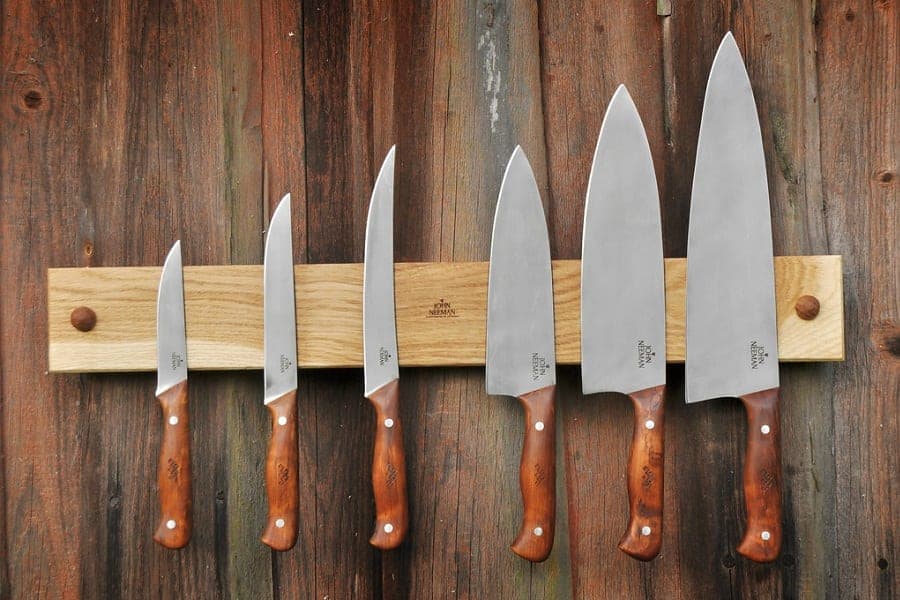
Best Wood for Knife Handles: A Working Guide to Knife Handle Wood
If you are trying to pick the best wood for knife handles, what you actually need to know is which species hold up in the hand you plan to use, and which ones look good in a display case but split the first time they get wet. This guide sorts knife handle wood by the things that matter at the bench: density, oil content, dimensional stability, and grain, so you can match a wood to a chef’s knife, a hunter, or an EDC folder without guessing.
Across owner reports and maker guidance on wood scales, the pattern is consistent. The woods that survive daily use are dense, oily, and either stabilized or naturally rot-resistant. The ones that disappoint are open-grained, thirsty, and sold on looks. Below is how to tell them apart, a comparison table of the woods worth knowing, and honest notes on when wood is the right call and when a synthetic is the better choice.
What Makes a Good Handle Wood
Not all wood belongs on a knife. Four properties decide whether a species earns a place at the bench, and they interact more than people expect.
Density and Hardness
Density is the first filter. Dense woods resist dents, hold a crisp edge on the scales, and take fine detailing without crumbling. Hardness is usually measured on the Janka scale, and for handle work you generally want something in the harder half of the range. Desert ironwood, cocobolo, and ebony sit near the top; oak, birch, and softer maples sit lower. A denser wood also tends to shrug off the small impacts a working knife collects on a cutting board or in a pack.
Oil Content
Naturally oily woods are the quiet workhorses of handle material. The oils in species like cocobolo, desert ironwood, and rosewood repel moisture from the inside, which is why they resist swelling, cracking, and rot without a heavy finish. The trade-off is that those same oils can slow the cure on some glues and finishes, so they need a proper wipe-down with acetone before gluing. For a user who does not want to fuss over maintenance, an oily species is the safer bet.
Dimensional Stability
Wood moves. It takes on moisture in a humid kitchen and gives it back in a dry winter, and every cycle of that movement stresses the pins, the glue line, and the tang fit. Stability is the property that keeps a handle from developing gaps or hairline cracks over years of use. Oily and dense woods are naturally more stable; open, thirsty woods are less so, which is exactly why they get stabilized (more on that below).
Grain
Grain is not only about looks. Tight, interlocked grain resists splitting along the length of the handle, which is where a dropped or pried knife tends to fail. Straight, open grain looks clean but can telegraph a crack from one pin to the next. Figured grain, burl, and curl are prized for appearance, but figure often comes with unpredictable internal stresses, which is another reason burls are almost always stabilized before they go on a knife.
Knife Handle Wood Comparison Table
These are the woods you will actually encounter, rated on the properties that matter in hand. “Hardness and durability” is a practical rating, not a lab number. “Stabilized or not” reflects what the species usually needs, not what is possible.
| Wood | Hardness and durability | Look | Stabilized or natural | Best for | Notes |
|---|---|---|---|---|---|
| Walnut | Medium, tough and shock absorbing | Warm chocolate brown, straight grain | Usually natural, sometimes stabilized | Chef’s knives, traditional fixed blades | Comfortable and classic; benefits from occasional oiling |
| Maple (incl. burl and curl) | Medium, low durability unless treated | Pale, often flamed or burled figure | Almost always stabilized | Show pieces, kitchen knives | Thirsty when raw; stabilizing and dyeing transform it |
| Rosewood | High, dense and oily | Deep reddish brown with dark streaks | Natural | Kitchen and hunting knives | Naturally water resistant; sourcing is restricted on some species |
| Cocobolo | Very high, very oily | Orange, red, and near black swirls | Natural | Working knives that see moisture | Stunning and durable; dust can irritate, degrease before gluing |
| Ebony | Very high, dense and brittle | Deep black, sometimes streaked | Natural | Formal and presentation knives | Elegant but can check if it dries too fast; keep it oiled |
| Olive | Medium to high, moderately durable | Golden with dramatic dark figure | Natural or stabilized | Kitchen knives, decorative handles | Beautiful grain; likes an oil finish to stay stable |
| Bocote | High, dense | Yellow-brown with bold black striping | Natural or stabilized | Fixed blades, folders | Oily and striking; can be pest susceptible when raw |
| Desert ironwood | Extremely high, very oily | Dark brown to olive with rich figure | Natural | Hard-use knives, premium builds | One of the most durable handle woods; heavy and dense |
| Oak | Medium, open grained | Light tan, pronounced grain lines | Better stabilized | Budget and rustic handles | Affordable and available; open grain can hold moisture |
| Birch (incl. laminate) | Medium, improved when laminated | Pale cream, subtle grain | Often laminated or stabilized | Kitchen knives | Birch laminate resists water well; raw birch is soft |
Stabilized vs Natural Wood
Stabilizing is a process where wood is placed in a vacuum chamber, saturated with a liquid resin, and then cured under heat so the resin hardens inside the cell structure. The result is a wood-and-plastic composite that keeps the wood’s appearance but gains most of a synthetic’s toughness. Stabilized wood does not swell, barely moves with humidity, resists moisture, and needs no oiling.
Natural wood is simpler: the species as it grows, finished with oil or wax. Dense, oily woods like desert ironwood, cocobolo, and ebony are stable enough on their own that stabilizing offers little and can even dull their natural luster, so they are almost always left natural. Thirsty, open-grained, or figured woods like maple, buckeye, and most burls are a different story. Raw, they crack and move; stabilized, they become reliable working handles and take dye beautifully.
The practical rule I use: if the wood is dense and oily, leave it natural and oil it. If it is soft, open-grained, or heavily figured, buy it stabilized or expect to maintain it carefully. Stabilized wood costs more up front and asks nothing of you afterward. Natural oily wood costs less and asks for an occasional wipe of oil. Both are valid; they just suit different owners.
Wood vs G10, Micarta, and Other Synthetics
Synthetics exist because wood, for all its beauty, has limits. It is worth being honest about where each wins.
G10 is a fiberglass-epoxy laminate. It is nearly indestructible, completely waterproof, dimensionally dead stable, and can be textured for grip. It shrugs off solvents, salt water, and abuse that would ruin most wood. The downside is that it looks and feels industrial. For a hard-use survival or tactical knife, G10 is the sensible default.
Micarta is a resin-impregnated laminate of linen, canvas, or paper. It is tough and stable like G10, but it feels warmer in the hand and develops a worn-in patina over time. Micarta grips better when wet, which many hunters and outdoor cooks prefer. It sits between wood and G10 in character: more organic than fiberglass, more bombproof than natural wood.
Wood wins on warmth, character, and the fact that no two handles are alike. A well-chosen dense wood on a chef’s knife or a hunter will outlast the owner if it is cared for. What wood does not do well is total neglect in wet, salty, or wildly humid conditions, and that is exactly the gap synthetics fill. My honest take: for a kitchen or a knife you will look after, wood is worth it. For a knife that lives in a tackle box or a bug-out bag, choose Micarta or G10 and do not look back. For more on matching a knife to its job, see our best chef knife guide and our best pocket knife guide.
Care and Oiling
Natural wood handles need care; stabilized wood and synthetics do not, beyond a wipe-down. If your handle is natural wood, the routine is simple and takes minutes.
- Never leave a wooden handle soaking in water or run it through a dishwasher. Heat and prolonged moisture are what crack handles.
- Hand wash, dry immediately, and store the knife somewhere with stable humidity rather than next to a stove or a window.
- Oil the handle when it starts to look dry or dull. Food-safe mineral oil is the standard choice for kitchen knives; a hard-drying oil like tung or a dedicated gunstock oil suits fixed blades.
- Wipe on a thin coat, let it soak in for several minutes, then buff off the excess with a clean cloth. Two or three light coats beat one heavy one.
- Check the frequency by feel. A well-used kitchen knife might want oil every month or two; a display piece, once or twice a year.
Oily species like cocobolo and desert ironwood need this far less often than thirsty woods like olive or oak. If a handle ever develops a raised grain or a rough patch, a light sanding with fine paper followed by fresh oil brings it back. For the full routine on blades and handles together, see our knife care guide.
Matching Wood to the Knife
The steel and the handle should suit the same job. There is little point pairing a corrosion-prone carbon blade with a maintenance-free handle, or a stainless workhorse with a wood that needs babying. A chef’s knife that sees daily washing does well with rosewood, stabilized maple, or a birch laminate. A hunting or bushcraft knife favors desert ironwood, cocobolo, or Micarta for their moisture tolerance. A folder or EDC knife, which spends its life in a pocket, is fine with almost any stabilized wood or a dense oily species. If you are still deciding on the blade itself, our knife steel guide covers how steel choice interacts with the rest of the build.
Frequently Asked Questions
What is the best wood for knife handles?
There is no single best wood, but the strongest all-round choices are desert ironwood, cocobolo, and rosewood. They are dense, naturally oily, and stable, which means they resist moisture and last for decades with minimal care. For a kitchen knife on a budget, stabilized maple or a birch laminate is an excellent value. The best wood is the one that matches how you will use and maintain the knife.
What is the most durable wood for a knife handle?
Desert ironwood is generally considered the most durable natural handle wood. It is extremely dense, heavily oiled, and dimensionally stable straight off the tree, which is why it needs no stabilizing and shrugs off moisture. Cocobolo and ebony are close behind. If durability under wet or abusive conditions is the only priority, a synthetic like G10 will outlast any wood.
Does knife handle wood need stabilizing?
It depends on the species. Dense, oily woods like desert ironwood, cocobolo, ebony, and rosewood are stable enough on their own and are usually left natural. Softer, open-grained, or heavily figured woods like maple, oak, buckeye, and most burls should be stabilized, because raw they crack and move with humidity. If you buy figured or pale wood, look for the word stabilized.
Is wood or synthetic better for a knife handle?
Neither is universally better; they suit different priorities. Wood offers warmth, individual character, and a comfortable feel, and a cared-for dense wood lasts a lifetime. Synthetics like G10 and Micarta are waterproof, dead stable, and maintenance-free, which makes them the right call for hard-use, tactical, or marine knives. For a kitchen knife or a knife you will look after, wood is worth it. For neglect and rough conditions, choose a synthetic.
How do I maintain a wooden knife handle?
Keep it out of standing water and the dishwasher, hand wash and dry it promptly, and oil it whenever it looks dry. Use food-safe mineral oil for kitchen knives or a hard-drying oil like tung for fixed blades, wiping on thin coats and buffing off the excess. Store the knife in stable humidity, away from heat sources. Stabilized wood and synthetics need only a wipe-down.
Which wood is best for a kitchen knife handle?
For a kitchen knife, favor woods that tolerate frequent washing: rosewood, birch laminate, olive, or stabilized maple. Rosewood’s natural oils and birch laminate’s water resistance handle a busy sink well. Avoid raw open-grained woods like untreated oak in the kitchen, since they absorb moisture. If you would rather never think about maintenance, stabilized wood is the safest kitchen choice.
About this guide
Steel Snob Editorial
Researched from manufacturer specifications, independent tests and owner reports, and edited for accuracy by the Steel Snob team.