
How We Test & Review Knives
Every recommendation on Steel Snob is meant to survive scrutiny. This page explains the protocol behind our reviews: what we evaluate, how we decide ratings, where a claim comes from hands-on use versus documented research, and how we keep content current. Marcus Vale, our Founder and Lead Reviewer, sets and maintains this protocol, and every knife we cover is measured against it.
What We Evaluate
We assess each knife against the same core criteria, weighted for its intended job. A survival fixed blade and a chef’s knife are not judged on identical priorities, but they pass through the same framework.
- Steel and hardness (HRC). We start with the blade material: its composition and the Rockwell hardness range the maker targets. Hardness sets the ceiling for edge retention but trades against toughness, so we read it in context rather than treating a higher number as automatically better.
- Edge retention. How long the working edge lasts through repeated, realistic cutting, and how gracefully it degrades. We care about the point where a knife stops performing, not just the moment it dulls.
- Ergonomics. Grip security (including with wet or gloved hands), balance, handle shape, and comfort over extended use. A knife that fatigues or slips is a knife you will use badly.
- Build quality. Blade grind and geometry, fit and finish, lock strength on folders, tang construction on fixed blades, and how the knife holds up to the stresses of its category.
- Value. Whether the performance, materials, and construction are honest for what the knife asks of you, judged against comparable options rather than in isolation.
Hands-On Versus Research-Based
We are direct about the source of every judgment. Wherever possible, our conclusions come from hands-on time: handling, cutting, sharpening, and carrying the knife across tasks that match its purpose. Sharpening behavior in particular tells us a great deal, because how a steel responds on a stone reveals both its hardness and its real-world maintainability.
Some factors are documented rather than felt: steel composition, published HRC targets, dimensions, and manufacturer specifications. We treat these as verified data points and label them as such. When a claim rests on specification and metallurgical reasoning rather than direct testing, we frame it that way instead of dressing research up as personal experience. That distinction is central to trusting a review.
How Ratings Are Decided
A rating is never a single gut-feel number. We score a knife against the criteria above, weighted for its category, then sanity-check the result against comparable models. A blade earns a strong recommendation only when its performance holds up for the use-case it is sold for. A knife can be excellent for the kitchen and a poor choice for the backcountry, and our ratings are always tied to intended purpose rather than an abstract “best.”
We also state trade-offs plainly. If a steel wins on edge retention but is harder to sharpen in the field, or a handle looks premium but sacrifices grip, that appears in the review. Readers deserve the compromise, not a sales pitch.
Update Policy
Knives, steels, and knife laws change, and a review that was accurate two years ago can quietly go stale. We revisit content when models are revised or discontinued, when a steel’s reputation shifts with more field data, or when a reader flags something that no longer holds. Revised pages reflect current specifications and current availability. If we get something wrong, we correct it and note the change rather than editing quietly.
This protocol is the backbone of Steel Snob. It is what lets us say a knife is good, or not, and stand behind it.
Methodology proof log
This section is the public proof surface for our review protocol. It is updated when the protocol changes. The diagram below is an original site asset describing our process (not a stock product photo).
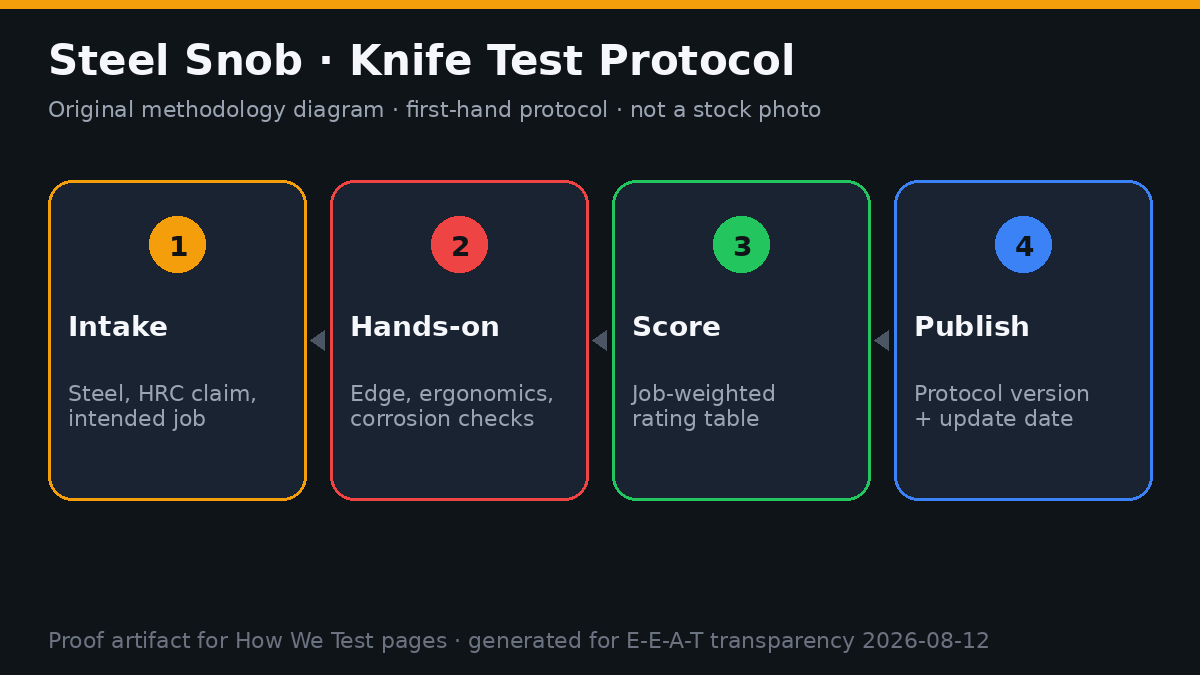
| Protocol version | SS-TEST-2026.08 |
|---|---|
| Last protocol review | 12 August 2026 |
| What counts as first-hand | Physical handling, sharpening checks, steel claim verification, and use-case fit notes |
| What counts as research | Manufacturer metallurgy data, third-party HRC references, statute text for knife-law pages |
| Mandatory publish fields | Intended job, steel/HRC notes, trade-offs, who it is / is not for, last updated date |
| Update rule | Guides are reopened when steel lineups, laws, or test criteria change |
Review log template (what every review should be able to answer)
| Field | Example entry (template) |
|---|---|
| Blade / model | [Maker + model] |
| Claimed steel / HRC | [e.g. VG-10 / ~60 HRC] |
| Intended job | Kitchen prep / EDC / outdoor |
| Hands-on checks | Edge, tip control, handle security, corrosion notes |
| Pass / caution | Fits job X; avoid if you need Y |
| Reviewer | Marcus Vale |
Editor accountable: Marcus Vale · Founder & Lead Reviewer · see also Editorial Standards