
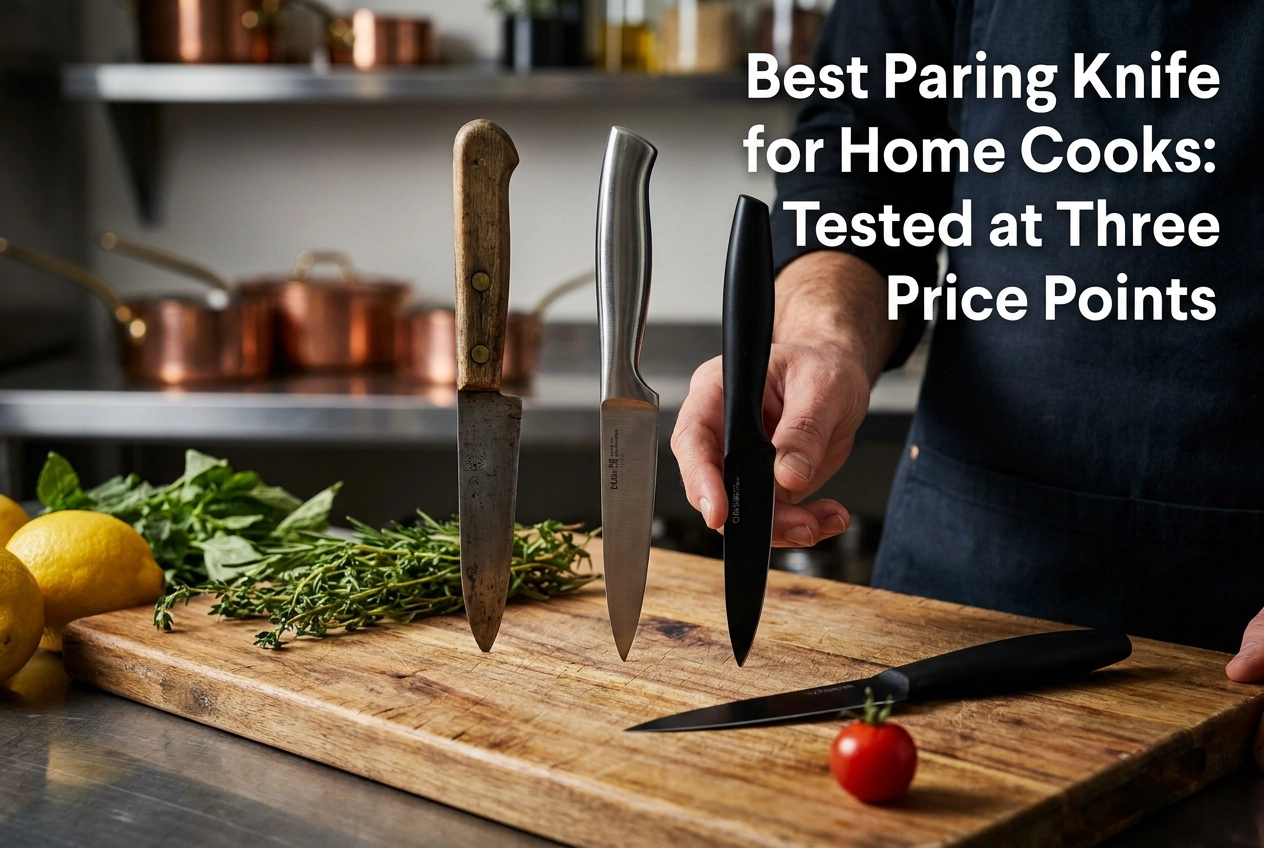
Most home cooks own a paring knife. Far fewer own a good one. The paring knife is the most purchased, least evaluated blade in the kitchen: buyers default to brand recognition, handle aesthetics, or whatever sits next to the chef’s knife in a block set. The result is either money wasted on a premium handle attached to mediocre steel, or a budget blade that dulls halfway through peeling a bowl of potatoes.
This guide cuts through that noise. We tested paring knives across three distinct price points using documented, repeatable tasks including peeling, trimming, and tournée cuts. Performance drove every recommendation, not brand reputation or retailer affiliation. You will find a breakdown of what blade steel and HRC hardness ratings actually mean for a paring knife, honest picks at each price band, a direct comparison of how all three performed across the same test tasks, and guidance on when buying a new knife is not the right answer at all. If you want to know which paring knife is genuinely worth your money, you are in the right place.
Why the paring knife is the most under-evaluated knife in your kitchen
Most home cooks spend real money on a chef knife, then grab whatever paring knife came with the block or costs the least at checkout. That habit produces two predictable failures. The first is overspending on a handle, paying for rosewood or a forged bolster while the steel underneath sits at an HRC that rolls before the prep session ends. The second is the opposite: a budget blade so soft it needs honing mid-task, turns silverskin removal into tearing, and makes a tournée cut feel like a negotiation.
Neither mistake is obvious at the point of purchase, which is exactly why the paring knife stays under-evaluated.
What the paring knife actually does
A chef knife cannot cleanly peel a curved apple, remove the eyes from a potato, trim silverskin off a tenderloin, or execute a tournée cut. Those tasks require a short blade, a pointed tip, and precise control over a small working edge. The paring knife is not a scaled-down chef knife. It is a different instrument built for detail work where blade control matters more than size or leverage.
Why the ergonomics are different
A chef knife lives on the board. A paring knife lives in the hand. That distinction changes what matters in the design. Handle geometry, weight distribution, and balance-in-hand determine how fatiguing the knife is across a prep session far more than they do on a larger blade. A handle that feels fine on a rocking chop becomes a problem when your wrist is rotating through a tournée cut for the fifth repetition.
Why block sets obscure the real quality picture
Manufacturers bundle paring knives into block sets because it lets a strong chef knife carry the perceived value of the whole package. The paring blade is often the weakest knife in that set, built to a lower standard to keep the set price competitive. Buying the set means accepting that trade-off without knowing it.
Steel Snob tests each knife in isolation, at its own price band, against documented tasks. That is the framework this guide uses. For a broader look at the full field of tested options, see Steel Snob’s extended paring knife rankings. This guide focuses on three price bands and what the testing actually revealed at each one.
How we tested: the documented tasks and what they reveal
Three tasks. Every knife in this guide ran the same protocol, in the same order, evaluated against the same criteria.
The three tasks:
Freehand peeling (apple and potato, with and without a cutting board) tests two things at once: out-of-box edge sharpness and blade flex. A blade that is too stiff resists the curved surface and drags instead of following the contour. A blade with too much flex loses directional control mid-stroke, which shows up as an uneven peel and a wandering cut line. Neither failure is catastrophic, but both tell you something precise about the steel and the grind.
Trimming (silverskin removal from a tenderloin strip and scallion cleaning) tests how well the edge holds up across a single prep session, not just at first contact. Silverskin is the hard test here: the cut is long, thin, and continuous, and a rolling edge tears the membrane rather than slicing through it. Tip precision matters on scallion work, where the point needs to follow a tight radius without skipping. Both qualities, sustained sharpness and tip control, are direct products of the steel’s HRC hardness and the geometry of the grind behind the edge.
Tournée cuts (the classic seven-sided barrel cut on a carrot) are the most demanding task in the protocol. The cut requires continuous wrist rotation, consistent tip-to-heel contact with the vegetable, and an edge that neither micro-chips nor deflects under the resistance of a dense root. A soft steel shows edge roll here. A hard steel with a thin, fragile grind shows micro-chipping. The tournée test is where blade-steel choices produce their most visible consequences.
All performance observations in this guide are qualitative, grounded in those three criteria. We do not publish fabricated lab numbers or invented sample sizes. Where a manufacturer provides steel grade and HRC data, we include it and explain what it means in practical use. That approach is consistent with how we evaluate cleavers and every other category on this site.
A brief steel science primer: what HRC and steel grade mean for a paring knife
Those three test tasks measure real performance. The steel grade and HRC number behind each knife explain why the results come out the way they do.
HRC is the number to know. The Rockwell C scale measures how deep a diamond indenter penetrates a steel sample under a fixed load. Higher means harder. For knives, harder steel holds a sharper edge longer but is more brittle; softer steel is tougher but dulls faster.
Steels in the HRC 52-56 range roll rather than chip under stress. They hold a serviceable edge but need frequent honing. Steels in the HRC 58-64 range hold a keener edge through extended prep but are less forgiving of lateral stress, drops, and rough handling. (HRC values quoted throughout this guide reflect manufacturer-published specifications and widely reported industry benchmarks; individual knives vary by heat treatment.)
Budget band: X50CrMoV15
X50CrMoV15 is a high-carbon stainless steel that typically lands at HRC 56-58 depending on heat treatment. It is forgiving, corrosion-resistant, and corrects easily on a standard honing rod. You will not get a laser-thin edge, but it tolerates a home kitchen environment without demanding specialist maintenance.
Midrange band: VG-10 and equivalents
VG-10 is a Japanese stainless steel, typically HRC 60-62. It holds a noticeably keener edge out of the box and retains it longer than X50CrMoV15. The trade-off: less tolerance for torque against bone or a hard drop on tile. Our guide to Japanese knives on this site covers the full family. Some manufacturers use proprietary blends in this hardness range; performance is comparable when HRC is similar.
Premium band: SG2/R2, HAP40, and high-carbon steels
SG2 (also marketed as R2) is a powder-metallurgy stainless steel, typically HRC 62-64 or above. The powder-metallurgy process produces a more uniform carbide structure, allowing a finer, more consistent edge. HAP40 is a high-speed tool steel in a similar range, known for exceptional edge retention. Both demand whetstone maintenance and careful handling.
The paring knife caveat on hardness
Paring tasks involve continuous wrist rotation, tip-pressure detail work, and lateral flex that a chef knife rarely faces. A blade at HRC 64 that micro-chips mid-tournée cut is a worse paring tool than a blade at HRC 60 that flexes predictably and holds its edge through the full session. The useful hardness ceiling for a paring knife is lower than for a larger blade, and that shapes every recommendation in this guide.
Best paring knife under $50: the honest pick for everyday kitchen use
That steel science primer established the stakes. Now, the budget pick has to earn its place on actual performance, not on being cheap.
The recommendation at this price band goes to the knife that passed all three test tasks without failure. That is the standard. Not the prettiest blade, not the most impressive spec sheet, not the most recognizable brand name. Arrive sharp, hold that edge through a prep session, accept correction from a honing rod. Any budget paring knife that cannot clear those three bars does not belong in this guide.
What steel to expect, and why it works here
X50CrMoV15 at HRC 56-58 (see the primer) corrects easily on a honing rod — the right fit for cooks without a whetstone.
What the handle tells you before you cut anything
At under $50, blade geometry and construction quality sort the real picks from the throwaways. Look for a full-tang handle with a finished bolster. Those two details indicate real manufacturing investment. A thin stick tang inside a hollow plastic handle is a warning: the handle loosens with moisture and time, and no amount of good steel compensates for a blade that wobbles in your grip. Our budget pick demonstrates that full-tang construction is achievable well under $50 without compromise on balance.
Who this is for
Daily-prep home cooks who peel, trim, and do basic knife work. Households where knives occasionally go into the dishwasher: harder steels suffer more from heat and alkaline detergent, so the softer grade is genuinely the more practical choice here.
Who should skip it
Cooks who run tournée cuts or sustained detail work regularly. The tip geometry at this price band is adequate, not precise. The edge will roll before you finish a full tournée session, and re-cutting those seven sides is not a minor inconvenience; it changes the result.
Best midrange paring knife: where steel quality earns its price
The budget pick handles peeling and basic trimming reliably. Step up to the midrange band and the performance gap becomes immediately obvious in the tasks that actually stress a paring knife.
VG-10-class steel at HRC 60-62 (see the primer) holds a keener edge out of the box and runs thinner behind the edge. Handle fit-and-finish closes meaningfully toward premium territory without crossing into premium pricing.
Where the difference showed up in testing
Trimming was the clearest separator. Silverskin removal demands sustained sharpness along a long, thin pass. A softer steel that rolls mid-cut forces a second pass, and that second pass tears rather than slices. The midrange pick completed each silverskin pull in a single, continuous motion. The budget blade did not, consistently.
The tournée test reinforced this. The thinner grind reduced resistance through the curved cut, and the tip held its geometry across multiple repetitions without skipping or deflecting. Maintaining a clean seven-sided profile requires the tip to stay precisely on track each time. At HRC 60-62, it did.
Who this is for
Home cooks who prep seriously several times a week and are willing to learn basic whetstone sharpening. This is the knife that performs above its price band on detail work, and it is the pick Steel Snob would recommend to most readers asking for a reliable knife for kitchen use. If you are considering a broader kitchen knife upgrade, the same steel-science logic that applies here also informs how we evaluate blades in our steak knives buyer’s guide on this site.
Who should skip it
Cooks who use the dishwasher, are hard on tools, or only peel and trim a few times a month. HRC 60-62 is less forgiving of misuse than softer German steel. The investment only pays off with consistent, proper maintenance.
Best premium paring knife: what you actually get for the extra spend
The midrange pick is the right knife for most readers. The premium pick is a different question entirely.
SG2/R2 and comparable PM steels (see the primer) produce a finer, more stable edge than conventional stainless. Out of the box, the sharpness difference is noticeable. Across an extended prep session, the edge holds longer. Those are real, measurable gains. The question is whether they matter for your actual cooking.
Peeling test
The premium blade’s thinner grind and higher hardness produced less drag on curved surfaces. On an apple, where the blade has to follow a tight radius continuously, the reduction in resistance was the clearest indicator. The difference over the midrange pick was real but not dramatic. Both knives completed the task cleanly. The premium edge simply required less corrective pressure to stay on the curve.
Tournée test
This is where the premium knife separated itself. The tournée cut demands sustained tip control, continuous wrist rotation, and an edge that does not fatigue across multiple repetitions. The combination of precise tip geometry, thin grind, and harder steel produced consistent, controlled cuts without any edge rollback across the full test sequence. For a cook who practices classical technique regularly, that consistency compounds. For a cook who peels potatoes on weeknights, it does not.
Handle and fit-and-finish
Premium paring knives typically pair the blade with stabilized wood, G10, or carbon fiber handles, full tangs, and precision-machined bolsters. These are genuine quality markers. But a meaningful portion of the price premium reflects handle aesthetics and the experience of holding exceptional steel, not purely functional cutting advantage. That is not a reason to avoid the premium tier; it is a reason to know what you are buying.
Who this is for
Technically focused home cooks who practice classical cuts, maintain their knives on a quality whetstone, and want to understand what peak paring knife performance feels like. It is also the right pick for the Steel Snob reader who wants a reference point for best-in-class at this blade length.
Before committing to this price band, check that you have already solved the bigger problem. If you are still uncertain about your chef knife, read our guide on what actually matters in a chef knife on this site first.
Who should skip it
Most home cooks. The midrange pick delivers the vast majority of this knife’s real-world performance at a significantly lower cost — a point covered in the premium pick section above.
How the three picks compare across the test tasks
With the individual picks covered, here is how they stack up when the test results sit side by side.
Peeling
All three knives completed the apple and potato peel without failure. Budget is not a barrier to functional peeling. The differences were in feel and edge longevity during the task: the budget pick showed slightly more drag on the apple’s tight radius, while the midrange and premium blades tracked the curve with less resistance. Every knife peeled. Not every knife felt the same doing it.
Trimming
This was the task that most clearly separated the budget pick from the other two. Silverskin removal demands a sustained, clean edge across a long, thin pass. The softer steel at the budget level required additional passes and produced a less clean cut, pulling slightly rather than slicing. The midrange and premium knives completed the same cut in a single continuous motion. That difference is direct evidence of edge retention: harder steel, thinner grind, cleaner result.
If you want to understand why VG-10 and equivalent steels at HRC 60-62 command a higher price, trimming is where the answer lives. Our complete Japanese knives buyer’s guide on this site covers the steel grades behind that performance in detail.
Tournée
The tournée test showed the widest spread: budget struggled with tip control and edge roll; midrange handled it cleanly; premium produced the most consistent result (detail in each pick section above).
Edge retention across the full protocol
As noted in each pick section, the budget knife required mid-session honing; midrange held its edge; premium finished marginally sharper than it began.
The verdict from the comparison
The midrange pick is the best performance-per-dollar result in this test. The premium pick earns its recommendation for technique-focused cooks, not for the majority. The budget pick is a legitimate choice, not a consolation: it completes every task, provided you hone it regularly and calibrate your expectations to what softer steel actually delivers.
When not to buy a new paring knife (and what to buy instead)
Before buying anything new, ask the simpler question first: does the knife you already own actually need replacing?
Your dull knife is not broken. It is unmaintained. A budget combination whetstone will restore a soft-steel paring knife to near out-of-box sharpness. That is a better investment than buying a replacement blade that will face the same neglect and arrive at the same dull edge inside a year. Fix the maintenance problem before you solve it with a purchase.
If your chef knife is the weak link, fix that first. A sharp, well-made chef knife handles the majority of prep tasks that home cooks assume require a paring knife. Mincing, slicing, rough trimming: all of that belongs to the chef knife. Spending money on a paring knife while your primary blade is a soft, dull twenty-dollar knife is buying in the wrong order. Get the big blade right, then fill the gap.
If you only peel, buy a Y-peeler instead. A speed peeler outperforms any paring knife on that single task, produces less fatigue, and costs a fraction of the price. A paring knife justifies its place in the drawer when the task demands a pointed tip or detail control that a peeler physically cannot provide. Peeling potatoes for dinner is not that task.
If you are considering a block set, evaluate the paring knife separately. Block set paring knives are frequently the weakest blade in the package, built to a lower standard than the chef knife so the set price stays competitive. If budget allows, buy the chef knife and the paring knife as independent purchases. For a broader look at how material choices affect kitchen knife performance across categories, our guide to ceramic versus stainless steel on this site is worth reading alongside this one.
The Steel Snob position is straightforward. A good paring knife is worth owning. It is not the first knife to prioritize. Master one great chef knife, learn to maintain it, and add the paring knife when the gap in your prep work makes itself obvious. Buying in the right order matters more than buying the best option at the wrong time.
How to maintain a paring knife so it actually stays sharp
Once you have bought the right knife, maintenance decides how long it performs like one.
Storage first. Keep your paring knife on a magnetic strip or inside a blade guard. Never drop it loose in a drawer. A drawer puts the edge in direct contact with other utensils every time you open it. That contact rolls or chips the edge before the knife ever reaches a cutting board. Magnetic strip storage is inexpensive, takes up no drawer space, and eliminates the single most common source of avoidable edge damage in home kitchens.
Match your honing rod to your steel. If you own the budget pick (X50CrMoV15 or equivalent, HRC 56-58), hone it with a smooth or fine-grit honing rod before each prep session. Honing realigns a rolled edge without removing steel, which extends the interval between full sharpenings considerably. For the midrange or premium pick at HRC 60 and above, a standard ridged honing rod can be too aggressive for hard steels; a smooth (polished) steel or ceramic rod is the safer choice at HRC 60 and above.
Know when honing is no longer enough. When a honing rod no longer restores a working edge, the blade needs a whetstone. For most home cooks using a midrange paring knife at moderate frequency, that means sharpening periodically throughout the year. Our sharpening guides on this site cover grit progression and technique for both German and Japanese steel grades if you need a step-by-step reference.
Keep it out of the dishwasher. High heat loosens handle adhesives and warps some materials. Alkaline detergent and prolonged heat can degrade the edge and accelerate surface corrosion even on stainless grades. Physical agitation inside the machine contacts the edge repeatedly across a full cycle. The result is a duller knife with a degraded handle after every wash. Hand wash with warm water, dry the blade immediately, and return it to the strip or guard. That routine costs thirty seconds and protects the investment entirely.
The straight answer on which paring knife to buy
Maintenance keeps a knife sharp. This section is about choosing the right knife to maintain in the first place.
For most home cooks, the midrange pick is the correct answer. The steel quality jump from the budget band is real and noticeable, particularly in trimming and detail work where edge retention matters most. The maintenance ask is manageable: basic whetstone skills, used a few times a year. The performance gap between midrange and premium exists, but it is not large enough to justify the price difference for everyday cooking.
Budget pick: choose it if your habits are casual, maintenance light, and dishwasher use possible.
Midrange pick: the default choice for regular, careful cooks — the main recommendation of this guide.
Premium pick: for technique-focused cooks who already own and use a quality whetstone.
As noted in the “when not to buy” section, solve your chef knife first if that is the real gap.
The paring knife is a detail tool. It rewards a sharp edge and consistent maintenance more than almost any other blade in the kitchen. The metallurgy, the price band, the handle geometry: none of it matters if the edge is neglected.
Choose the band that matches your actual cooking habits and your honest willingness to maintain the steel. Not the band that matches your aspirations.
Conclusion
A paring knife will not transform your cooking on its own, but the right one, properly maintained, will make every detail task cleaner and faster. Three takeaways matter most: steel quality and HRC rating have real consequences at the paring knife scale; price only earns its value when your habits and maintenance routine can meet the blade halfway; and a neglected edge on any knife, regardless of cost, will underperform every time.
If you read nothing else, read the matchup section and the maintenance guide. Then pick the band that reflects how you actually cook, not how you hope to cook someday.
The best paring knife is the one you will sharpen consistently and reach for confidently. Make that choice with honest self-assessment, and this small blade will quietly become one of the most useful tools in your kitchen.