
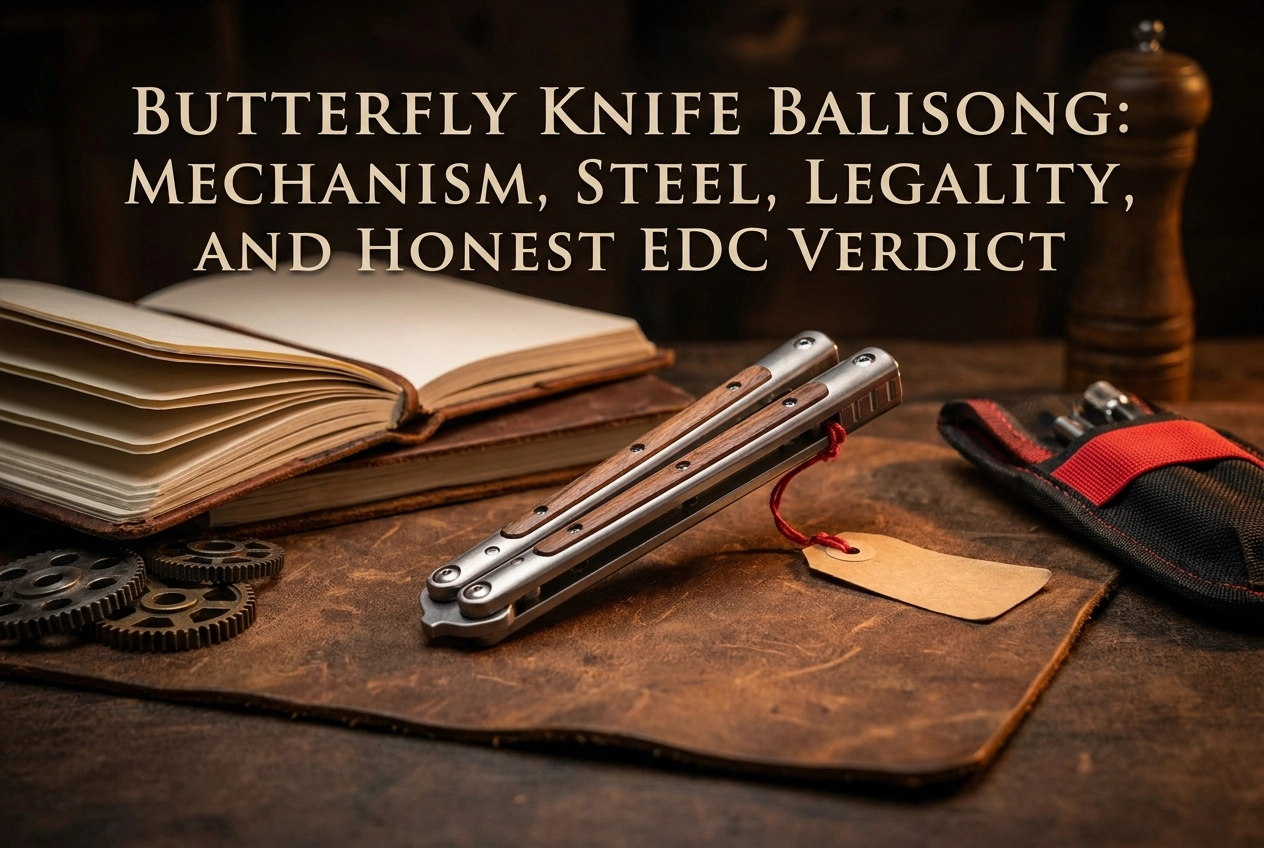
Few knives generate as much curiosity and confusion as the butterfly knife balisong. With its distinctive split handle that rotates around the blade, this tool sits at an interesting crossroads between functional cutting instrument, mechanical puzzle, and legal gray area depending on where you live.
If you have recently encountered one of these knives and want to understand what makes them tick, you are in the right place. This guide breaks down everything a beginner needs to know, starting from the ground up. We will cover how the pivot mechanism actually works, what steel compositions are commonly used and why they matter for performance and durability, and the legal landscape across different regions so you can stay informed before making any purchase decisions.
We will also give you an honest verdict on whether the butterfly knife balisong makes practical sense as an everyday carry tool, or whether its reputation outweighs its real-world usefulness. By the end of this tutorial, you will have a clear, technical foundation that cuts through the marketing noise and gives you the facts you need to make smart, informed decisions.
What a balisong actually is
A balisong is a folding knife with two counter-rotating handles that each pivot 180 degrees around the blade tang via dual pivot pins. When closed, the blade sits concealed between the two handles. When you open it, both handles rotate outward and lock together to form a single unified grip. The mechanism is mechanically straightforward. The challenge is in controlling it.
“Butterfly knife” is the common US name. “Balisong” is the Filipino term of origin, tracing back to the Batangas region of the Philippines. Both names describe exactly the same knife and exactly the same opening mechanism. You will see both used interchangeably across retailers, forums, and legal statutes, so it helps to recognize either.
The single most important anatomy detail for a beginner is the safe handle versus bite handle distinction. The safe handle has no contact with the sharp edge when the knife is closed. The bite handle rests directly against the edge. Grabbing the wrong handle during a flip puts your fingers against live steel. Every technique you learn starts with knowing which handle is which before you touch the knife.
The quick verdict: a balisong is a genuine cutting tool, not a novelty. It holds an edge, it cuts, and it opens with a mechanism unlike any other folding knife. Whether it belongs in your carry is a separate question, and the answer depends on two things: your state’s laws and your willingness to practice the deployment until it is consistent. Balisongs are banned outright in Hawaii and restricted in several other states, so verifying your state’s current statutes before purchasing a live-blade version is a hard requirement, not a suggestion. Laws in this category are actively evolving, and general information here is not legal advice.
If you live in a restricted state or simply want to build skill before handling a sharpened blade, trainer balisongs are the practical starting point. Trainers carry an unsharpened blade, which makes them legally distinct from a knife in many jurisdictions while preserving the same weight, balance, and pivot feel as a live-blade version. They are now a mainstream product category, not an afterthought. For most beginners, a trainer is the correct first purchase regardless of where you live. You can read more about the full history and mechanism of the butterfly knife to get the broader context before deciding which version fits your situation.
How the mechanism works
The dual-pivot architecture
A conventional folding knife has one pivot pin. The blade rotates around it, and the handle stays fixed. A balisong inverts that logic entirely. The blade is rigid, attached to a tang that never moves. What moves are the two handle scales, each mounted on its own separate pivot pin at opposite ends of the tang. The front pivot sits near the blade tip; the rear pivot sits near the base of the tang. Each handle can rotate a full 180 degrees around its respective pin, independently of the other. That independence is the whole mechanism. No other production folding knife design works this way, which is why the balisong is sometimes described as a fixed blade that folds rather than a folder in the conventional sense.
The latch and the stop pin
The latch holds both handles together in the closed position during carry. It clips onto one handle, pinching the pair shut and keeping the blade concealed. Which handle the latch clips to depends on the design. In most traditional configurations it catches the bite handle, the handle that rests against the sharp edge when closed. Some designs reverse this. The distinction matters because the latch position determines which handle you move first when opening, and that sequencing affects how the knife feels in motion.
The tang pin (also called the zen pin in modern production knives) is a small transverse stop pin set into the blade tang itself. When a handle completes its rotation arc, it contacts this pin and stops. Without it, the handle would over-rotate past the correct position and strike the cutting edge. That would dull the edge and, over time, damage the pivot system. The zen pin is both a safety feature and a durability control. It defines the hard stop that makes consistent, repeatable handle movement possible.
The opening sequence as physics
When you open a balisong, one handle swings away from the blade along its pivot arc. It travels 180 degrees from the closed position, clearing the blade entirely. The second handle then follows along its own pivot in the opposite rotational direction, also traveling 180 degrees. When both handles have completed their arcs, they lie parallel and flush against each other on the spine side of the blade. The geometry of the two pivots ensures that full extension produces a stable, aligned grip with no mechanical play if the tolerances are correct. For a deeper look at how the parts interact, the balisong anatomy breakdown at Artisan Cutlery covers the relationship between pivot placement and handle travel clearly.
Why this raises the complexity ceiling
A liner-lock folder has one pivot pin, one locking surface, and one axis of motion. A balisong has two independent pivot pins, two rotating handle assemblies, a tang pin, and a latch, all of which must be machined to consistent tolerances for the knife to flip cleanly and lock out solidly. If either pivot is even slightly loose, you get handle wobble. If the zen pin is mispositioned by a small margin, the lockout feels soft. That mechanical interdependence is why the quality ceiling on a balisong is higher than on a comparable folder, and why cheap construction shows up immediately in feel. It is also why the skill floor is higher for the user: you are managing two independent moving parts rather than one, and the knife responds to how you treat those parts.
History and origin
The balisong traces directly to the Philippines, specifically to Batangas province on the island of Luzon, roughly 150 km south of Manila. The name most likely derives from “baling sungay,” a Tagalog phrase meaning “broken horn,” a reference to the water buffalo horn that craftsmen traditionally used for the rotating handles. Some historians favor an alternative reading tied to Balisong village in Taal town, where the knife is still manufactured today. Both interpretations point to the same geographic root.
The veinte y nueve standard
The traditional Filipino balisong measures 29 centimeters (approximately 11 inches) when fully open. That fixed dimension gave the knife its Spanish-language nickname: veinte y nueve, meaning “twenty-nine.” Spanish colonial influence ran deep in Filipino regional culture, and the term stuck as a shorthand identifier long after the colonial period ended. When a craftsman in Batangas says veinte y nueve, the size and the tool are both understood.
From craft to production
Documented mass production in the Philippines dates to the early 1900s, though whether the knife existed in pre-colonial form is still an open question among historians. Evidence points to regional craft traditions that predate modern manufacturing, but no definitive pre-colonial record has settled the debate.
The American chapter
The US chapter begins with Les de Asis, a Filipino-American who grew up in Southern California with a family balisong and later used his machine-shop skills to engineer a more durable version. His founding story is documented directly by Benchmade: he walked into a gun store with a prototype and left with an order for 100 units. That commission led to the establishment of Bali-Song, Inc. in California around 1979 to 1980, marking the first serious domestic production of the design. Bali-Song, Inc. later became Pacific Cutlery Corp., which closed in 1987. De Asis then founded Benchmade in 1988, relocating to Oregon in 1990.
Regulation and market shift
Once state legislatures began classifying balisongs alongside switchblades, the US market shifted noticeably. Import restrictions and outright bans in several states reduced the volume of imported budget models and pushed domestic producers toward two defensible categories: unsharpened trainer balisongs, which sidestep the legal definition of a knife in many jurisdictions, and premium titanium builds aimed at collectors willing to pay for lawful, high-quality hardware. Those two segments now define the current US market. Knife law varies significantly by state and locality, so always confirm what your jurisdiction permits before purchasing or carrying any balisong.
Steel science for balisongs
Most knife buyers research steel as if edge retention is the only variable that matters. For a balisong, that framing misses the point almost entirely.
A balisong blade does not primarily experience edge-on cutting loads. It experiences repeated lateral stress at the tang, centrifugal loading during rotational tricks, and handle-strike impacts every time the two handles clap shut. Those are mechanical conditions a conventional EDC folder blade never faces. So when you evaluate steel for a balisong, toughness at the chosen hardness, edge stability under flex, and how the grind geometry interacts with the steel’s carbide structure all rank ahead of raw cutting endurance. Keep that priority order in mind as you read through the four steels you will encounter most often in the current market.
440C
440C is the most common steel in budget and midrange balisongs, and it earns that position honestly. It is a high-chromium martensitic stainless, typically heat-treated to 56-58 HRC in production balisongs, though a tighter heat treatment protocol can push it to 58-60 HRC. That range matters: the same steel name can represent meaningfully different performance depending on the maker’s oven protocol. At 56-58 HRC, 440C offers adequate toughness for flipping impacts, good corrosion resistance from roughly 17 percent chromium content, and an easy sharpening experience. Its carbide structure is relatively coarse, which limits edge retention compared to modern tool steels, but for a knife that is flipped far more than it cuts, that trade-off is largely invisible in daily use.
D2
D2 is a high-carbon, high-chromium tool steel that runs approximately 60-62 HRC in well-executed production pieces. The higher hardness and dense carbide content deliver meaningfully better edge retention and wear resistance than 440C. However, D2 is classified as semi-stainless: its chromium is largely tied up in large carbides rather than remaining in solution to form a complete passive oxide layer. That means lower corrosion resistance than either 440C or VG-10, which is a real maintenance concern for a knife that sees constant bare-hand contact during flipping. There is also a brittleness consideration. At thin grinds, D2’s large carbide clusters make the edge more susceptible to micro-chipping under lateral impact, exactly the kind of impact a balisong blade absorbs during handle strikes. D2 is a good choice on a well-ground, moderately thick blade; it rewards careful maintenance and is less forgiving of thin geometry than the other steels here.
VG-10
VG-10 is a Japanese stainless steel with cobalt and vanadium additions that produce a fine, uniform carbide structure. Hardness typically falls at 60-62 HRC. The fine grain is the defining advantage: it takes an acute, thin edge without the chipping risk that comes with D2 at similar hardness. Corrosion resistance is excellent, better than D2 in practice. VG-10 is the logical choice for midrange balisongs with thinner blade profiles, and it appears in that segment consistently. Sharpening requires more effort than 440C, but any quality whetstone handles it without difficulty.
CPM-S30V
CPM-S30V uses a powder-metallurgy process that produces a carbide distribution too uniform to achieve through conventional casting. Hardness sits at 59-61 HRC, with edge retention that exceeds 440C substantially and matches or beats D2, paired with better toughness than D2 at equivalent hardness. Corrosion resistance is solid stainless-class performance. The material and machining costs mean CPM-S30V appears almost exclusively in high-end balisongs built on precision-machined titanium hardware. On that kind of platform, the steel upgrade is justified. You can read through the 440C vs D2 vs Damascus breakdown at Balisong Butterfly to see how the market currently segments these tiers.
The honest verdict
For most owners who flip 90 percent of the time and cut 10 percent of the time, pivot quality and blade geometry determine the experience far more than steel grade. A loose pivot or inconsistent blade-to-handle clearance will ruin a balisong regardless of what the blade is made from. Upgrading from 440C to CPM-S30V on a poorly constructed platform changes nothing meaningful. On a quality platform, the premium steel does produce a longer interval between sharpenings for owners who actually use the knife as a cutter. That benefit is real, but it is secondary. Get the platform right first, then consider the steel.
Pivot and handle materials
Material selection matters more in a balisong than in almost any other folding knife. The reason is mechanical. Both handles rotate a full 180 degrees around the blade tang on every open-and-close cycle, placing continuous rotational load on the pivot pins. During flipping, the handles clap together repeatedly at the spine, generating impact stress that a conventional single-pivot folder never experiences. Those two load types, rotational wear and handle-clap impact, accumulate fast. The materials you start with largely determine how the knife feels after a thousand cycles versus ten thousand.
Handle materials, from entry level to premium
Zinc alloy is the defining material of budget balisongs. It is inexpensive to cast and easy to machine, which keeps production costs low. The trade-off is weight and surface durability. Zinc alloy is denser than most competing handle materials, which shifts the balance toward the handle ends and makes flip dynamics feel sluggish. More critically, the soft alloy surface wears noticeably under repeated handle-clap impact. Scuffs and surface deformation appear quickly on active users’ knives. Zinc alloy is a reasonable starting point if you are spending under $50 and want to learn the basics, but it is not a long-term material.
G-10 is a fiberglass laminate composite and the most common handle material in the midrange segment. It is lightweight, dimensionally stable, and naturally grippy thanks to its textured surface. G-10 absorbs handle-clap impact without deforming, resists moisture, and holds up well under regular use. For most beginners, G-10 represents a significant step up from zinc alloy without a premium price jump.
Stainless steel handles are fully durable and corrosion-resistant, but they add real weight to the knife. That mass concentrates at the handle ends, which increases rotational momentum during tricks. Some flippers actively prefer this characteristic because heavier handles generate more consistent swing arc. For casual carry, the added weight is a practical downside.
Titanium (specifically 6AL-4V aerospace alloy) is the premium choice. It delivers a better strength-to-weight ratio than stainless steel, excellent resistance to surface wear at the clap contact points, and long-term dimensional stability. The price reflects that. Titanium handles appear at the upper end of the premium band and are aimed at serious practitioners rather than occasional users.
Bushing vs. bearing pivot systems
The pivot system controls how the handles rotate around the blade tang. Bushing pivots use simple bronze or brass sleeves around the pivot pin. They create smooth, consistent rotation with a slightly deliberate feel. They also tolerate dust and light debris without significant degradation and require almost no maintenance. That makes bushing systems well-suited to carry knives and to beginners who are not yet focused on flip speed.
Ball-bearing pivot systems, including IKBS (Ikoma Korth Bearing System) and similar designs, replace those sleeves with caged ball bearings. The result is near-frictionless rotation and noticeably faster, more fluid flipping. The active flipping community strongly favors bearing systems for exactly that reason. The maintenance requirement is the trade-off: ball bearings trap fine debris and lubricant residue over time. Periodic disassembly and cleaning are necessary to sustain that frictionless feel. If you are not prepared to maintain the pivots, a bearing system will degrade faster than a well-kept bushing system.
Pivot pin materials
The pivot pin itself is often overlooked when evaluating a balisong, but it is the component under the most sustained wear. Hardened stainless steel pins resist the rotational erosion generated across thousands of flip cycles. Softer alloy pins, common in budget models, develop play over time as the contact surfaces gradually wear down. That play manifests as wobble in the handle action, and once wobble develops, the knife loses its precise feel regardless of how good the handles or blade are. Pin quality is not something you can easily inspect at purchase, which makes buying from makers with documented material specifications worth the effort, particularly if you plan to flip regularly.
Practical recommendation by use case
For casual carry and occasional use, G-10 handles paired with a bushing pivot system are the practical choice. G-10 resists handle-clap wear without premium pricing, and bushing pivots deliver reliable smooth action with minimal upkeep.
For active flipping practice, titanium handles with bearing pivot systems justify the investment. The combination maintains consistent feel and balance across thousands of cycles in a way that budget materials simply cannot sustain. If you are serious about developing flipping technique, the materials you practice on will shape the feedback you build muscle memory around. Starting on a knife that develops wobble after a few months of practice is a hidden cost that often exceeds the price difference at purchase.
US legality by state: what the law actually says
Balisongs are legal to own and carry in most US states. That is the baseline. But a meaningful number of states restrict them, several ban them outright, and the legal landscape shifted at least twice in 2026 alone, according to the most current state-by-state balisong law guide available. If you are planning to carry one, the general picture is not enough. You need to know your specific state, your county, and your municipality before the knife leaves the house.
California: the strictest major-state example
California treats balisongs as switchblades. Penal Code section 17235 defines a switchblade as any pocketknife with a blade two inches or longer that opens by pressing a button, applying pressure to the handle, flicking the wrist, or using any mechanical device. A balisong opens by wrist flick and handle rotation. It falls squarely inside that definition.
Penal Code section 21510 specifies the illegal acts: carrying a switchblade in public, carrying one on your person, selling or offering one for sale, and giving or transferring one to another person. Owning one at home sits in a murkier space, but public carry, sale, and transfer are clearly prohibited. A public post from the Lakewood Sheriff’s Station (Los Angeles County) spelling out exactly these rules drew more than 8,200 views and 75 reactions on Facebook. That level of engagement reflects genuine public confusion about what the law says, not casual browsing. People are genuinely unsure, which means a lot of people are at risk of unknowing violations.
Hawaii: the outright ban
Hawaii takes the strictest position in the country. The state imposes a flat ban with no carry or ownership exception for the general public. There is no blade-length carve-out, no open-carry allowance, and no collector exemption that applies to ordinary residents. If you live in or are traveling to Hawaii, a balisong is not a lawful carry option under any practical reading of current state law. Confirm the current statutory citation through official state sources before drawing any conclusions for your own situation.
The grey areas that a simple legal/illegal label misses
Binary framing (legal vs. illegal) leaves out the details that actually determine whether a specific knife, carried a specific way, in a specific place, creates legal exposure. Three categories of nuance matter most.
Blade-length thresholds. Some states that permit balisongs still cap blade length, commonly at three inches or 3.5 inches. A knife that clears the state threshold may still trip a local ordinance. Always check both layers.
Concealed vs. open carry. A state may permit balisong ownership and even carry, but separately restrict how the knife is carried. Concealed carry is frequently regulated even when open carry is allowed. The American Knife and Tool Institute tracks these distinctions across state law resources and is a reliable reference for understanding where this line sits in your state.
County and city preemption. Not every state has knife preemption laws that stop local governments from imposing rules stricter than state law. Los Angeles County illustrates the point: even setting aside the California switchblade statute, county rules generally prohibit openly carrying any knife with a blade three inches or longer. A knife that might be permissible under a narrower state reading can still be illegal at the county level.
Trainer balisongs and the grey zone
Trainer balisongs use an unsharpened, dull blade. They are widely sold as legal alternatives for skill practice in ban states. The problem is that California’s definition under Penal Code section 17235 does not require a sharp edge. It targets blades that open by wrist flick or handle pressure. A trainer operates by exactly the same mechanism. Whether a court or prosecutor would treat a trainer as a “blade” within that definition is an open interpretive question, not a settled one. Do not assume a trainer is automatically legal in any jurisdiction that bans balisongs. The same interpretive uncertainty applies in other restrictive states.
Hard disclaimer
This section is general information only, not legal advice. Knife laws change. At least two state-level changes occurred in 2026 alone. Local ordinances can be stricter than state statutes, as the Los Angeles County example demonstrates. Always verify the current state statute, county ordinance, and municipal code before carrying any balisong. When you have any doubt, consult a licensed attorney in your jurisdiction.
Trainer balisongs: who they are for and what to look for
A trainer balisong is an unsharpened practice tool built to replicate the exact weight, balance, and pivot feel of a live blade. The blade channel is blunt and rounded rather than ground to an edge. You can flip it, drop it, fumble the catch, and repeat indefinitely without laceration risk. That is the entire point.
Why weight distribution is the critical spec
Not every trainer delivers on that promise equally. The key design requirement is that the trainer must match the weight distribution of the live knife it is meant to prepare you for, not just its overall weight. Balance shifts the moment you change where mass sits relative to the pivot pins. A trainer with a hollow blade section, or one that uses an oversized channel to approximate heft without matching the geometry, will feel different in the hand at the moment of rotation. You will build muscle memory around that difference. When you move to a live blade, the timing will be off. A cheap trainer that does not share frame dimensions and blade-channel proportions with a real sibling model is not a shortcut. It is a setback.
The blade channel on a well-designed trainer also retains correct tang pin placement. The tang pins limit handle rotation and prevent the handles from swinging past their intended arc. That mechanical stop should behave identically to the live version. If it does not, you will over-rotate in practice and correct the wrong habit later.
Who should use a trainer
Trainers serve three distinct groups. Beginners need one before they ever touch a sharpened balisong. Learning the basic open and close, the bite handle orientation, and the thumb-clear timing while holding an unsharpened blade removes one variable entirely so you can focus on mechanics. Intermediate flippers use trainers to build speed and consistency without fatigue-related risk during long sessions. And anyone living in a state where live balisongs are restricted, but trainers fall outside that restriction, can still handle the mechanism legally. Confirm that distinction against your current state and local statutes before purchasing, since the legal status of trainers varies and the laws themselves change.
Buying guidance by budget
At the budget end, prioritize a trainer that shares exact frame dimensions with a live-blade sibling in the same product line. That detail is usually listed in the manufacturer’s specs. If the trainer and the live model have matching handle length, handle width, pivot placement, and overall weight, your muscle memory will transfer directly when you step up. At the midrange and above, matched-weight titanium trainers become available from the same makers who produce premium live-blade versions. These use denser blade-channel materials to replicate the mass of a ground steel blade precisely. The pivot hardware is typically identical to the live model, so the bearing feel and resistance transfer without adjustment.
Honest EDC verdict
A balisong is a practical EDC knife. But that answer carries a condition that no other folder type imposes: it is only practical for users who have already put in the practice time. For everyone else, it is a conversation piece that happens to have a sharp edge.
Deployment: honest comparison
A thumb-stud liner-lock folder is deployable by any adult user from day one. The motion is short, direct, and does not require rehearsal. A practiced balisong flipper can achieve a fully open, locked blade in under one second, but reaching that threshold takes deliberate repetition, typically measured in weeks on a trainer before the motion becomes reliable. More important, balisong deployment uses a specific rotating wrist motion that does not survive adrenal stress without prior conditioning. Under pressure, fine motor patterns that have not been heavily reinforced tend to collapse. A liner-lock or frame-lock folder does not have this vulnerability. If your primary interest is a working knife that opens without hesitation, the conventional folder wins by a wide margin.
Blade security and pivot wear
When a well-made balisong is fully open, blade rigidity is comparable to a liner-lock. Both handles are locked by the latch, and tight pivots eliminate play. The failure mode is specific: pivot wear. As the pivot pins and bushings wear down through repeated use, the handles develop lateral wobble. That wobble transfers directly to the blade during cutting tasks, degrading both precision and safety. This is not a design flaw unique to budget knives; it is a wear characteristic of the dual-pivot architecture. Regular pivot inspection and tightening is part of owning a balisong, not an optional maintenance step.
Carry profile
Two handles folding around a blade add both length and weight compared to an equivalent-blade-length conventional folder. A three-and-a-half-inch blade balisong will typically run longer overall and noticeably heavier than a three-and-a-half-inch liner-lock. Pocket presence is real. The latch also presents a snagging risk on pocket fabric, particularly in lightweight pants materials, which is a daily nuisance that conventional folders avoid entirely.
The Steel Snob verdict
A balisong earns a legitimate place in a carry rotation for users who commit to practice time and live in a state where carry is legal. For that person, the balisong’s deployment and handling become genuinely skilled, and the knife rewards the investment. For everyone else, a quality liner-lock or frame-lock folder at the same budget band will be more reliable, more pocketable, and legal in more jurisdictions. Check your current state and local statutes before carrying any balisong; this is general information, not legal advice, and the law in your area may be more restrictive than you expect.
Sharpening and maintenance
Sharpening a balisong is more involved than sharpening a standard folder. Both handles must be fully open and held completely stable before any abrasive contacts the blade. That geometry is awkward by definition, because you are managing handle position, blade angle, and sharpening stroke simultaneously. The practical fix is to clamp the open knife in a padded vise, which immobilizes both handles and lets you focus entirely on maintaining a consistent bevel angle. A guided-angle sharpening system works equally well and is the better option for beginners who have not yet developed freehand technique. Freehand sharpening on a whetstone is possible, but it requires real discipline to hold the bevel steady while the handles obstruct your grip.
Pivot maintenance
The balisong pivot is the highest-wear component on the knife, and it degrades faster than the pivot on any standard folder. Every single open-and-close cycle rotates each handle through 180 degrees, which means lint, pocket debris, and dried lubricant accumulate at the pivot far more aggressively than on a knife with a conventional short-arc pivot. Active flippers should disassemble the pivot area periodically, flush it with isopropyl alcohol to dissolve contamination, and re-lubricate with a light oil or a PTFE-based dry-film lubricant. A quality ball-bearing or Teflon-washer pivot will last far longer than a brass bearing-pin system, which shows measurable wear over years of weekly use. For complete guidance on the full cleaning process, this butterfly knife maintenance guide from Artisan Cutlery covers the protocol in useful detail.
Latch wear
The latch takes impact on every closing cycle. It is a spring-loaded component, and budget latches made from soft alloys lose tension gradually rather than failing all at once. A weakened latch allows the handles to swing open unintentionally during pocket carry, which is a real safety concern. Check latch snap and tension by feel on a regular schedule. Replace a latch that feels soft or inconsistent before it fails completely. Higher-quality knives use hardened steel latches that resist deformation over long service life; budget models with zinc or pot-metal latches will need attention sooner.
Pivot screw torque
Torque is easy to get wrong on a balisong. Over-tightened pivot screws can crack handle scales, particularly on G-10 composite and zinc alloy construction. Under-tightened screws develop blade play that worsens with every flip. Use a correctly sized driver, typically a T9 Torx for the pivot screws and a T6 for handle screws, because the wrong bit size strips heads quickly. Check torque after every disassembly. Apply thread-locking compound only if the manufacturer explicitly recommends it, as it complicates future disassembly and is not appropriate for all pivot configurations.
Who this is for and who should skip it
Who this is for
The balisong suits three types of buyers. First, hobbyist collectors who want a mechanically complex design with genuine cultural depth. The dual-pivot architecture, the interplay between handles, pivot hardware, and blade tang, rewards the kind of attention that a simple liner-lock never demands. Second, EDC carriers in permissive states who are willing to invest real practice time. Reliable one-hand deployment requires trained muscle memory; if you are prepared to build that, the format works. Third, intermediate to advanced enthusiasts who want to engage seriously with blade steel selection, pivot tolerances, and handle materials in a format where those variables visibly affect performance. The Armory Life’s balisong overview covers the EDC angle well if you want additional framing.
Who should skip it
Skip it if you are in California, Hawaii, or any other state with a clear statutory ban. Carrying one in those jurisdictions is not a gray area. Skip it if you want a reliable, low-skill-floor folder for daily tasks. A standard flipper or assisted opener is a safer choice. Skip it if regular maintenance is not something you will do consistently. Neglected pivots and a worn latch degrade performance faster than on a single-pivot folder, and a sloppy balisong is genuinely unpleasant to use.
The Steel Snob position
We cover the balisong as a mechanical and materials subject. That is the scope of this guide. The decision to carry one belongs to you, and it must be made against your current state and local statutes, which you should verify independently. Our job is to make sure you understand what you are buying before you commit to it.
Key takeaways
A balisong has two counter-rotating handles on dual pivots. One is the safe handle, one is the bite handle. A latch and tang pin complete the system. That is the whole mechanism.
On steel: grade matters, but it is not the first variable to optimize. Pivot quality and blade geometry determine how a balisong performs in daily use. A knife that is flipped as much as it cuts needs tight, durable pivots before it needs premium steel.
On legality: California and Hawaii are outright bans. Many other states impose blade-length limits or carry restrictions. Always confirm current state, county, and city law before purchasing or carrying. This is general information, not legal advice.
On EDC: practical for practiced users in permissive states, a conversation piece for everyone else. Skill is a prerequisite, not a bonus.
For deeper reference, see Steel Snob’s state knife law guides and sharpening how-tos. Both are written in plain English and kept current.