Few knife brands carry the reputation and trust that Victorinox has built over more than a century of precision Swiss craftsmanship. Whether you are outfitting a professional kitchen, upgrading your everyday carry, or searching for a reliable outdoor companion, Victorinox knives offer a solution that consistently punches above its price point.
But with dozens of lines, blade styles, and handle materials available, choosing the right Victorinox knife for your specific needs can feel overwhelming, even for experienced buyers. The wrong choice often means a blade that sits unused in a drawer rather than earning its place in your daily routine.
This guide cuts through the confusion. We have organized the best Victorinox knives by use case, so you can quickly identify which model suits your situation, whether that is professional cooking, camping, hunting, or general utility tasks. You will also find key details on blade performance, ergonomics, and value so you can make a confident, well-informed purchase. If you are ready to find the right tool for the job, let us get into it.
What Victorinox actually makes
Victorinox has been making knives since 1884, and the Swiss Army Knife trademark dates to 1897. That is more than 130 years of continuous production, which places the brand in a very short list of knife makers with that kind of track record. The longevity is real. But it can mislead buyers into treating Victorinox as a single product. It is not. The catalog spans three distinct categories that serve different buyers with different performance needs, and conflating them is the fastest way to buy the wrong knife.
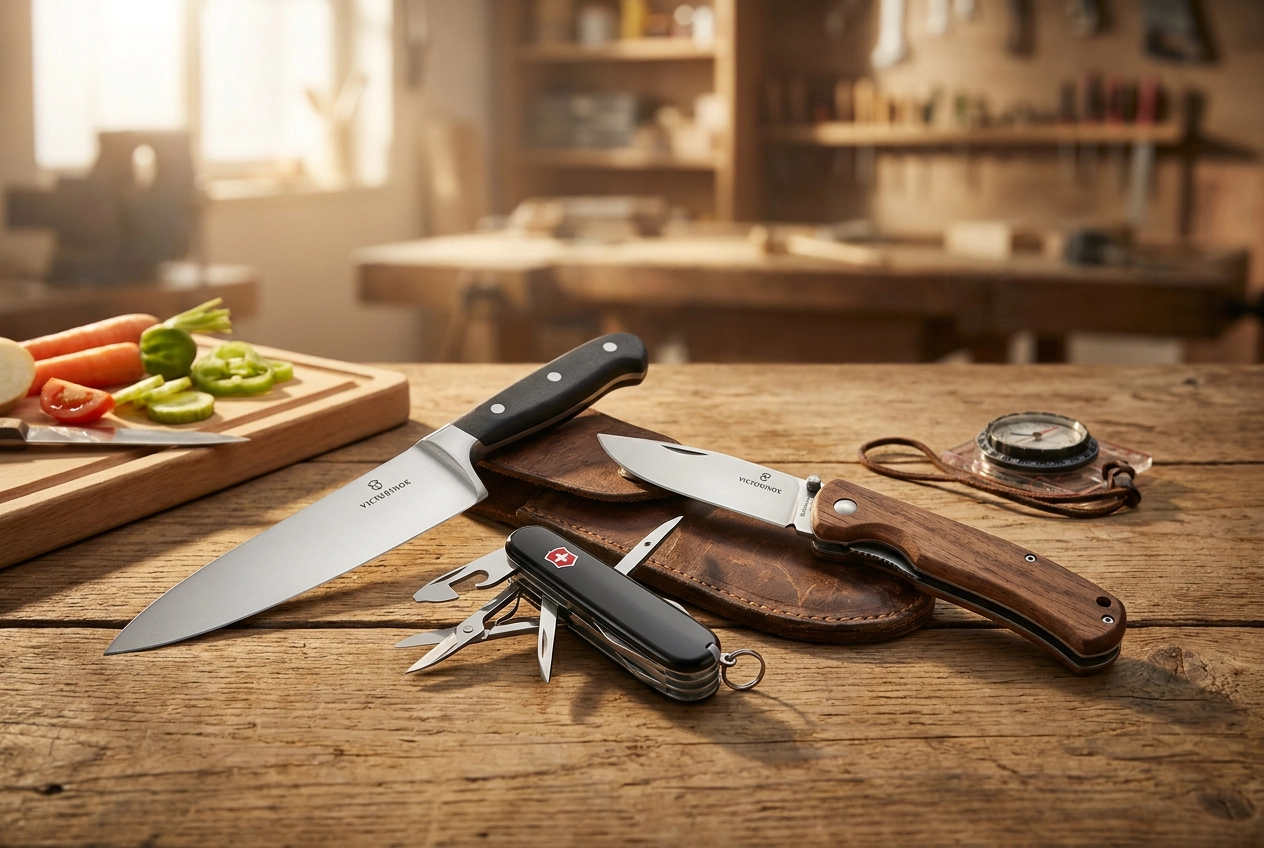
The three categories this guide covers are kitchen knives, EDC and Swiss Army knives, and outdoor fixed blades. The kitchen line is anchored by the Fibrox Pro chef’s knife, a budget-to-midrange workhorse with a textured thermoplastic handle and a stamped blade in X50CrMoV15 stainless. The EDC line is built around the 91mm Swiss Army Knife platform, which ranges from the 12-tool Tinker to the 33-tool, 185-gram SwissChamp. The outdoor fixed-blade line is led by the Venture and Venture Pro, both designed around bushcraft geometry and field ergonomics.
Consumer confusion in the SAK segment is well documented. The lineup runs to dozens of models that share the same red cellidor handles and silver tool profiles at a glance. The Tinker, Spartan, and Huntsman can look nearly identical in a display case, yet they differ meaningfully on tool count, weight, and intended use. Outdoor Life’s tested Swiss Army Knife guide for 2026 reflects exactly this navigation problem, dedicating significant editorial space to helping buyers distinguish models.
At Steel Snob, we judge each category under separate criteria. Kitchen knives are evaluated on edge retention through repeated prep tasks. EDC tools are assessed on carry weight, mechanism reliability, and practical tool utility. Fixed blades are judged on blade geometry, grind consistency, and handle ergonomics under simulated outdoor use. A score that makes sense for a chef’s knife tells you nothing useful about a pocket multi-tool.
Price positioning is budget to midrange across all three lines, with most models sitting well under the premium threshold. That value band is Victorinox’s core competitive identity, and every recommendation in this guide is read through that lens. If you need a knife that punches above its price, Victorinox belongs in the conversation. If you need the highest-performance steel available, you are looking at a different category entirely.
Kitchen knives: the Fibrox Pro in context
Steel identity: what’s actually in that blade
The Fibrox Pro uses X55CrMo14, a Swiss stainless alloy that sits close in composition to the German X50CrMoV15 family but is Victorinox’s own spec. Both alloys carry roughly 0.5% carbon and high chromium content for corrosion resistance, and both land in the 56 to 58 HRC range when properly hardened. That puts the Fibrox Pro noticeably softer than most Japanese kitchen steels. VG-10 typically runs 60 to 61 HRC, and Aogami Super pushes higher still. The gap matters more than it looks on paper.
Harder steels hold a keener edge for longer between maintenance sessions. Softer steels are more forgiving under abuse and return to a serviceable edge faster. The Fibrox Pro sits firmly in the second camp, and understanding that shapes every other judgment you make about it.
What that hardness means in actual use
A lower HRC means the edge rolls under stress rather than chipping. That is not a defect. It is a predictable failure mode and, for most home cooks, a more manageable one. A chipped edge on a hard Japanese knife requires stone work to repair. A rolled edge on the Fibrox Pro often comes back with four or five passes on a honing rod. Professional sharpeners who service commercial kitchens consistently note that the Fibrox Pro resharpens quickly and takes a clean factory-grade edge without requiring extended time on coarse abrasives. The trade-off is frequency. This steel will not hold a razor edge through a week of daily prep the way a harder alloy can. For a home cook who hones for thirty seconds before each session and puts the knife to a medium-grit stone two or three times a year, that is a reasonable and sustainable trade. It is a tool that rewards low-friction maintenance habits.
The “lightest chef’s knife” claim, examined
Several online video reviews frame the Fibrox Pro as the lightest good-quality chef’s knife you can buy. That claim is unverified by any documented comparative methodology, and Steel Snob does not repeat unverified superlatives. What the evidence does support is this: at roughly 5.6 oz for the 8-inch version, the Fibrox Pro is meaningfully lighter than forged German alternatives at the same blade length. The weight advantage comes from two structural facts. First, it is stamped rather than forged. Second, it carries no integral bolster. Forged knives add mass through the blade blank itself and through the bolster that sits between blade and handle. Remove both, and the weight drops. Calling the Fibrox Pro “among the lighter options in the category” is accurate. Calling it definitively the lightest requires a measured, comparative data set across all current contenders at the same blade length. We do not have that, and neither does anyone making the claim casually.
Stamped vs. forged: the honest trade-off
A stamped blade is laser-cut from a sheet of steel. A forged blade is shaped from a heated billet under pressure. Neither method is inherently superior. They produce different knives suited to different cooks. The stamped Fibrox Pro has a thinner spine, less mass behind the edge for heavy rocking cuts, and no bolster. That last point is actually a usability advantage at the sharpening bench: the full edge, heel to tip, is accessible on a flat stone without the bolster interrupting your angle. Forged knives with a full bolster develop a concave section near the heel over years of sharpening, which is a known and well-documented maintenance problem. The Fibrox Pro sidesteps it entirely. The handle on the Fibrox Pro does the ergonomic work that a bolster would otherwise provide, with a textured TPE grip that locks the hand naturally behind the blade. It is not the same feeling as a full bolster, but it is functional and comfortable over long prep sessions.
Best Victorinox kitchen knife for the home cook
The 8-inch Fibrox Pro is the recommendation for anyone buying a first serious kitchen knife at a budget price point. It is well-balanced for a stamped blade, the handle is genuinely comfortable under extended use, and the steel is easy to maintain without specialized equipment. For a detailed breakdown of how it performs against other options in this price band, the TechGearLab chef’s knife roundup provides useful tested context. A sharpener’s perspective on real-world maintenance behavior is covered thoroughly at Serious Fast Sharpening’s comparison.
Who should skip it
Cooks who want longer intervals between sharpening sessions should look at knives in the VG-10 or SG2 tier. Those steels hold a working edge significantly longer before degradation becomes noticeable, at the cost of being more demanding to restore when they do dull. The Fibrox Pro is also not the right entry point for someone who wants to learn Japanese knife geometry or explore harder alloys. It is a European-profile blade built for frequent, low-friction maintenance. If your goal is a set-and-forget edge, look elsewhere. If your goal is a capable, durable kitchen knife that sharpens fast and handles hard daily use without drama, the Fibrox Pro earns its reputation.
EDC and Swiss Army knives: navigating the 91mm platform
The 91mm format is where most adults land when they move past the novelty phase and start thinking about a Swiss Army Knife as a functional carry tool. Victorinox makes SAKs in smaller and larger sizes, but the 91mm platform covers the widest model range, hits the most useful price points, and fits cleanly in a front pocket without bulk. If you are buying one SAK to actually use, you are almost certainly buying a 91mm.
Handle material: Alox vs. cellidor
The red plastic body is cellidor, a cellulose acetate material that Victorinox has used for decades. It is light, durable, and exactly what most people picture when they think of a Swiss Army Knife. Most 91mm models ship in cellidor as standard.
Alox is the alternative. The scales are ribbed aluminum, anodized for corrosion resistance. The Alox version of a given model costs $5 to $15 more than its cellidor equivalent, shaves a small amount of weight, and drops the toothpick and tweezers. Those two tools live in channels built into the cellidor scale design. The aluminum scales do not accommodate them, so they are gone. That is not a flaw; it is a design tradeoff.
Where Alox earns its premium is feel and precision. The fit and finish on Alox models runs noticeably tighter than on comparable cellidor versions. The back springs, which are what give the tools their snap and resistance, draw consistent praise in US EDC communities as being above what the price tag implies. If you are comparing a cellidor Tinker to a Pioneer Alox side by side, the Pioneer costs more and carries fewer tools, but it does not feel like a less expensive knife.
Model navigation: matching the tool count to the task
The confusion most buyers run into is that 91mm SAKs look nearly identical at a glance. The difference is in what is packed between the scales.
The Tinker is the practical baseline. It covers 12 tools: a large blade, a small blade, a can opener, a flat screwdriver, a Phillips screwdriver, a wire stripper, scissors, a nail file, and a few other utilities. At a budget price point, it handles the everyday tasks that actually come up: opening packages, tightening loose screws, cutting cord. For most buyers who want a capable general-purpose SAK without overthinking it, the Tinker is the answer. The Victorinox Swiss Army Knife model comparison guide identifies it as the EDC sweet spot in the cellidor lineup.
The Huntsman steps up to 15 tools and adds a wood saw and a hook. The saw is functional for light camp tasks, and the hook handles bags and twine. If your carry context is suburban and occasionally outdoor-adjacent, the Huntsman is worth the modest premium over the Tinker.
The SwissChamp is the ceiling of the standard lineup at 33 tools. It also weighs 185g. For reference, the Classic SD, Victorinox’s smallest SAK, weighs roughly 23g to 24g. The SwissChamp is nearly eight times heavier. That weight lives in your pocket all day. Unless you specifically need the full tool complement for a defined use case, the SwissChamp is more impressive to look at than it is practical to carry.
The Pioneer Alox and why EDC communities keep recommending it
The Pioneer is a simple knife. It carries a blade, a nail file, a screwdriver, an awl, and a bottle opener. That is it. No scissors, no can opener, nothing that makes it look like an obvious multi-tool. What it offers instead is an Alox build at a midrange price point, with back spring tension and blade action that sit comfortably alongside single-blade folders costing significantly more.
The Pioneer appears in tested roundups and holds its position there not because of tool count but because of build quality per dollar. In US EDC communities, it draws a level of sustained enthusiasm that the Tinker and Huntsman do not, specifically because it functions less like a toolbox and more like a proper knife that happens to have a few useful extras. If your primary need is a blade and your secondary need is compactness and quality feel, the Pioneer Alox is the correct choice.
What the blade steel actually is
Most published coverage skips this entirely. Victorinox’s SAK blades use a martensitic stainless steel generally cited as approximately equivalent to 1.4110, the European designation for what is sometimes written as X55CrMo14. The hardness sits in the mid-50s on the Rockwell C scale. That is meaningfully softer than premium folder steels such as S30V or 20CV, which typically land in the 59 to 62 HRC range.
In practice, the lower hardness means the edge will not hold as long under heavy use, but it also means the steel sharpens quickly and easily. A ceramic rod handles touch-ups without difficulty. A leather strop brings the edge back to working condition between sharpenings. For the light cutting a SAK actually does, which is food prep, cord, cardboard, and the occasional light whittling task, the steel is entirely adequate. You would only feel the limitation if you were using a SAK as a primary cutting tool, which is not what it is designed for.
Carry rules: what you can and cannot do
Any SAK with a blade goes in checked baggage, full stop. The TSA does not permit blades in carry-on bags regardless of length. The Jetsetter is the purpose-built exception: it carries scissors, a nail file, a screwdriver, a bottle opener, and an eyeglass screwdriver, all without a blade, and it passes carry-on screening. If you fly frequently and want a SAK on the plane, the Jetsetter is the only option in the standard lineup.
For ground carry, US state laws on folding knife blade length vary widely. Most states do not restrict folding knives with blades under 3 inches, but several states and a number of municipalities impose tighter limits, and some jurisdictions treat multi-blade tools differently from single-blade folders. The techwriteredc guide to Swiss Army knife buying touches on this context for US buyers. Confirm current statutes in your state and municipality before carrying any blade. This is general information, not legal advice.
Best Victorinox SAK for each use case
Best for general everyday carry: Pioneer X (Alox, 91mm)
The Pioneer X is the one to buy if you carry a SAK daily and want it to hold up over years of real use. It gives you a blade, scissors, a can opener, a bottle opener, a screwdriver, and a wire stripper in a package that weighs less and feels more substantial in the hand than the red cellidor equivalents. The Alox aluminum scales are the reason. They are stiffer, more impact-resistant, and they do not pick up scratches the same way plastic does. The back springs in Alox models are also consistently tighter, which means tool deployment feels more deliberate and less sloppy. The Alox premium runs roughly $5 to $15 over a comparable cellidor model. That is money well spent. Who this is for: daily carriers who want a no-compromise 91mm SAK that improves with age. Who should skip it: anyone who dislikes the bare-metal aesthetic or needs the toothpick and tweezers that Alox omits.
Best for tool coverage without absurd weight: Huntsman
The Huntsman hits a practical sweet spot that few SAKs match. Fifteen tools include a blade, scissors, wood saw, can opener, bottle opener, and wire stripper, among others. The wood saw is what separates it from the Tinker and similar mid-range options. It is a genuinely functional saw for small branches and camp tasks, not a decorative feature. Community enthusiasm for the Huntsman is well-documented, and readers choosing it for EDC consistently cite the saw as the deciding factor. Weight stays manageable for daily pocket carry, unlike the SwissChamp. This is the right SAK for someone who spends time outdoors, camps occasionally, or wants broader utility without committing to a brick in their pocket. Who this is for: outdoor-oriented users and campers who want a single pocketable tool that covers real field tasks. Who should skip it: urban EDC users who will never use the saw and want a leaner carry.
Best for air travel: Jetsetter
The Jetsetter is the only Victorinox SAK we recommend for air travelers. It carries no blade, which means it clears the TSA carry-on checkpoint without issue. The tool set covers the practical needs most travelers actually face: a nail file, screwdriver, scissors, and a few other compact implements. If you travel frequently and want tool access without checking a bag, this is the answer. Confirm current TSA rules before your trip, because screening policies can change. Who this is for: frequent flyers who want functional tools on arrival. Who should skip it: anyone who needs a cutting edge, because there is none.
Who should skip the SAK entirely
The SAK blade does not lock. For light utility cutting, opening packages, and food prep tasks, that is entirely acceptable. For any task that puts lateral force on the blade, a purpose-built EDC folder with a positive lock is the safer and more capable choice. The Quora EDC community makes this distinction clearly: if your primary need is a blade, buy a blade. A locking folder in the budget to midrange tier will outperform any SAK on cutting tasks. The SAK wins on tool variety and portability, not on cutting performance.
A note on the SwissChamp
The SwissChamp has 33 tools and weighs 185g. That weight is the honest disqualifier for daily pocket carry. It belongs in a glovebox, a desk drawer, or a collector’s display. For anyone who wants to understand what Victorinox can build when weight is no constraint, it is an impressive object. For anyone who has to carry it all day, it is a burden. Keep it as a reference piece or a fixed-location tool. Do not mistake review count for carry suitability: the SwissChamp’s popularity on community lists reflects its novelty appeal, not practical daily use.
Outdoor and fixed-blade: the Venture and where it fits
The Venture is the most frequently referenced Victorinox fixed blade in current outdoor coverage, yet it gets a fraction of the editorial attention that the Fibrox Pro and the SAK lineup attract. That gap is worth closing, because the knife is genuinely useful for a specific type of user and genuinely wrong for another.
Steel and what it means in the field
One clarification upfront: the section outline references the X50CrMoV15 family, but detailed product sources identify the Venture’s steel as 14C28N, a Sandvik-developed stainless alloy. That distinction matters. Both alloys sit in the moderately soft stainless range compared to tool steels, but 14C28N carries a slightly higher hardness ceiling and better corrosion resistance than X50CrMoV15. The practical result is similar: the edge is easy to restore with a field-grade ceramic rod or a folding sharpener, but you will be touching it up more often than you would with a harder tool steel like O1 or 1095. For a backpacker who might spend three days in the field, that trade-off is entirely workable. For someone processing game or doing sustained wood carving, it is a real limitation.
The blade is a drop-point geometry, which is the right call for a general camp knife. It handles food prep, cord cutting, and light carving tasks without the compromises of a clip point or a tanto. The spine is ground to a 90-degree edge, which functions as a genuine ferrocerium striker. That is a functional detail, not a marketing embellishment.
Handle, fit, and finish
The handle is Thermoplastic Elastomer (TPE), a textured polymer that maintains grip in wet conditions. It is not premium, but it is purpose-appropriate. The fit and finish at this price band are competitive. The knife ships with a polymer sheath that doubles as a fire-starting blowtube, adding modest but real utility for backpacking scenarios.
At 4.13 oz for the knife alone, the Venture is genuinely light for a fixed blade. Gram-conscious hikers will notice that advantage over heavier full-tang knives. The spine thickness is 3.5 mm, which brings us to the most important caveat in the whole product.
Where the Venture fits and where it does not
The “bushcraft” label that Victorinox and several retailers apply to the Venture deserves scrutiny. At 3.5 mm, the spine is too thin for batoning firewood without risk of lateral stress. Outdoor Life’s review frames it as a “do-it-all bushcraft blade,” but that overstates its range. Heavy chopping, prying, and sustained field processing are outside what this knife handles reliably. For those tasks, a higher-carbon fixed blade with a 4 to 5 mm spine and a convex or Scandi grind is the better tool.
What the Venture does well: food prep at camp, light whittling, cord and packaging work, general cutting tasks on a multi-day hike. It is a legitimate lightweight fixed blade for the user who wants the ergonomics and safety of a fixed-blade sheath knife without carrying 8 oz of steel.
Who this is for, and who should skip it
Buy it if you are a backpacker or day hiker who wants a fixed blade primarily for food prep and light camp tasks, values easy field sharpening over maximum edge retention, and is not ready to spend premium money on a dedicated bushcraft or outdoor-survival knife.
Skip it if you process game in the field regularly, do serious woodcraft, or need a knife that handles hard-use batoning without concern. Those users should look at a higher-carbon steel with a thicker spine. The Knife Magazine review covers the Venture’s practical performance in detail and is worth reading alongside the official specs before you decide.
Sharpening and maintenance: Victorinox-specific guidance
Sharpening the kitchen blade: angle and abrasive selection
X50CrMoV15 sits at 56 to 58 HRC. That is softer than most Japanese steels, and it changes how you sharpen. Harder steels hold a steep edge well. At this hardness range, a shallower angle gives you better results with less effort. The Fibrox Pro leaves the factory ground at roughly 15 degrees per side. Hold that geometry and the steel rewards you with an edge that comes back quickly.
You do not need an elaborate abrasive progression for this alloy. A medium-grit whetstone in the 1000-grit range removes enough steel to reestablish the bevel cleanly. A high-grit finishing stone is not necessary. The steel is not hard enough to benefit from a polished, mirror-refined edge the way a 61 HRC Japanese blade would. Sharpen at 1000 grit, strop on a leather block or a clean piece of cardboard, and stop there. A guided-angle system works well here if you find freehand angle control unreliable. Consistency matters more than technique elegance.
Honing: the maintenance step that matters most
Because X50CrMoV15 rolls rather than chips under use, honing is your primary maintenance tool. A rolled edge can be realigned. A chipped edge requires material removal. Keep the edge rolling back into alignment with a smooth honing steel or a fine ceramic rod before each session. Victorinox recommends five passes per side at roughly 20 degrees. That is a reliable starting point. A coarse diamond rod is the wrong choice for routine work on this alloy. It removes too much material for a task that is essentially edge alignment, not re-grinding.
SAK blade maintenance
The blades on a Tinker or Pioneer run at a wider geometry, typically around 20 to 25 degrees per side. They are small, which limits your options on a full bench stone. A ceramic pocket rod or a folding diamond paddle is the practical solution. A few light passes per side, alternating, followed by stropping on leather or stiff cardboard, will keep the edge serviceable through months of carry use. Full reprofiling on a whetstone is rarely justified unless the blade has been chipped on a hard surface.
Cleaning and storage
Victorinox confirms the Fibrox handle is dishwasher-safe. Hand washing and immediate drying is still the better practice. Dishwasher heat and detergent accelerate edge degradation over time, and blade-to-cutlery contact in the basket causes micro-damage. For SAK models, cellidor scales can be rinsed and air-dried with the tools open. Alox handles tolerate moisture better, but dry the knife before closing the tools regardless of scale material. Trapped moisture at the pivot points causes staining and corrosion on the blade tang.
The mistake worth avoiding
Do not use a coarse pull-through sharpener on the Fibrox Pro. Pull-through devices are angle-fixed, aggressive, and rarely match the factory geometry. They remove more steel per pass than a whetstone session does, and the angle they cut is often steeper than 15 degrees per side, which means you are progressively rebuilding the wrong bevel. Over several sessions, you lose both edge geometry and blade height faster than necessary. A whetstone or a guided system keeps you in control of the angle and removes far less material per sharpening event.
Steel Snob verdict: which Victorinox is worth buying and which is not
The Fibrox Pro earns its reputation honestly. The steel is not exotic, the construction is stamped rather than forged, and the edge requires more frequent maintenance than a harder Japanese blade. None of that disqualifies it at the budget tier. Those are honest characteristics of a knife optimised for value, not weaknesses disguised as features. For a first serious kitchen knife purchase, it remains the recommendation. Hone it regularly, sharpen it on a medium-grit stone every few months, and it will outperform knives at twice the price that never get maintained.
The Pioneer X (Alox) is the strongest SAK recommendation for daily carry. The Alox handle has been in production since 1957 for a reason: it outlasts cellidor in real use, resists cracking under stress, and adds almost no weight penalty. The tool selection covers the tasks most EDC users actually encounter. The build quality exceeds what the price tier suggests. If you carry a SAK and want one knife for the next decade, the Pioneer X is the answer.
The SwissChamp is not a carry knife. At 185g, it belongs in a glove box, a desk drawer, or a display shelf. The Pioneer X handles 90% of real-world SAK tasks at a fraction of the weight. The SwissChamp is a capable tool and a legitimate collector piece. It is not a pocket carry recommendation, and buying it as one is a use-case mismatch, not a brand failure.
The Venture fixed blade is worth considering for ultralight hikers and backpackers who need a fixed blade for food prep and light camp tasks. It is not built for heavy-use or hard chopping. Buy it with accurate expectations and it will not disappoint.
Victorinox earns its 130-year run. The quality-to-price ratio across kitchen, EDC, and outdoor categories is consistently above average. The models this guide steers you away from are not bad knives. They are the wrong tools for the wrong use cases, and knowing that distinction is the whole point.
The takeaway
Match the knife to the use case first. The Fibrox Pro belongs in a working kitchen where durability and easy maintenance matter more than edge longevity. The Pioneer X Alox belongs in a pocket where daily utility and long-term build quality justify the modest price premium. The Venture belongs on a pack where weight is a real constraint.
Understand the steel before you commit. X50CrMoV15 is a capable alloy, corrosion-resistant and forgiving to sharpen, but it trades edge retention for accessibility. Hone it consistently and it performs well. Expect long intervals between sharpenings and it will disappoint you.
For SAK selection, ignore tool count as a status signal. Start with the 91mm platform, list the tasks you actually need covered, and stop adding tools at that point.
Before you carry any blade, including a SAK, confirm current blade-length rules in your state and locality. This guide is general information only, not legal advice.
Steel Snob’s kitchen knife guides, EDC blade-steel explainers, and state knife-law reference pages cover each of these topics in full depth.
Conclusion
Victorinox has earned its reputation by delivering exceptional quality at a price point that outperforms the competition, and this guide has shown you exactly how to harness that value. The right knife depends on your specific use case, whether that is professional cooking, outdoor adventures, everyday carry, or utility tasks. Blade performance, ergonomics, and handle materials all play a role in finding your ideal match. And with Victorinox, you rarely have to compromise on any of these factors.
Now it is time to act. Revisit the use case that matches your lifestyle, pick the model that checks your most important boxes, and invest in a tool built to last decades. A great knife does not just sit in a drawer; it becomes part of how you work, cook, and explore. Choose wisely, and Victorinox will reward you every single day.