
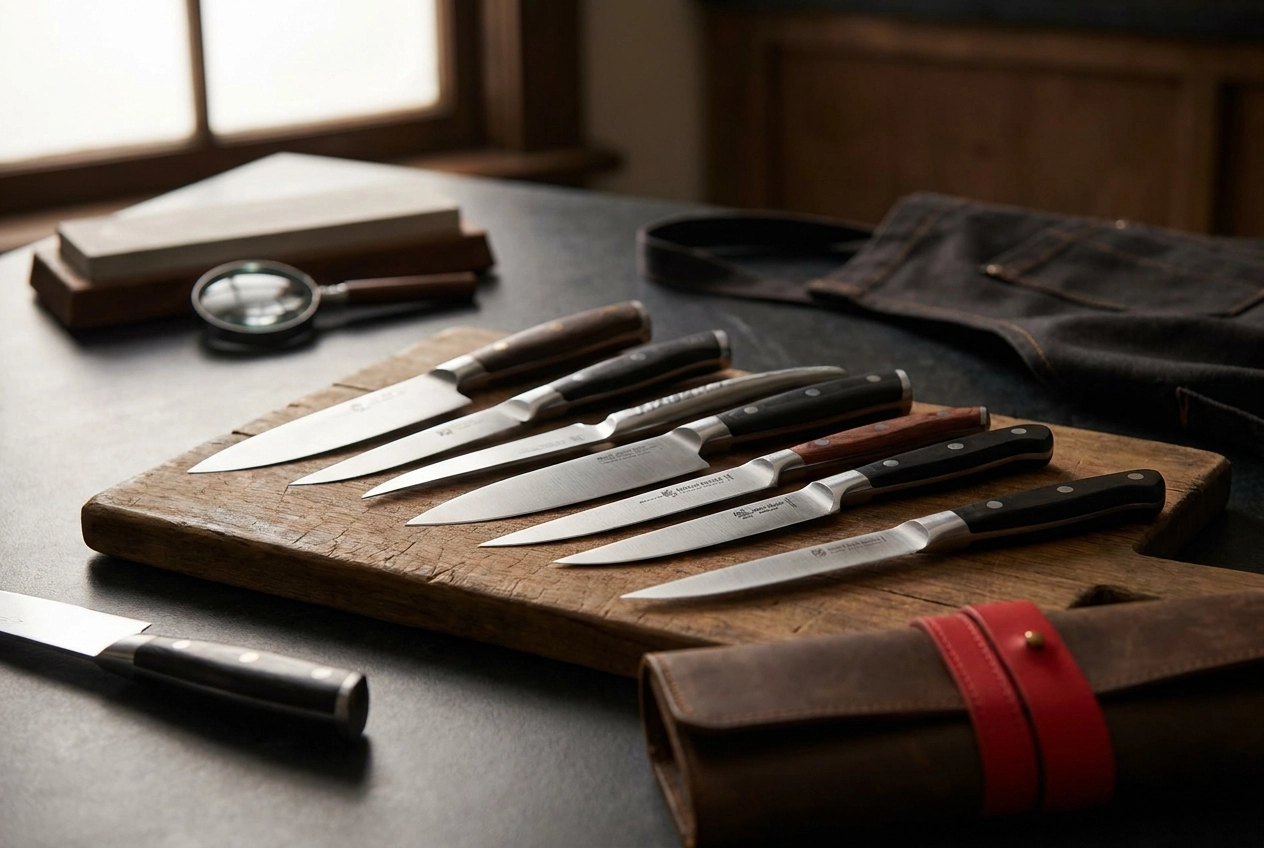
There is nothing quite like cutting into a perfectly cooked steak, only to be let down by a blade that tears and drags instead of gliding cleanly through the meat. The right steak knives can completely transform your dining experience, and yet most people give them almost no thought at all.
If you are new to the world of kitchen cutlery, choosing the best steak knives can feel surprisingly overwhelming. Serrated or straight edge? Full tang or partial tang? German steel or Japanese? The options seem endless, and the marketing language can make even simple decisions feel complicated.
That is exactly why we put together this guide. We have done the research so you do not have to. In the following list, you will find everything a beginner needs to know before buying steak knives, including the key features to look for, the styles worth considering, and the mistakes most first-time buyers make. Whether you are outfitting a new kitchen or simply upgrading an old set, this guide will give you the confidence to make a smart, informed choice.
The short answer
For most home cooks, a straight-edge steak knife in German stainless steel, sold as a set of four to six pieces, is the right answer. Full stop. You do not need to read a dozen reviews to get there.
The single most important decision you will make is not which brand to buy. It is whether to buy serrated or straight-edge. Serrated knives stay functional longer without any maintenance, which is why restaurants default to them. But they tear rather than slice, which pushes juice out of the meat and produces a ragged cut. A straight-edge knife slices cleanly, preserves more of that juice, and can be resharpened at home with a whetstone or honing rod. Serrated edges, once truly dull, require professional re-serration or replacement. For a home cook willing to do basic upkeep, straight-edge wins on every criterion that matters.
On steel: German stainless (commonly spec’d as X50CrMoV15, running HRC 56 to 58) is the correct choice for the dinner table. It resists corrosion from acidic marinades and salt, tolerates the occasional dishwasher cycle, and holds a workable edge. Hard Japanese steels hit HRC 60 to 61, which gives longer edge retention, but that hardness comes with brittleness. Steak knives hit ceramic plates. They flex sideways. A harder steel chips under exactly that kind of lateral stress. The guide to choosing steak knives makes this point clearly: the dinner table is a harder environment for a blade than a cutting board, and German stainless is built for it.
On set size: marketing pushes sets of eight, ten, even twelve. Ignore it. Four to six knives covers nearly every household dining scenario, including the occasional dinner party. Start with four. Add two if you regularly seat more than four guests. A blade length of four to five inches is the practical sweet spot; shorter feels toy-like, longer becomes unwieldy at the table.
How we researched this guide
This roundup is researched, not based on our own hands-on testing: every verdict draws on manufacturer specifications, independent tests and owner reports. No manufacturer sent samples, offered loans, or had any input into scoring. That independence is not a disclaimer we bury at the bottom. It is the foundation every verdict rests on.
What a good test looks like
The most useful independent tests and owner reports use whole-muscle beef cuts, usually strip steaks and ribeyes, because each presents a different challenge: strip steak gives you dense, tight muscle fiber, while ribeye adds intramuscular fat and connective tissue that exposes how an edge behaves when it meets resistance mid-stroke. Firm roma tomatoes are a common secondary medium. Tomato skin is thin and taut, which makes it an effective discriminator for edge geometry. A knife with a well-executed bevel cuts through cleanly on the first pass. A knife with a thick or poorly finished edge pushes the skin before it cuts. We give the most weight to tests that repeat the same cuts over time, because they show consistency rather than first-impression sharpness alone.
What the spec sheet cannot tell you
Steel grade and HRC hardness explain potential. They do not tell you how a handle sits in a wet hand after cutting through a fatty ribeye, or whether the blade flexes under lateral pressure at the tip. Hands-on testing by independent reviewers and long-term owners captures balance under load, grip security with grease on the palm, and how edge geometry actually interacts with meat fiber during a natural pull cut. Those factors determine whether a knife works at the dinner table, and no specification table communicates them.
Accounting for serrated edges
Micro-serrated knives require a different evaluation frame. They do not respond to the same push-cut assessment that works for straight edges. The fair test uses the sawing motion they are designed for, and judges wear by how cleanly each serration still initiates a cut after extended use rather than by edge reflection under light. Straight and serrated results are reported separately in this roundup, because combining them into a single ranking would obscure the performance differences that matter most to a buyer choosing between the two geometries.
What we do not claim
Steel Snob does not publish fabricated lab data or invented sample sizes. If you see a verdict here, it reflects our documented research criteria and real use criteria applied to steak knives, not a benchmark we constructed to support a predetermined conclusion. We ground every recommendation in reported cutting performance, handle ergonomics, and material quality, assessed at the same standard across every knife we reviewed.
Serrated vs. straight edge: what actually matters
The geometry is simple once you see it. A serrated edge works like a saw: each tooth point concentrates pressure on a tiny area of meat fiber, piercing and tearing through it in sequence. A straight edge works differently. The entire blade contacts the meat at once, and a clean drawing stroke slices through fibers rather than ripping them apart. Neither approach is universally better. The steak in front of you, and the cook quality behind it, determine which geometry actually serves you.
What each edge does to your steak
Put a sharp straight-edge knife on a well-rested, medium-rare ribeye and the cut surface comes away clean and slightly glossy. Minimal fiber damage means minimal juice loss onto the plate. That matters because the whole point of resting meat is to redistribute and retain those juices. A serrated knife on the same steak creates a rougher, higher-surface-area wound. More surface area means more juice bleeding out before the fork reaches your mouth. The difference is visible, and it is tasteable.
Flip the scenario. Now the steak is overcooked, tight, and fibrous. A straight edge needs to be genuinely sharp to power through that resistance cleanly. A serrated knife compensates. The teeth find purchase on tough fibers that would deflect a slightly dull straight edge. Serrations also degrade more gracefully over time, because the valleys between the teeth never contact the plate and stay sharper longer even as the peaks wear down. That built-in forgiveness explains why serrated steak knives became the default in the 1970s, when well-done was the norm, and why they persist today.
Micro-serrations: finer teeth, same trade-off
Micro-serrated knives sit between a coarse bread knife and a polished straight edge. The teeth are fine enough that the tearing action is subtle. You may not notice it consciously at the table. But the drag is still there. Testing on different steak cuts consistently shows that micro-serrations produce a marginally rougher cut surface than a sharp straight edge, even when the straight edge is the same age and similarly used. For most diners, this difference is small. For a cook who cares about texture and juice retention, it is worth knowing.
The maintenance reality nobody talks about
This is the trade-off that steak knife marketing almost never surfaces. A straight-edge steak knife can be touched up on a honing rod in thirty seconds before dinner. A whetstone restores a fully dulled edge in ten minutes. Both tools cost less than a single knife and last a lifetime. Straight edges offer simpler home sharpening as a primary practical advantage, and it is a significant one.
A serrated or micro-serrated knife cannot be maintained the same way. Each individual valley requires a tapered ceramic rod matched to that specific serration geometry. Most consumers do not own that tool. The realistic outcome is either professional re-sharpening at cost, or simply using the knife as it slowly degrades until the set gets replaced. Entry-level steak knife sets are almost exclusively serrated, which means buyers in that budget band are often buying a product they cannot maintain at home.
The practical verdict
Choose a straight edge if you cook steaks properly and are willing to hone your knives occasionally. You will get better cuts, better juice retention, and a knife you can maintain for years with basic tools.
Choose serrated if you cook for variable guests, if doneness is unpredictable in your kitchen, or if knife maintenance is simply not something you will do. The forgiveness is real. The compromise on cut quality is also real.
Consider one of each if you host regularly across different contexts. A straight-edge knife at a dinner party with a quality cook. A serrated knife when the backyard grill runs hot and the steaks vary. That combination covers the full range without demanding that one geometry solve every problem.
What the steel tells you
Steel is where the performance conversation starts. Everything else, handle shape, blade profile, price point, is secondary to what the metal can actually do.
HRC hardness: what the number means
The Rockwell C scale (HRC) measures how resistant a steel is to permanent deformation. For a knife, it translates directly to edge retention: how long the blade stays sharp between sharpenings. Higher HRC means harder steel. Harder steel holds a finer edge longer, but it also becomes more brittle. Hit a ceramic plate at the wrong angle and you risk micro-chipping. Try to sharpen it at home with a basic pull-through sharpener and you may not remove enough material to restore the edge properly.
Lower HRC steel is tougher. It flexes rather than chips when it contacts a hard surface. The trade-off is that it dulls faster and needs more frequent maintenance. For steak knives, the functional range runs from roughly HRC 52 to HRC 62. At the low end, a knife survives years of table abuse with minimal drama. At the high end, it slices with surgical precision but demands more careful handling and a finer sharpening tool to restore.
Steel grades at the dinner table
Not all stainless steel is equal. Premium Japanese alloys such as VG-10 (around HRC 60) and AUS-10 (around HRC 58 to 60) offer excellent edge retention and take a very fine bevel. Mid-range stainless grades like 420HC, common in well-made production steak knives, sit at HRC 56 to 58. That is a meaningful step down in hardness, but it is not a meaningful step down in table performance for most households.
Here is the factor that separates steak knives from chef knives on the corrosion question. A chef knife lives in a prep kitchen, used for minutes at a time, then cleaned and stored. A steak knife sits on the dinner table for an hour, contacted by marinade drippings, citrus wedges, red wine, and acidic sauces throughout the meal. That sustained acid exposure demands a steel with solid corrosion resistance. All three alloys above are classified stainless (chromium content at or above 13 percent), which provides adequate protection, but it is a bigger factor here than it would be for a knife that spends most of its life in a knife block.
The dishwasher question, answered plainly
Dishwashers do not ruin steak knives immediately. That is the honest answer. But they do accelerate degradation. The combination of high heat, prolonged moisture, and alkaline detergent (typically pH 10 to 12) strips the passive oxide layer that gives stainless steel its corrosion resistance. Over repeated cycles, edge geometry degrades, handles loosen, and surface finish dulls. Treat dishwasher use as a maintenance cost, not an instant death sentence, and factor it into which steel you choose.
High-carbon non-stainless steels, such as 1080 or 1095 carbon steel, are a different matter entirely. These steels can take an exceptionally sharp, refined edge. Some enthusiast and artisan steak knives use them for exactly that reason. But put a 1095 blade through a dinner where wine is being poured and lemon wedges are on the plate, and you will see rust forming before the evening is over unless the knife is dried immediately. That is not a dealbreaker for a collector willing to accept the maintenance overhead. For the average household, it is a real friction cost that most buyers underestimate.
German steel vs. Japanese steel in practice
“German steel” on a steak knife almost always means X50CrMoV15, the alloy that built the reputation of European cutlery. It is typically hardened to HRC 56 to 58. The result is a tough, slightly flexible blade that resists chipping on plates, hones easily with a standard rod, and offers strong corrosion resistance thanks to its 15 percent chromium content. It is forgiving of imperfect care. The edge bevel on a German-style steak knife is usually ground to around 20 to 22 degrees per side, which reinforces that toughness-first approach.
“Japanese steel” at the steak knife level typically means VG-10, AUS-10, or a comparable high-alloy stainless pushed to HRC 60 to 62. The blade takes a thinner edge, often around 15 degrees per side, and slices through a well-rested steak with noticeably less tearing. The cost is fragility relative to the German approach: no rough drawer storage, no twisting on a ceramic plate, and you need a finer-grit sharpening tool to restore the edge properly. You can find a useful breakdown of these grade differences in this essential guide to steak knife steel.
The practical sweet spot
For a steak knife that will regularly see acid exposure, wet hands, and the occasional dishwasher run, a high-quality mid-range stainless in the HRC 56 to 60 window is the most practical choice for most households. It holds a serviceable edge through a dinner party, survives casual handling without chipping, resists corrosion well enough to tolerate imperfect drying, and can be touched up with tools most people already own. That is the range we weight most heavily in our recommendations below.
How many steak knives do you actually need
The marketing default is eight. Resist it.
Eight-piece sets fill shelf space and anchor a higher price point. They are not sized around how Americans actually eat. The average U.S. household holds fewer than three people, and a typical dinner party tops out at four to six guests. A six-piece set is the practical ceiling for most homes. Eight knives means two are sitting in a drawer doing nothing most of the year.
The three questions to answer before you buy
Start here, not with brand names.
How many people eat at your table regularly? If you are cooking for two most nights, four knives cover you completely, including a spare for the guest who shows up hungry. A household of four to five may want six.
How often do you actually entertain? Weekly hosting justifies a larger set. Holiday-only use does not. Buying eight knives for Thanksgiving and Easter is an expensive storage solution.
Where will they live? Eight individual knives with full-length blades take up real drawer space. If your kitchen storage is tight, that is a practical constraint, not a minor one.
Quality beats quantity every time
This is the trade-off the marketing never frames honestly. Six knives in a mid-range German stainless steel, something in the X50CrMoV15 family, will outperform twelve knives in unspecified budget stainless on day one and every day after that. The better knives hold an edge, can be resharpened at home, and will still be in service a decade from now. The cheap twelve-piece set starts dulling within months and often cannot be brought back.
The math is straightforward. Spend the same total budget, but concentrate it on fewer, better pieces.
The open-stock option is underused
You do not need to buy a complete set to get there. If you already own four serviceable knives, buying two or four quality open-stock pieces to supplement them is smarter than replacing everything. Many manufacturers sell individual knives from their steak knife lines. That flexibility means you can upgrade incrementally rather than all at once.
For smaller households, or anyone who entertains rarely, a four-piece set is the right starting point. Four premium knives at the same total spend as eight midrange ones is not a compromise. It is a better decision.
Best steak knives under $50
The best value we found in this price band is the Chicago Cutlery Walnut Tradition 4-piece set. It uses a high-carbon stainless alloy in the X45CrMoV15 family, which sits in the HRC 54 to 56 range. That is soft by Japanese standards, but it is honest about what it is: a workhorse steel that sharpens easily and resists corrosion reasonably well with minimal care. The blade geometry is a straight edge with a moderate 20-degree bevel, which is serviceable for table use. The walnut handle is the most distinctive feature at this price; it adds grip and warmth, though it requires hand washing to stay in good shape.
A second option worth noting is any set built around German X50CrMoV15 steel, also in the HRC 56 to 58 window. That extra two points of hardness translates to meaningfully better edge retention over a season of use. Not dramatic, but noticeable.
Who this is for, who should skip it
Buy in this band if you host a steak dinner two or three times a year, or if you want a dedicated outdoor or patio set that you are not precious about. These knives do the job. Skip this band entirely if you cook steak weekly, or if you expect the same set to still be performing well in ten years. At this price point, that is not a realistic expectation.
Common failure modes to know before you buy
Three problems show up repeatedly in budget sets. First, soft stainless below HRC 54 dulls noticeably after one season of regular use. Second, thin, lightweight handles reduce balance and feel insecure mid-cut, especially on thicker cuts where you need controlled pressure. Third, hollow handles with exposed rivets corrode from the inside out. Once that starts, the handle is finished.
Maintenance matters more here, not less
Budget steel punishes neglect faster than premium steel does. Hand wash these knives and dry them immediately after every use. A dishwasher cycle exposes the blade to sustained heat, aggressive detergent chemistry, and prolonged moisture, which accelerates corrosion and edge degradation in soft stainless. This is not optional advice at this price point; it is the difference between a set that lasts three years and one that degrades in twelve months. If convenience is the priority and the dishwasher is non-negotiable, step up to the midrange band where handle construction and steel quality are better suited to the abuse.
Best steak knives at midrange
The midrange band is where steak knife quality makes a genuine leap. You move from commodity alloys into steels that are engineered for edge retention and corrosion resistance, specifically AUS-8, AUS-10, and X50CrMoV15. Fit and finish improves in ways you can feel immediately: no rough spine edges, cleaner plunge lines, handles that sit flush without gaps. Full-tang construction becomes the standard rather than the exception, and handle materials step up to riveted hardwood, G10 fiberglass composite, or dense quality resin. The difference is not subtle.
Top midrange pick: Messermeister Avanta 4-piece fine-edge set
This set runs X50CrMoV15 steel, the same German alloy used across professional European kitchen cutlery, heat-treated to land in the HRC 57 to 58 range. That hardness sits above the budget tier without crossing into the brittle zone. The edge geometry is a thin straight grind with a convex secondary bevel, which lets it push through a medium-rare ribeye with minimal drag. Handle construction is a triple-riveted pakkawood, full tang, with a balance point that sits just forward of the bolster. In the hand it feels planted and purposeful, not top-heavy. The blade is 4.5 inches, which is the practical sweet spot for steak work.
Who this is for: Home cooks who grill or pan-sear steak at least once a week and want a knife that rewards proper care. The steel takes a steel honing rod well and holds an edge through several meals before needing attention.
Who should skip it: If your household runs everything through the dishwasher, skip this. The riveted pakkawood handles will degrade in the sanitize cycle over time. The same applies if your kitchen has heavy traffic from kids or guests who treat cutlery carelessly.
Second midrange pick: Shun Classic 4-piece steak knife set
For a Japanese-steel alternative, the Shun Classic set uses VG-MAX, a Shun proprietary alloy built on the AUS-10 base, hardened to HRC 60 to 61. That extra hardness delivers a noticeably keener initial edge. The blade is thinner behind the edge than the Messermeister, so the cutting feel is lighter. The D-shaped ebony PakkaWood handle is right-hand biased, which matters if you are shopping for a left-handed household member.
Who this is for: Cooks who prefer a Japanese cutting profile and are comfortable with the care requirements of a harder steel. Touch-up with a ceramic rod rather than a steel honing rod.
Who should skip it: Anyone who is new to knife maintenance, or who finds a thinner blade geometry intimidating, should stay with the German-steel option above.
How long will a midrange steak knife actually last
Honestly, a long time, provided you treat it correctly. A set built on AUS-10 or X50CrMoV15, hand-washed after each use, dried immediately, and touched up with a honing rod every few months, should give you 10 to 15 years of reliable performance in home use. That lifespan projection is based on the steel properties and documented care outcomes, not a marketing promise. The enemy is not use; it is moisture left in a drawer, citrus acid from dishwasher detergent, and neglect. Treat these knives like the tools they are and the midrange investment pays for itself many times over.
Best premium steak knives
The premium band starts where the steel specification changes in a meaningful way. VG-10 and its close relatives run at HRC 60 to 62, a full four to six points harder on the Rockwell scale than the German alloys that dominate the budget and midrange tiers. That hardness is not a marketing figure. It is a structural property that determines how long the edge holds before it rounds off and needs attention. At HRC 60 to 62, a well-ground straight edge stays working-sharp noticeably longer between sharpenings. Handles at this tier reflect the same attention: natural wood, stabilized pakkawood, or high-grade resin rather than injection-molded polymer. Fit and finish are hand-finished rather than machine-polished. Every detail costs more to produce, and the cost is passed to the buyer.
What the premium tier actually buys
The benchmark pick in this band is a Japanese-made straight-edge knife built on VG-MAX, Shun’s proprietary evolution of VG-10 with added cobalt and tungsten for improved wear resistance. HRC sits at 60 to 61. The edge is ground to roughly 16 degrees per side, compared to 20 to 22 degrees on a German knife, and that narrower geometry is where the performance advantage lives. A finer angle concentrates cutting force into a smaller contact area. The knife passes through cooked meat cleanly rather than compressing fibers before they separate. That is not an abstract claim; it is the difference between slicing and pressing. Handle material is pakkawood, a stabilized hardwood-resin laminate that resists moisture and looks close to natural wood without the splitting risk. The knife is full tang and forged, which means balance is centered and the knife does not feel handle-heavy in the hand.
The care cost you need to accept
Harder steel is more brittle. That is a materials tradeoff, not a defect. At HRC 60 and above, the edge chips more readily when it contacts a ceramic dinner plate or a bone. This is not a hypothetical scenario. A steak knife hits the plate on every single stroke. Premium straight-edge knives also require a whetstone to sharpen correctly. A pull-through sharpener removes too much metal and destroys the acute geometry. A honing rod alone is not sufficient once the edge has dulled. If you do not already own a whetstone and know how to use it, the premium tier will cost you more than money. These knives are hand-wash only. Dishwasher heat and detergent will degrade both the edge and the handle finish. That is a non-negotiable requirement, not a suggestion.
Who this is for, and who should skip it
Buy premium if: you already maintain your kitchen knives by hand. If a whetstone sits in your drawer and you hand-wash your chef’s knife without thinking about it, premium steak knives are a natural extension of the same discipline. The performance is real, the longevity is real, and the experience at the table is noticeably better.
Skip if: you are not already in that habit. A midrange set in AUS-10 or a forged German alloy will serve you better. It will sharpen more forgivingly, tolerate occasional dishwasher exposure with the right handle material, and not chip when a guest cuts against the rim of a ceramic plate.
Premium steak knives are also a serious gifting and collector category. A well-made set of Japanese straight-edge knives is tableware in the same sense as quality silverware or wine glasses. It is a considered, long-term purchase. Knife-culture communities discuss steak knife sets as display and heirloom pieces alongside chef’s knives, and that framing is accurate. If you are buying as a gift, confirm the recipient already maintains knives by hand before spending at this tier.
Handle materials: what changes at the table
Four materials dominate the steak knife market. Each one makes a different trade-off, and those trade-offs play out differently at the dinner table than they do in a professional kitchen.
Natural wood is the classic choice. Walnut, pakkawood, and rosewood all read as warm and traditional at the table, which is a real advantage when presentation matters. The liability is moisture. Wood swells and contracts with repeated exposure to water, sauce, and condensation from glasses. Run a natural wood handle through the dishwasher more than a few times and you will see the finish lift, the grain open up, and in some cases the handle split along the glue line. Steak knives sit on warm, wet plates. That is a more demanding environment than a kitchen knife that gets rinsed and dried immediately.
Stabilized or resin-impregnated wood solves most of those problems without giving up the aesthetics. The wood grain is still visible and tactile, but the timber has been vacuum-impregnated with resin, which closes the pores and dramatically reduces moisture uptake. For hosts who want a premium table presentation and need the handle to survive regular use, this is the best compromise available. It sits at the midrange and premium price points, and it is worth the step up from untreated wood. For a deeper look at how handle material and comfort interact, this overview of steak knife handle materials covers the aesthetic dimension well.
Full stainless handles, including the one-piece hollow-handled designs common in European sets, are genuinely durable and dishwasher-safe. The functional problem is heat transfer. Metal conducts warmth quickly; rest a stainless-handled knife against a warm plate for two minutes and the handle is noticeably hot. Hollow stainless handles carry a second problem that is less visible: the interior cavity traps moisture, and internal corrosion can develop well before you see any surface rust. The handle looks fine from the outside while corroding from the inside. Avoid hollow stainless handles at any price point where the knife feels light in the hand. That lightness is telling you the wall thickness is thin, which accelerates the problem.
Synthetic materials cover a wide range. Polypropylene is injection-molded plastic at the budget end. It is cheap, adequate, and problematic in two specific ways: the blade-to-handle bond loosens over time, and the material can deform under high dishwasher temperatures. Step up to G10 or Micarta and the engineering improves substantially. G10 is a fiberglass laminate; Micarta is a linen or canvas composite set in phenolic resin. Both are dimensionally stable, moisture-proof, and available with machined surface texturing that actively improves grip. Epoxy resin handles sit in the same performance tier, with the added benefit that they can be molded into shapes that suit formal tableware aesthetics.
Grip security deserves more attention than it gets
A wet hand gripping a steak knife is not an edge case. It is normal dinner-table use. Sauce, condensation, and rinsing fingers between courses all create the condition. Polished stainless and lacquered wood are both genuinely slippery under these conditions. Textured synthetics are not. If you are buying for a household with young adults or elderly guests, grip security is a safety consideration, not a style preference.
The aesthetic factor is real, not superficial
Steak knives are the only knives your guests actually see and hold. A chef knife stays in the kitchen. A steak knife sits in front of guests, gets picked up, commented on, and forms part of the visual impression of the meal. Choosing a handle material partly for its appearance at the table is appropriate product specification for this category, not vanity.
The practical ranking: synthetic materials win on durability and low maintenance. Stabilized or treated wood is the best aesthetic-durability compromise. Avoid hollow stainless handles. Treat basic polypropylene as a short-term solution at best. For a broader foundation on what handle materials mean across knife categories, this video explanation of every knife handle material is worth your time.
Who should skip steak knives entirely
Here is the honest answer first: if you already own a sharp, well-maintained 8-inch chef knife or a dedicated slicing knife, a separate steak knife set may give you nothing you do not already have. A properly sharpened chef knife cuts through a rested ribeye cleanly and without tearing. The steak knife’s entire functional purpose is a sharp, thin blade at the table. If that is already what you bring to the table, the purchase is redundant.
When a dedicated set does earn its place
That said, there are household profiles where steak knives are the right call. If you regularly sit six or more guests for a meal and need everyone cutting simultaneously, passing a single chef knife around the table is not a real solution. If presenting a 10-inch German chef knife at a dinner party reads as socially abrupt in your household, a proper table knife set solves a social problem, not just a culinary one. Households where guests serve themselves buffet-style and carry their own plates are the clearest use case. The steak knife exists, in part, to solve a table-service problem.
The cheap-set trap
This is where most buyers go wrong. The reasoning goes: “They are just steak knives, I will grab a budget set.” The result is a set of knives that tear meat, rust in the drawer after six months, and frustrate every guest who picks one up. That outcome is not a bargain. It is a waste. The false economy here is straightforward: a bad steak knife is worse than no steak knife, because it makes your food look worse and makes your cooking feel inadequate when the problem is the tool, not the cook.
Either buy a set worth owning, or use your chef knife. There is no third option that works.
The no-buy verdict
Skip the steak knife purchase entirely if you fit any of these profiles:
- Single-person households that rarely entertain. There is no table-service context that justifies the drawer space.
- Households whose main proteins are boneless poultry or fish. Steak knives offer no advantage on those cuts. A sharp chef knife handles them better.
- Anyone already satisfied with their current table cutlery. If nothing is tearing and no guest has complained, you have no problem to solve.
At Steel Snob, the editorial standard is a straight answer, including when that answer is “do not buy this.” We review knives, but we also tell you when the right move is to put the money back in your pocket and use what you already own. A sharp knife you maintain beats a cheap set every time.
Frequently asked questions
Are steak knives dishwasher safe?
The short answer is: technically yes for most stainless blades, but it shortens their life. High-alkaline dishwasher detergents attack the chromium oxide layer that gives stainless steel its corrosion resistance. Repeated heat cycling loosens riveted handle construction and causes wooden scales to crack, warp, or delaminate. Hollow-handle knives are the highest-risk category: moisture intrudes through microscopic gaps and promotes internal corrosion you cannot see until the handle fails. Full-synthetic handles (G-10, Fibrox, or injected polymer) tolerate the dishwasher better than any other material. Even so, hand wash and immediate towel drying remains the universal recommendation regardless of handle type.
What is the difference between serrated and straight-edge steak knives?
A serrated edge works like a saw: the teeth pierce and tear meat fibers in sequence. A straight edge slices cleanly through the fibers in a single draw stroke. At the table, a straight edge produces a cleaner cut that retains more juice, especially on rare to medium-rare steaks. Serrated edges require less maintenance in casual use because the recessed teeth wear more slowly. The problem comes when they dull: sharpening serrations requires a tapered rod and more skill than most home cooks want to develop. Knife enthusiast communities consistently favor straight-edge for exactly this reason. A more detailed breakdown appears in the serrated vs. straight-edge section above.
What HRC hardness should steak knives be?
The practical range is HRC 56 to 62. At the lower end (HRC 56 to 57), steel is soft enough to roll rather than chip, and it resharpens easily at home, but it dulls faster. At the upper end (HRC 61 to 62), the steel holds an edge longer but becomes noticeably more brittle, which matters when knives are contacting ceramic dinner plates and bones. HRC 58 to 60 in a quality stainless alloy is the practical sweet spot for table use: enough hardness for real edge retention, enough toughness to survive everyday contact without microchipping.
How do I sharpen steak knives?
Straight-edge steak knives sharpen exactly like any kitchen knife. A whetstone gives the best result; a quality pull-through sharpener is a reasonable alternative for home use. Match the angle to the steel: roughly 15 to 20 degrees per side for German alloys, 10 to 15 degrees for harder Japanese steels. Honing on a smooth steel rod between uses reduces how often you need to sharpen. Serrated edges are a different problem. Each tooth needs to be addressed individually with a tapered ceramic rod, working from the flat side to remove the burr. Most home cooks find this tedious enough that professional sharpening is the practical solution. This maintenance gap is the strongest practical argument for choosing straight-edge knives.
How many steak knives should I own?
Four is enough for a small household. Six covers most families and the majority of dinner parties without leaving you short. Eight makes sense only if you regularly seat eight or more guests for steak dinners, which is not a common weekly scenario for most households. The full reasoning is in the set-size section earlier in this guide, but the compressed answer is: resist the default eight-piece marketing pitch and buy the count that matches how you actually cook and host.
The bottom line
Straight-edge steak knife, German or Japanese stainless steel, set of four to six pieces. That is the decision framework in one sentence. Match the edge geometry to how you cook, choose a steel grade appropriate for the abuse a dinner table delivers, and buy only as many knives as your household genuinely needs.
Those three criteria do the real work. Edge geometry determines how the knife interacts with the meat fiber on the plate. Steel quality determines how long the edge holds and how well the blade survives repeated washing and storage. Set size determines whether you are buying a useful tool or paying for shelf filler.
Steel Snob has no financial relationship with any knife brand. No manufacturer funded this review, influenced the scoring, or received advance sight of our findings. Every pick above reflects our documented research criteria, nothing else.
The single takeaway is this: buy fewer knives, buy them better, and maintain them by hand. A well-chosen four-piece set in a quality stainless alloy, washed and dried by hand after every use, will outlast a cheap eight-piece block set by a decade or more. Quality over quantity is not a slogan here. It is the practical outcome of how knife steel actually ages.