
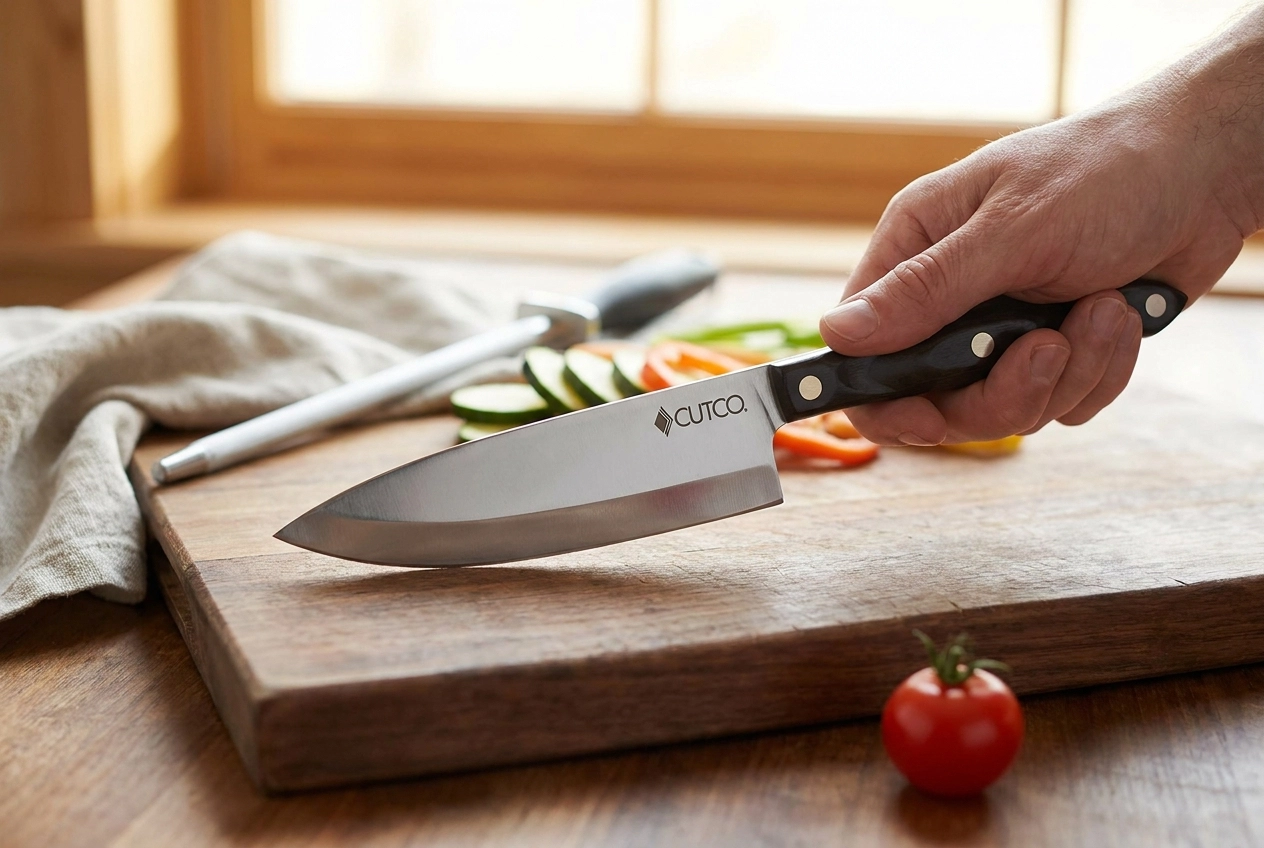
Few kitchen brands spark as much debate as Cutco. Walk into any American home and there’s a good chance you’ll find at least one of their knives tucked in a drawer, often purchased through a friend or family member doing summer sales work. But does the product itself hold up to the hype, or are buyers simply paying a premium for a clever distribution model?
In this review, we take a hard, honest look at Cutco knives from every angle that matters: steel quality, edge retention, ergonomics, pricing, and the famous Forever Guarantee that the company uses as a cornerstone of its pitch. We’ll compare Cutco against competing brands at similar and lower price points to give you a clear picture of where the value actually lies.
Whether you’re considering your first Cutco purchase or already own a set and want to know if expanding your collection makes sense, this breakdown will give you the facts you need. No sales pitch, no nostalgia. Just a straightforward assessment of what these knives deliver and where they fall short.
The short answer
Cutco is a legitimate American knife brand, manufactured in Olean, New York, with a real lifetime guarantee that the company actually honors. It is not a scam. The knives are functional, the warranty is genuine, and the brand has been making essentially the same product since 1949. That said, legitimate does not mean worth buying new.
The central problem is the steel. Cutco uses 440A stainless hardened to approximately 54 to 56 HRC. That is soft by any serious standard. Most comparably priced knives run harder, which translates directly to longer edge retention between sharpenings. Softer steel dulls faster under regular cutting stress, full stop. The stamped construction adds another layer of concern, since stamped blanks lack the structural density and balance geometry that forged knives deliver at the same price point. You are paying a premium price for below-average materials, and the gap in overhead from Cutco’s direct-sales model explains why.
The answer splits clearly into two audiences. New buyers have better options at or below the same price. The math does not work in Cutco’s favor when you factor in the steel hardness, the construction method, and the pricing. Existing owners have a defensible case for staying put. The Forever Guarantee changes the value proposition for anyone who already has a set: free sharpening, free replacement, no questions asked. That is real, and it matters if you plan to use the knives for decades.
This review keeps those two audiences separate throughout, because conflating them produces bad advice for both. Read the section that applies to you.
Who this is for and who should skip it
Who this is for
This review is written for two groups of readers.
The first is the home cook who just sat through a Vector Marketing demo, probably presented by a college student with a sample set and a rehearsed script, and who wants an independent read before putting real money down. That is a completely reasonable position. The sales environment is designed to create urgency, and a second opinion grounded in the metallurgy is exactly what the situation calls for. If you found this page within 24 hours of a pitch, you are in the right place.
The second group is current owners, including gift recipients who received Cutco as a present and are now wondering what they actually have. Cutco owners frequently describe genuine satisfaction with their knives, and that response is worth taking seriously. If you are in this group, we will tell you what the steel means for long-term performance, what sharpening options actually exist for your specific blade profile, and whether keeping the set makes practical sense.
Who should skip this review
Professional cooks outfitting a working kitchen can stop here. The answer is no. The 440A steel hardened to roughly 54 to 56 HRC will not hold an edge through the daily volume that professional prep demands, and the price-to-performance ratio does not survive comparison at that level. This is not a debate worth extending.
Committed knife enthusiasts already know the 440A story. You are probably here to check whether our take aligns with yours. It mostly will. The rest of this review is written for someone making a first serious knife purchase with real money involved, who deserves a straight answer built on the materials science, not on sentiment from a sales pitch or contrarianism for its own sake.
The steel: what 440A actually is
Cutco uses 440A stainless steel. That is a factual starting point, not a marketing claim, and understanding what that designation means is the fastest way to evaluate whether these knives justify their price.
The metallurgy in plain terms
440A is a martensitic stainless steel. Martensitic means it can be hardened through heat treatment, specifically by heating to a critical temperature and then quenching rapidly. That distinguishes it from austenitic grades like 304 or 316, which are the stainless steels used in cookware and sinks. Those grades resist corrosion extremely well but cannot be hardened, so they have no place in a knife blade. 440A can be hardened, and that is why it ends up in cutlery at all.
The defining constraint is carbon. 440A runs approximately 0.65 to 0.75 percent carbon by weight. Carbon is the element that enables martensite formation during quenching. More carbon means more martensite, which means harder steel. At 0.65 to 0.75 percent, the carbon ceiling is low, and that ceiling is the direct reason 440A cannot harden past roughly 56 HRC even with optimal heat treatment. Cutco’s knives come in at approximately 54 to 56 HRC. That places them at the soft end of the kitchen knife spectrum.
What HRC actually means for your cutting board
Hardness on the Rockwell C scale is the standard proxy for edge retention. A harder blade holds a fine edge longer under load because the steel resists micro-deformation and abrasive wear more effectively. The relationship between hardness and edge retention is not linear; it scales in a way that makes even modest HRC gaps consequential in real kitchen use. The knife steels rated by a metallurgist analysis from Knife Steel Nerds, which uses CATRA abrasive wear testing, makes this scaling relationship explicit and is the most rigorous public reference on the subject.
440A versus 440C: the sibling comparison
440A’s closest relative is 440C. The difference is carbon content. 440C runs 0.95 to 1.20 percent carbon and can reach 58 to 60 HRC with proper heat treatment. That higher carbon translates directly to more carbide volume in the finished blade, which is what drives abrasive wear resistance upward. 440C is the better knife steel within the 440 family, and it is used in EDC knives, kitchen knives, and surgical instruments precisely for that reason. 440A is cheaper to produce and, critically, easier to stamp into shape. Stamping is a high-volume manufacturing process that punches blade blanks from sheet steel. It suits softer, more ductile grades. It is not a neutral choice; it is why Cutco can produce knives at scale, and why the steel grade is what it is.
The benchmark gap: X50CrMoV15 at 58 HRC
German premium kitchen knife makers use X50CrMoV15, which runs at approximately 58 HRC. That is a 2 to 4 HRC advantage over Cutco’s 440A. Given the non-linear scaling of edge retention, that gap is not cosmetic. Under equivalent cutting tasks, a 58 HRC blade will hold a working edge meaningfully longer before the user notices degradation. Japanese kitchen knives, running steels like VG-10 or SG2, reach 60 to 65 HRC and extend that gap further.
Where 440A is genuinely strong
440A is not a poor steel in all contexts. Its chromium content sits around 16 to 18 percent, which delivers excellent corrosion resistance. It is used in marine hardware and industrial blades for exactly that reason. It is also notably tough under impact and very easy to resharpen, because soft steel removes quickly against an abrasive. Those are real advantages in the right application. For a kitchen knife sold at a premium price point, though, those advantages do not fully compensate for the edge retention shortfall.
What this means in your hand
A Cutco knife will feel acceptably sharp out of the box. It will dull noticeably faster than a comparable blade made from a 58 HRC German steel or any Japanese equivalent. When it dulls, it will respond well to resharpening, which is part of why the Forever Guarantee’s mail-back sharpening service has genuine utility for owners who do not want to maintain their own edges. The trade-off is maintenance frequency, not catastrophic failure. The knives work. They just work on a shorter cycle between sharpenings than the price suggests they should.
Cutco does not publicly state a specific HRC figure on its product pages. That absence is worth noting. Manufacturers confident in their steel specification tend to publish it.
For readers who want to go deeper on what HRC numbers mean across the full range of knife steels, the Steel Snob blade steel science reference covers that ground in the same plain-language approach used here.
Stamped vs. forged: the precise version
Cutco knives are stamped. That means a blade blank is punched from a flat sheet of rolled steel using a die, then ground and finished to shape. Forged knives follow a different path entirely: a steel billet is heated and shaped through compression and hammering, a process that physically reorganizes the metal at a microstructural level. The difference is not just about manufacturing cost or tradition. It is about what happens inside the metal.
What grain structure actually means here
When steel is rolled into sheet form, the crystalline grain runs in a single direction, dictated by the rolling process. Stamping cuts a shape out of that sheet without disturbing the grain. Forging does something different: the compression and heat cycle refines the crystalline structure and can realign grain direction along the blade’s geometry. That refinement can improve toughness and make edge geometry more consistent from heel to tip. It also allows a smith or manufacturer to vary metal thickness across the blade cross-section, which is how a proper bolster gets formed as part of the blade rather than as a separate welded-on component. Stamping cannot do that. The steel arrives as a uniform sheet, and it leaves as a uniform sheet with a knife outline.
The “forged is better” claim needs a qualifier
The forging advantage is real but not unconditional. Steel grade and heat treatment are independent variables, and they can outweigh manufacturing method. A well-made stamped knife in high-hardness steel, the Victorinox Fibrox is the standard example here, can outperform a poorly made forged knife in soft, undertreated steel. Discussions among experienced cooks on forums like DiscussCooking make this point clearly: forging refines and densifies the steel, but only if the base material and heat treatment are worth starting with. The manufacturing method is not a shortcut around metallurgy.
Where Cutco’s construction becomes a compounding problem
For Cutco specifically, the stamped construction does not stand alone as a criticism. It layers on top of the 440A softness problem already covered in the steel section. You have steel running at 54 to 56 HRC that also lacks the grain refinement benefit of forging. Neither limitation is disqualifying in isolation. Together, they point in the same direction. The weaknesses do not offset each other.
Balance is also affected. Forged knives typically include a full bolster, the thick shoulder between blade and handle, which shifts weight forward and suits a pinch grip. Cutco’s stamped construction produces a lighter, handle-forward feel. Some home cooks find that comfortable during long prep sessions. Knife enthusiasts and professionals who use a pinch grip generally find it unbalanced. ChefTalk threads on Cutco’s steel choices reflect this divide consistently.
Structural density rounds out the picture. Forged blades are denser at the spine and heel, which affects how the knife moves through dense produce like hard squash or root vegetables. Stamped blades are thinner throughout, which is a genuine advantage for fine slicing work but a real limitation under heavy chopping load.
The bottom line: stamped construction is not disqualifying on its own. At the premium price point Cutco occupies, combined with 440A at 54 to 56 HRC, it is a compounding limitation where better-constructed alternatives exist.
The Double-D edge: honest technical take
The Double-D edge is Cutco’s most recognized design feature, and also its most misunderstood. It is not a serrated edge in the conventional sense. The profile consists of alternating small recurve scallops ground into the blade, creating a series of micro-points along the cutting edge rather than a single continuous bevel. Cutco also produces a condensed variant called the Micro Double-D edge, which tightens the scallop spacing further. Both designs are trademarked and positioned as core identity features of the brand.
Why it exists
Understanding why Cutco uses this design requires going back to the steel discussion above. At 54 to 56 HRC, the 440A steel used in Cutco knives is soft enough that a plain edge will round off relatively quickly under normal kitchen use. A micro-serrated profile partially compensates for that. The scallop points continue to bite into food even as the metal between them loses its edge, which extends the knife’s functional cutting life without requiring frequent sharpening. That is a legitimate engineering response to a material constraint. It is not a performance innovation. It is a workaround, and Cutco’s marketing does not frame it that way.
Where the Double-D works and where it doesn’t
The trade-off is real and worth knowing before you use these knives. Micro-serrations do well on tasks that benefit from a grabbing, tearing action: bread, tomato skin, citrus rind, and fibrous vegetables like celery or leeks. The scallops catch the surface and pull through efficiently. On push-cutting tasks, the picture reverses. Slicing onion, mincing garlic, or chopping herbs requires a clean, controlled contact between a sharp plain bevel and the food. Micro-serrations drag across soft food surfaces rather than slicing cleanly, which produces ragged cuts and gives the cook less feedback through the handle. One user with direct experience of both edge types described the Double-D as feeling like it “tears rather than cuts” on field-dressing tasks, which matches what kitchen users report on precision prep work.
The sharpening problem
The Double-D edge cannot be restored on a flat whetstone or a standard pull-through sharpener. Each scallop requires a round ceramic rod with a diameter matched to the scallop geometry to sharpen correctly. Most home sharpening equipment does not qualify. Professional sharpeners can service the profile if they have the right tooling, but it is specialized work, and not every shop takes it on. This is the structural reason Cutco’s mail-back sharpening service exists. The Forever Guarantee covers sharpening returns, with a modest handling fee for domestic shipments. For owners who are comfortable sending knives away and waiting, the system works. For owners who want to sharpen at home or use a local sharpener, the Double-D is a genuine inconvenience.
Third-party sharpening: what professional sharpeners actually do
Professional sharpeners who work with the Double-D regularly report two approaches. The first is regrinding the profile correctly using appropriate ceramic rods, which restores the original geometry. The second, more interesting option is converting the Double-D to a plain edge entirely during the sharpening session. That conversion removes the micro-serration pattern and replaces it with a standard bevel. Most professional sharpeners say the converted knife performs better on everyday kitchen tasks than the Double-D profile did, at the cost of the longevity benefit the serrations provided. Whether that trade is worth making depends on how you use the knife.
Straight-edge Cutco models are a different conversation
Not every Cutco knife uses the Double-D profile. The product line includes straight-edge models, and those knives respond well to conventional third-party sharpening. Professional sharpeners consistently note that a straight-edge Cutco knife sharpened by a skilled third party typically comes out sharper than the same knife returned from Cutco’s mail-back service. The anatomy of the knife is sound enough that the steel takes a proper edge when worked correctly. If you own straight-edge Cutco models, finding a local professional sharpener is worth the cost and will return better results than the factory service.
Cutco vs. Wusthof: same price bracket, different outcomes
The benchmark comparison here is specific: Cutco’s Classic 8-inch chef knife against the Wusthof Classic 8-inch. Put them side by side on a cutting board and the price anomaly becomes the first thing worth addressing. As of 2026, Cutco’s direct-sales price runs into the premium band. Wusthof’s retail price sits lower, available through normal retail channels where competitive pricing applies. You are paying more for the Cutco despite it using softer steel and stamped construction. That inversion is not a coincidence, and it is not a reflection of quality.
The steel gap is real
Cutco runs 440A stainless at 54 to 56 HRC. Wusthof’s X50CrMoV15 is hardened to 58 HRC. That 2 to 4 point gap on the Rockwell scale translates directly to how long the edge holds between sharpenings. Harder steel resists micro-deformation at the apex better, so under equivalent use, the Wusthof edge degrades more slowly. There is also an edge-angle factor worth understanding: Cutco’s factory grind runs at roughly 22 degrees per side, while Wusthof’s PEtec process produces an angle closer to 14 degrees per side. The Cutco knife can feel sharper out of the box because the more acute angle cuts with less resistance initially. But a softer steel at a sharper angle rolls faster. Within a few weeks of regular home cooking, the Wusthof is sustaining the edge that Cutco has already started to lose.
Construction and balance
Wusthof’s Classic line is forged from a single piece of steel, with a full bolster and triple-rivet handle. The forging process creates heel-to-spine density that a stamped blank cannot replicate. That density, combined with the bolster, produces the forward-weighted balance that supports a pinch grip. Most culinary professionals and serious home cooks use the pinch grip for control and reduced fatigue over extended prep sessions. Cutco’s stamped construction results in a different balance profile. It is not unusable. Some users genuinely prefer it. But it is a step down in engineering terms, and the balance is not optimized for the grip technique that produces better cutting mechanics.
Why Cutco costs more
The price premium exists because of distribution, not materials. Cutco is sold exclusively through Vector Marketing, a direct-sales model that puts college-student representatives into homes for face-to-face demos. That model carries embedded overhead: representative commissions, training costs, marketing materials, and the structural cost of funding the Forever Guarantee across the entire installed customer base. None of that overhead improves the steel or the construction. You are paying for the sales infrastructure and the warranty, not for better metallurgy. This comparison of the two Classic lines lays the distinction out plainly for readers who want a second reference point.
One place Cutco has a real edge
Wusthof’s full bolster is a mark of forged quality, and it creates a known maintenance problem. The bolster extends past the heel of the blade, which means a standard flat stone cannot reach the full length of the edge without a dedicated bolster-grinding step. Over time, as you sharpen the blade body back, the bolster begins to protrude further and makes full-blade contact with a stone increasingly difficult. Cutco’s bolster-free stamped design does not have this problem. The full edge is accessible on a flat stone from the first session. For a home user who sharpens independently, that is a genuine advantage. It is narrow, but it is real.
The verdict on this comparison
For a new buyer at this price point, Wusthof delivers better steel, forged construction, and a lower purchase price. On the three factors that determine long-term knife performance, it wins outright. The Cutco Forever Guarantee is the only genuine differentiator, and it deserves honest consideration. If you are the kind of owner who will send a knife back for service rather than pick up a stone, the no-questions-asked replacement and sharpening policy has real value. If you are comfortable maintaining an edge yourself, or willing to budget for occasional professional sharpening, the guarantee does not justify the price premium or the performance gap.
The Forever Guarantee: what it is actually worth
The Forever Guarantee is real. That needs to be stated plainly because it is the most contested claim in every Cutco conversation. Cutco’s own policy page documents the terms: free sharpening, free repair, and free replacement for life, with no requirement to prove fault or provide a receipt. Long-term owners confirm it holds up in practice, including for damage caused by misuse, dishwasher exposure, and rust. One documented case involved a full set lost by a shipping carrier in transit; Cutco replaced it at no charge despite bearing no technical liability for the loss. This is not a warranty that disappears when the fine print is examined. It is honored.
That said, the guarantee is not free. The cost is embedded in the purchase price, and for new buyers, that framing matters. You are prepaying for a maintenance and replacement service at the moment of purchase. A portion of the premium you pay over a comparable German knife goes toward direct-sales overhead, and a portion covers the guarantee’s long-term liability. If you use the mail-back service regularly over twenty years, that calculus may work in your favor. If you buy the set, sharpen your own knives, and never send anything back, you have paid for coverage you did not use.
For existing owners, the math is different
If you already own Cutco knives and they have held up structurally, the guarantee becomes the single strongest argument for keeping them rather than replacing them. The marginal cost of exercising the guarantee is only the return shipping fee, which scales from roughly eleven to twenty-one dollars depending on how many pieces you send. That is a low barrier for restoring a full set to working condition. The knives you bought a decade ago do not depreciate in guarantee terms. A set purchased in the 1950s still qualifies today, which is a genuinely unusual policy in the housewares category.
What the mail-back service actually delivers
Convenience, yes. Optimal results, not consistently. Consumer accounts describe returned edges with variable geometry, angles ranging between fifteen and twenty-five degrees, and a coarse belt-finish that functions but does not impress. The service restores a working edge. It does not produce the refined, polished bevel that a skilled hand sharpener achieves on a whetstone. For straight-edge Cutco models, a competent local sharpener will typically outperform the mail-back result. If you have access to a professional sharpener who charges ten to fifteen dollars per knife, that route produces better results on plain-edge models and costs less than you might expect over a year.
Double-D models versus plain-edge models
The calculation splits here. Consumer reports and owner accounts confirm that the Double-D edge cannot be maintained on a standard whetstone or a conventional pull-through sharpener. The geometry requires a ceramic rod of a specific diameter to seat correctly in the recessed scallops. Most local sharpeners do not carry that tool. For Double-D knives, the mail-back service is the practical default unless you locate a professional specifically equipped for them. For plain-edge Cutco models, the opposite applies: skip the mail-back, find a good local sharpener, and you will get a finer edge for a comparable cost.
Who the guarantee is actually worth it for
The maintenance-free buyer profile is real and deserves to be taken seriously rather than dismissed as a rationalization. If you genuinely will not sharpen your own knives, will not research local sharpeners, and want a single point of contact for everything that goes wrong with your kitchen knives for the rest of your life, Cutco’s value proposition holds. The guarantee removes friction that is real for a large segment of home cooks. That is a legitimate reason to buy, as long as it is made with clear eyes on what you are paying for the privilege.
Verdict by audience: new buyer, existing owner, gift recipient
New buyer verdict
The case for buying Cutco new is weak, and the numbers explain why. The 440A steel runs at roughly 54 to 56 HRC. A Wusthof Classic operates at 58 HRC. That gap translates directly to edge retention, and you will feel it inside the first month of regular cooking. The Wusthof also costs less through standard retail channels, is forged rather than stamped, and carries a construction pedigree that has proven itself in professional kitchens over decades. The price premium on a new Cutco purchase does not fund better materials. It funds commissions, sales training, and the infrastructure of a direct-sales distribution model. Those are real costs, but they are not your costs to absorb if you are simply shopping for the best knife at this budget. Buy the Wusthof Classic, or put the same money toward a quality Japanese option with a higher HRC and a thinner grind. Either choice delivers more cutting performance per dollar.
Existing owner verdict
Do not throw out your Cutco. That is the short version, and it deserves emphasis because the enthusiast critique of 440A steel sometimes pushes owners toward a conclusion the evidence does not support. The Forever Guarantee is a genuine asset. The steel, while soft by collector standards, is corrosion-resistant, easy to sharpen, and entirely capable of handling home cooking at a reasonable maintenance interval. You are not under-equipped. You are just not optimally equipped, and that is a different problem.
The practical maintenance path is straightforward. Straight-edge Cutco models respond well to third-party professional sharpening, which typically produces a better result than the company’s own mail-back service. Take those knives to a local sharpener. The Double-D models are a different case: the recurve scallop geometry cannot be replicated by most third-party sharpeners, so use the mail-back program for those. Both options cost you nothing beyond shipping, which is a real benefit of the guarantee you already own.
Gift recipient verdict
You received a well-made, American-manufactured knife backed by a lifetime guarantee that the company has honored consistently since 1949. That is not nothing. The 440A steel is softer than alternatives at the same price point, but home cooking does not impose the edge-retention demands of professional-volume work. If the edge is maintained, most kitchen tasks will not expose the limitation. Use the Forever Guarantee whenever the edge needs attention. If you find yourself wanting a finer edge for tasks like thin slicing or precision work, consider adding one higher-hardness option to your rotation rather than replacing what you have.
The sales pitch dynamic
Many buyers come to Cutco through an in-home demonstration from a college student rep, and the sales framing centers on American manufacturing, the guarantee, and a personal trusted connection. All three of those things are factually accurate. The steel specifications are also factually accurate. Both can be true at once, and holding both simultaneously is the honest way to assess the purchase. The emotional context of the sale does not make the knife worse. It does, however, create a mismatch between the purchase experience and objective performance expectations, which is where most buyer disappointment originates. Community discussions comparing Cutco and Wusthof reflect exactly this pattern: owners who cook regularly report satisfaction, while expectations shaped by the sales pitch sometimes outpace what the steel can deliver.
A note on professional kitchen use
Professional chefs do not use Cutco in working kitchens. The reasons are worth stating precisely. It is partly the steel hardness relative to professional-volume demands. It is also kitchen culture: professional kitchens have established norms around what gear looks credible, and Cutco does not fit that context. Neither reason amounts to the knives being unsuitable for cooking as a function. Home cooking and professional cooking impose different requirements on an edge, and feedback from home cooks consistently separates the professional consensus from the home-use reality. The professional kitchen verdict is not a verdict on your kitchen.
Alternatives worth considering
Wusthof Classic: the most direct substitute
The Wusthof Classic is where most buyers should land when they step away from Cutco. It uses X50CrMoV15 stainless steel, forged in Solingen, Germany, and runs at 58 HRC. That is a 2 to 4 point hardness advantage over Cutco’s 440A, and that gap is not cosmetic. Harder steel holds a finer edge longer, requires fewer touch-ups, and rewards a proper honing routine with noticeably extended performance between sharpenings. The Wusthof is also available through normal retail channels, which means you can compare prices directly rather than navigating a direct-sales structure.
One legitimate trade-off to flag: the full bolster on the Classic sits at the heel of the blade, and as the knife ages and the edge recedes toward the bolster, flat whetstone sharpening becomes awkward. The bolster prevents the heel from lying flush against the stone. It is not insurmountable, but first-time owners should know it before they buy. A qualified sharpener handles it routinely. The edge retention improvement over Cutco is worth the consideration.
Shun Classic: for buyers who want significantly more hardness
Shun Classic sits in the premium bracket and uses VG-10 steel, hardened to 60 to 61 HRC. That is a substantial jump over both Cutco’s 440A and German steel in the 58 HRC range. The payoff is a thinner, more acute edge that stays sharper longer on pull-slice cuts through proteins, soft vegetables, and herbs.
The trade-offs are real and specific. Harder steel is more brittle. VG-10 at 60 to 61 HRC chips under heavy downward rocking on hard root vegetables or lateral stress on anything dense. It requires a lighter cutting style, and it demands proper whetstone maintenance. A pull-through sharpener will damage the edge. If you are willing to learn whetstone technique and adjust how you cut, Shun rewards that investment clearly. If you want a knife you can treat roughly, it is not the right fit.
Victorinox Fibrox Pro: the stamped-construction value case
The Fibrox Pro is stamped, like Cutco, but it uses harder steel and comes in well below Cutco’s pricing. For a home cook who wants a capable, maintenance-friendly workhorse without the direct-sales overhead, it is a strong midrange choice. It will not match Wusthof on construction or Shun on edge retention, but it handles everyday prep reliably and sharpens without complication. It carries no lifetime guarantee, but at its price point, that trade-off is easy to accept.
How to choose
The right alternative depends on three things in order: your cooking style, your willingness to maintain the blade, and your budget. Start with the steel grade and what HRC range suits your usage. Then look at construction, forged versus stamped, and what that means for balance and longevity. Then consider handle geometry, ideally by handling the knife in person before buying. Let price be the final filter, not the first one. For home cooks building a first serious kit from scratch, the Steel Snob chef knife buyer guide walks through this process across budget bands without directing you toward any particular brand.
The bottom line
Cutco is not a scam. It is a legitimate American manufacturer with a lifetime guarantee that owners consistently report being honored without friction. The knives work. For home cooking, they are functional and durable enough to last decades with basic care.
The technical verdict is less generous. 440A steel at 54 to 56 HRC is soft for this price bracket, and stamped construction compounds that weakness. These are not fatal flaws for a home cook, but they are real ones, and they matter when you are spending premium money.
The decision rule is simple. Buying new: spend that same budget on a forged knife in harder steel. You will get better edge retention, better geometry, and no direct-sales overhead built into the price. Already own Cutco: keep the knives, use the Forever Guarantee, and take straight-edge models to a professional sharpener rather than relying solely on the mail-back service.
Before any knife purchase, read the Steel Snob blade steel guide. Understanding what HRC numbers mean in practical cutting performance is the fastest way to avoid paying a premium for the wrong steel.