
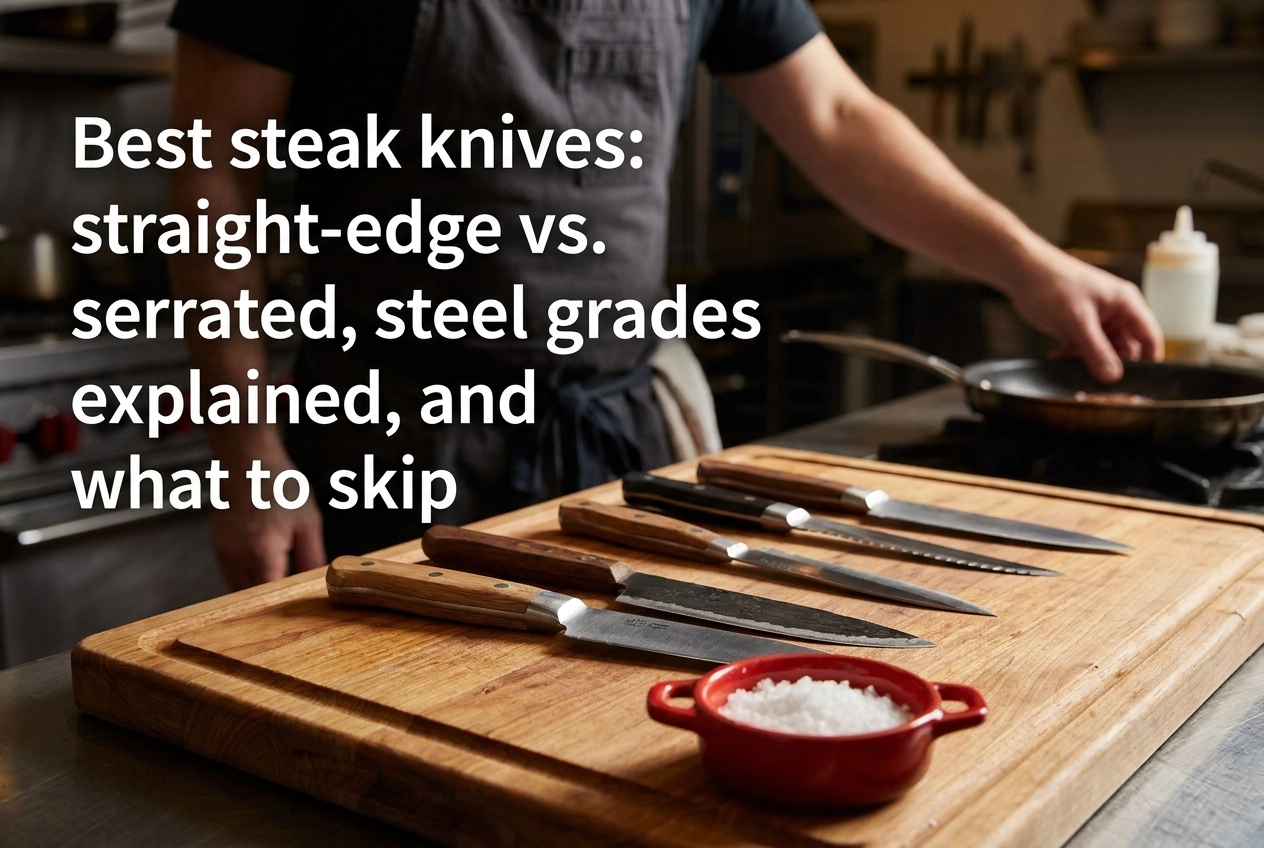
A great steak deserves more than a dull, struggling knife dragging across the plate. Yet most people never give a second thought to the tools they use at the dinner table, and that oversight quietly ruins an otherwise perfect meal. The right steak knives make a genuine difference, delivering clean, effortless cuts that preserve the texture and juices of every bite.
If you have ever stood in a kitchen store or scrolled through endless online listings feeling completely overwhelmed, you are not alone. The options seem endless, the terminology gets technical fast, and the price range stretches from suspiciously cheap to eyebrow-raising expensive.
This guide cuts through all of that confusion. You will learn the real difference between straight-edge and serrated blades, understand what steel grades actually mean for everyday performance, and find out which popular options simply are not worth your money. Whether you are outfitting your first kitchen or finally upgrading a tired old set, these picks and explanations will give you the confidence to choose steak knives that will serve you well for years to come.
The short answer if you want a recommendation now
For most households, the right steak knife is a straight-edge blade, 4 to 5 inches long, made from a named steel grade such as X50CrMoV15 or VG-10. That is the verdict. A straight edge cuts cleanly through meat without tearing fibers, and both of those steel grades hold a working edge long enough to justify the investment. X50CrMoV15 is the German workhorse of the kitchen cutlery world, landing around HRC 56 to 58, corrosion-resistant, and easy to sharpen at home. VG-10 is the Japanese alternative, running harder at HRC 60 to 61, with longer edge retention at the cost of slightly more brittleness on ceramic plates.
Serrated knives are the right call for a specific type of household: one that never sharpens, runs everything through the dishwasher, or only grills steaks a few times a year. Serrations stay functionally sharp longer without any maintenance, which is a real advantage if sharpening is not part of your routine.
One filter to apply immediately: if the packaging or product page does not name the steel grade, skip it. Unnamed “stainless steel” is a reliable sign of commodity metal that will not hold an edge and cannot be recovered once dull. Serious Eats tested 37 steak knife sets specifically to separate credible options from misleading ones, and steel transparency was a consistent dividing line.
A 6-piece set covers most households comfortably. If you are unsure about the style or steel, buying a single quality knife first is a legitimate strategy before committing to a full set.
Why steak knives are a different problem than kitchen knives
Steak knives live in a completely different world than the knives on your prep counter. Understanding why that matters will save you from buying the wrong tool.
The ceramic plate problem
Every cut a steak knife makes lands on a glazed ceramic dinner plate. That never happens in the prep kitchen, where wood and plastic cutting boards absorb impact and protect the edge. Ceramic is vitrified, dense, and unforgiving. Each stroke drags the blade laterally across that surface, creating a chipping risk that simply does not exist on a cutting board. This is not a minor difference. It is the defining mechanical reality of the dinner table environment.
That single fact shifts the optimal steel hardness range. A chef knife running at HRC 60 or above earns its keep through long edge retention during prep work. At the table, that same hardness becomes a liability. Harder steel is more brittle, and brittle steel chips faster against hard ceramic. German stainless steels at HRC 56 to 58 absorb plate contact more forgivingly than Japanese steels at HRC 60 to 61. You trade a small amount of edge retention for meaningfully better durability in the actual use environment.
The dishwasher reality
Prep knives get hand-washed. Steak knives go into the dishwasher with the rest of the tableware. That is simply how most households operate. Alkaline detergents, high heat, and thermal cycling are hard on any steel, but they hit high-HRC Japanese steels harder. The same brittleness that creates chipping risk on ceramic also makes those steels less tolerant of repeated dishwasher exposure. German stainless steel, with its higher chromium content and lower hardness, handles that environment considerably better.
Size and geometry are purpose-built for the table
A steak knife does one thing: slice through already-cooked meat in short, controlled strokes. That task requires none of the geometry packed into a chef knife. No pronounced belly curve for rocking cuts. No weight-forward balance for chopping. No 8 to 10 inches of blade for breaking down large ingredients. Most steak knives run 4 to 5 inches, and that length is deliberate. It is exactly enough to cut through a full steak in one or two strokes without the blade overhanging the plate awkwardly.
A belly curve, which is essential on a chef knife, would actually work against you at a dinner plate. The geometry optimized for prep tasks creates the wrong contact angle at the table.
A chef knife at the table is the wrong tool
Reaching for your good chef knife to cut a steak seems logical. It is sharp, well-made, and built for cutting. But it is the wrong ergonomic fit for the job. The length makes it unwieldy at a place setting. The balance point favors downward prep force rather than the shorter, more controlled strokes used to portion meat at the table. The handle geometry assumes a pinch grip used in professional prep, not the one-handed grip a diner uses. A steak knife is not a smaller chef knife. It is a different tool designed around a different set of physical constraints.
Serrated vs. straight-edge: the full trade-off
The case for straight-edge
A straight-edge steak knife slices through meat fiber rather than tearing it. The blade pushes cells apart cleanly, which means less juice escapes and each bite stays as the cook intended. That clean action also shows up in texture: a serrated knife leaves a slightly ragged cut surface, while a straight edge leaves a smooth one. For anyone who has spent time and money on a good piece of beef, that distinction matters.
The maintenance story is equally straightforward. A straight-edge steak knife uses the same sharpening equipment you already own for your chef’s knife. A whetstone, a honing rod, or a quality pull-through sharpener will restore the edge in minutes. The same habit that keeps your kitchen knives sharp keeps your steak knives sharp. No special tools, no separate workflow.
The case for serrated (and its hard limit)
Serrated edges work by gripping meat fiber and sawing through it. The individual teeth do the work even when the edge itself is not razor-sharp, which is why serrated knives feel effective straight out of a budget box set and stay that way for a surprisingly long time. That forgiveness explains their dominance in lower-cost consumer sets and restaurant supply purchasing, where replacement cost drives decisions more than cut quality does.
The problem is permanent. Once the micro-serrations wear down, standard sharpening tools cannot reach the geometry inside each gullet. A tapered ceramic or diamond rod can be worked into individual gullets tooth by tooth, but that process is slow, requires matching the rod diameter precisely to each gullet, and demands a level of patience most home cooks will not bring to a steak knife. A professional re-grind is technically possible, but the cost typically equals or exceeds what the set is worth at retail. Most households reach a dead end and replace the knives entirely.
Practical verdict by user type
If you already sharpen your kitchen knives, go straight-edge. Side-by-side testing on multiple steak cuts confirms the cut-quality advantage is real and measurable, and your existing sharpening routine covers the maintenance with no extra effort.
If knife maintenance is genuinely not something that will happen in your household, serrated is the honest recommendation. The cut quality is lower, and the dullness is eventually unrecoverable, but the knives will perform acceptably for years under rough conditions including ceramic plate contact and drawer storage. That trade-off is worth naming clearly rather than pretending it does not exist.
Steel grades that actually appear in steak knives
Not every steel that gets called “stainless” performs the same way. The grade stamped on the blade (or conspicuously absent from the product listing) tells you more about long-term value than the price tag alone.
X50CrMoV15: the German workhorse
X50CrMoV15 is the steel you will encounter most often in well-regarded German-style steak knives. It lands at HRC 56 to 58 on the Rockwell C scale and carries roughly 15% chromium, which gives it solid corrosion resistance. That chromium content is why these knives tolerate occasional dishwasher cycling better than harder Japanese alloys. The moderate hardness is a genuine practical advantage: the edge can be refreshed with a standard pull-through sharpener or a basic honing steel, tools most home cooks already own. The honest trade-off is that the edge dulls faster under heavy use than harder steels do, so more frequent honing is part of the deal.
VG-10 and VG-MAX: the Japanese premium tier
VG-10 and its close relative VG-MAX (a proprietary alloy used by KAI/Shun) hit HRC 60 to 61. That extra hardness means the edge holds its geometry longer between sharpenings, which is the main reason these steels command a higher price. The cost is brittleness. At HRC 61, the steel’s crystalline structure is dense enough that lateral stress, the kind created when a blade skids sideways across a stoneware dinner plate, can cause micro-chipping rather than the gentle edge-rolling you see with softer German alloys. Sharpening also requires whetstones or diamond abrasives rather than standard pull-through tools. If your household uses ceramic or stoneware plates regularly, that brittleness risk is real, not theoretical. Bon Appétit’s 2026 steak knife testing confirms these Japanese-steel knives remain top performers, provided users understand the handling requirements.
What HRC actually means at the dinner table
The Rockwell C number measures a steel’s resistance to indentation under a standardized load. In practical terms: higher HRC means the edge apex holds its shape longer, but the steel flexes less before it fractures. A German steel at HRC 57 will deform slightly and roll when it contacts a hard surface. A Japanese steel at HRC 61 is more likely to chip under the same stress. The “right” hardness depends on your tableware and your habits as much as on cutting performance in isolation.
AUS-10: the sensible middle ground
AUS-10 is a Japanese stainless produced by Aichi Steel that sits between X50CrMoV15 and VG-10 in both hardness (typically HRC 58 to 60) and price. It offers a meaningful step up in edge retention over German alloys without the full brittleness risk of VG-10 at HRC 61. It responds to whetstones but is more forgiving of standard sharpening tools than VG-10. For households that want better-than-German performance but use mixed ceramic and stoneware tableware, AUS-10 is a practical compromise worth knowing. Seido Knives’ steak knife guide lists it alongside VG-10 as a legitimate option at the accessible-premium level.
“Unspecified stainless steel”: the red flag you cannot ignore
If a product listing does not name the steel grade, treat that omission as a warning. Sets priced below roughly $10 per knife almost never identify the alloy. That silence consistently points to low-carbon generic stainless, often in the 420-series family, achieving HRC 52 to 54 at best. Edges at that hardness lose sharpness quickly and, more importantly, cannot be restored to a useful working edge by any standard sharpening method. The steel simply lacks the carbon content required to take and hold a fine apex. Buying a set with unspecified steel is not a budget compromise; it is a decision to eventually throw the knives away rather than maintain them.
Stamped vs. forged construction in the steak knife context
The stamped-vs-forged debate dominates a lot of knife marketing. For steak knives specifically, it matters far less than sellers want you to believe.
What stamped means
A stamped knife starts as a flat sheet of rolled steel. The blade profile is cut from that sheet, then ground, heat-treated, and sharpened. The result is typically thinner and lighter than a forged alternative, and the production cost is lower. That lower cost is why stamped construction appears across every price tier in the steak knife category, from a budget box-store set to a respectable midrange option. Thin and light are not flaws here. At the dinner table, a lighter blade is often easier to handle.
What forged means
A forged knife is shaped from a single billet of steel heated and worked under pressure. The process typically produces a thicker spine, a heavier feel, and, on many designs, a full bolster between blade and handle. Forged construction has long been positioned as the premium choice, and it usually carries a higher price. The quality gap between well-made stamped and forged knives has narrowed considerably at midrange price points, though, making construction method alone an unreliable shortcut to quality.
Why it matters less for steak knives
The stamped-vs-forged argument carries real weight for long, heavy-use prep knives where stiffness and balance affect performance across extended cutting sessions. Steak knives operate under different conditions entirely. The blade is short (4 to 5 inches), the load is light (already-cooked protein on a plate), and the session is brief. The structural advantages of forging simply do not come into play. The full bolster common on forged designs, useful on an 8-inch chef’s knife, can feel unbalanced and awkward at the dinner table, adding weight the task does not require.
The practical rule
Steel grade outweighs construction method at every price point. A well-executed stamped knife in a named grade, X50CrMoV15 or VG-10, will outperform a forged knife made in unspecified stainless. The heat treatment and the alloy composition determine edge retention and sharpening behavior. The manufacturing route is secondary. Research into forged versus stamped Japanese knives supports this: VG-10, a respected benchmark steel in the Japanese knife market, performs well in both stamped and forged form. The steel is the variable that matters.
The marketing risk
“Forged” is used loosely in product listings. It functions as a premium signal, and that creates an incentive to apply the label broadly. A listing that leads with “forged” but omits the steel grade, a Rockwell hardness figure, or any transparent origin detail is incomplete information, not reassurance. Treat it as a red flag. A named steel grade with a disclosed HRC range tells you something concrete. “Forged” alone tells you almost nothing.
Handle materials and the dishwasher question
The handle material decides how long your steak knives stay functional, not just how they look on the table.
G-10: the practical durability winner
G-10 is a fiberglass epoxy laminate, the same class of material used in industrial circuit boards. That origin matters. It is engineered to resist moisture absorption, dimensional change under heat cycling, and surface degradation. A G-10 handle will not swell, crack, or loosen at the bolster after hundreds of dishwasher runs. If longevity under real-world kitchen conditions is the priority, G-10 is the strongest choice available in consumer steak knives.
Synthetic handles: the sensible middle ground
Fibrox, POM (polyoxymethylene), and polypropylene handles all perform well in the dishwasher. They absorb negligible moisture, hold their shape under repeated heat exposure, and do not develop the surface cracking that plagues natural materials. These are the handles found on most midrange European-style sets. If the knives are going in the dishwasher regularly, a synthetic handle removes one major failure point from the equation.
Why wood handles fail in the dishwasher
Wood is the problem material here. The mechanism is straightforward: wood absorbs water during the wash cycle, then dries rapidly under heat. That expansion-contraction cycle repeats with every wash. Over time, the wood cracks along the grain, warps away from the tang, and the adhesive or riveted connection between handle and blade loosens. Real-world dishwasher damage to knife handles is well documented in consumer communities, and the outcome is often irreversible.
The blade-side problem nobody mentions enough
The handle is only half the story. High heat and alkaline detergent attack the cutting edge directly. Dishwasher detergents contain phosphate and chlorine compounds that degrade the passive chromium oxide layer protecting stainless steel. That layer is what makes stainless steel stain-resistant rather than stain-proof. Once it is compromised, oxidation accelerates at the edge. Higher-HRC steels, including most Japanese-grade blades at HRC 60 and above, have a tighter carbide grain structure that can make them more vulnerable to this micro-corrosion mechanism than the softer, more corrosion-tolerant German grades sitting at HRC 56 to 58. Knife experts consistently flag this point: the dishwasher does more harm to the edge than to any other part of the knife.
The practical rule for dishwasher households
If you will not hand-wash, match a corrosion-tolerant German steel (X50CrMoV15 or similar) with a synthetic or G-10 handle. That pairing minimizes both failure modes. Do not buy Japanese-steel steak knives if they are going in the dishwasher. And accept one non-negotiable cost: dishwasher use shortens sharpening intervals regardless of steel grade, because edge degradation is cumulative. Remove the knives as soon as the cycle ends, dry them immediately, and store them away from moisture. That single habit extends edge life meaningfully even if full hand-washing is not on the table.
Set size and the single-knife question
Six pieces is the right number for most households. A table of four leaves you two spares, which matters more than it sounds. Steak is often served in courses, guests arrive with different timing, and knives get dropped. Having two extras means you are never short at the moment it counts.
If you already own a serious chef knife or a well-maintained santoku, you may be asking whether a dedicated steak knife set is really necessary. The honest answer is yes. The problem explained in earlier sections still applies: your prep knives were designed for a cutting board, not for contact with ceramic or stoneware at a dinner table. The edge geometry is different, the handle ergonomics are different, and the blade weight is calibrated for a different task. A prep knife used at the table is the wrong tool for the job, regardless of how sharp it is.
Try one knife before you commit to six
Buying a single knife first is a legitimate strategy, not a compromise. Handle fit is personal. Blade weight preference varies. And edge behavior on your specific dinnerware, whether that is porcelain, stoneware, or a coated ceramic, is something you cannot fully predict from a spec sheet. Order one knife, use it for a few dinners, and then order the set. Most manufacturers sell open stock for exactly this reason.
Matching set size to your household
Four-piece sets make sense for smaller households or those who rarely cook for guests. The math is straightforward: the same total spend spread across four knives instead of six buys a meaningfully higher per-knife quality. That trade-off is worth making if the table rarely seats more than four.
Resist the pull of eight- and twelve-piece sets unless you regularly entertain at that scale. Larger sets almost always dilute per-knife quality to stay within a price ceiling. The manufacturer spreads the same budget thinner, and the result is hardware that looks impressive in the box but underperforms in use. Knife-buying guidance from enthusiast communities consistently reflects this: buyers who care about performance lean toward smaller, focused sets rather than large block collections.
Budget bands and where diminishing returns begin
Per-knife pricing is the only metric that matters here. Set sizes across this category range from four to twelve pieces, so a $60 set and a $120 set can represent identical per-knife costs depending on how many blades are included. Always divide the set price by the knife count before comparing.
Under $50 for a full set
At this price, you are almost always looking at stamped blades in unspecified stainless steel, with serrated edges as the default configuration. The serration exists partly to hide the fact that the underlying steel cannot hold a fine straight edge for long. These knives can feel reasonably sharp out of the box, but the edge deteriorates quickly because the steel is soft, typically something close to 420-grade stainless, which runs toward the lower end of the hardness range. Once dull, a serrated budget blade is effectively finished. You cannot restore it at home with a standard whetstone, and professional sharpening on serrations costs more than the knife is worth. Treat this tier as a short-term placeholder, not a long-term kitchen investment.
Midrange, roughly $15 to $30 per knife
This is the functional sweet spot for most households. Named steel grades appear consistently at this price point. German X50CrMoV15 is the most common, and it hits a practical balance: corrosion-resistant, tough enough to handle occasional contact with ceramic plates, and fully resharpenable at home with a whetstone or a quality pull-through system. Both forged and well-executed stamped options exist here, and both are worth considering. The construction method matters less than the steel specification and the edge geometry.
Premium, above $30 per knife
Japanese steels such as VG-10 and VG-MAX appear reliably at this level. They run harder, typically HRC 60 to 61 versus HRC 56 to 58 for German steels, and they hold a sharper edge for longer between sharpenings. The trade-off is real: harder steel is more brittle, and a hard plate is a genuine hazard. For households that hand-wash and touch up edges regularly, the premium is justified. For households that run knives through the dishwasher and cut on porcelain plates, it is not.
The honest ceiling
Above the premium band, additional spend goes toward handle materials, fit and finish, and brand aesthetics. The cutting performance at a dinner table does not improve in any meaningful way. You are buying a nicer object, which is a legitimate reason to spend more, but it is not a performance reason. Know which one you are paying for.
The picks
Best overall straight-edge pick: midrange X50CrMoV15 set
Steel: X50CrMoV15 | Edge: Straight | Blade length: 4.5 inches | Handle: Full-tang synthetic or stabilized wood | Budget band: Midrange
X50CrMoV15 is a German stainless alloy that runs at HRC 56 to 58. That hardness range is not the sharpest available, but it is deliberately practical. The steel resists chipping when a blade tip contacts a ceramic plate, tolerates the moisture and acidic marinades that live on a dinner table, and responds to a standard whetstone or pull-through sharpener without specialized equipment. For a steak knife that will see weekly use across years, that combination outperforms harder, more brittle alternatives in real-world conditions.
A six-piece set in this steel and configuration sits comfortably in the midrange band. Per-knife cost lands in a range that rewards you with honest durability rather than packaging theater. Full-tang construction, where the steel runs the full length of the handle, adds balance and structural longevity that a partial-tang or welded handle cannot match over time.
Who this is for: Home cooks who want a set they can maintain themselves, households that use steak knives more than twice a week, and anyone who prefers a clean cut over a serrated tear on chicken, pork, and dense vegetables as well as beef. Who should skip it: Cooks who genuinely want the longest possible edge retention and are willing to accept brittleness risk and strict maintenance rules. That group should read the Japanese-steel pick below.
Best for low-maintenance households: serrated set in 420J2 or 1.4116 stainless
Steel: 420J2 or 1.4116 stainless | Edge: Serrated (micro-serrated or full serration) | Blade length: 4 to 5 inches | Handle: Fibrox or injected synthetic | Budget band: Midrange, lower end
A serrated steak knife is the honest choice for households that do not sharpen their knives at all. The serrated edge bites through surface crust and meat fiber without needing a refined apex, so it stays functionally adequate longer between any kind of maintenance. Synthetic handles, particularly Fibrox-style polypropylene composites, hold up through heavy use and occasional dishwasher cycles better than most wood options. This is a practical tool for a practical household.
The trade-off is real and should not be softened. Once a serrated edge dulls past a functional threshold, home sharpening is not realistically possible without a specialized rod or professional equipment. Most households in this category will eventually replace the set rather than sharpen it. Buying in the lower midrange band acknowledges that reality honestly. Spending premium money on a serrated set is rarely justified unless you have a professional sharpening service available to you regularly.
Who this is for: Households with four or more people eating together regularly, anyone who finds knife maintenance genuinely unappealing, and buyers who want a durable table knife that handles the full spectrum of weeknight proteins without any upkeep. Who should skip it: Anyone who cares about long-term ownership cost or wants a knife that still performs the same way in ten years as it does on day one. A straight-edge set with a basic sharpener is the better lifetime investment.
Best for the serious home cook: Japanese-steel straight-edge set (VG-10 or VG-MAX)
Steel: VG-10 or VG-MAX | Edge: Straight | Blade length: 4.5 to 5 inches | Handle: Pakkawood or G-10 composite | Budget band: Premium
Japanese stainless alloys like VG-10 and VG-MAX run at HRC 60 to 61. The higher hardness produces a thinner, sharper edge that holds its geometry longer between sharpening sessions compared to German steel. On a well-rested steak, the difference is perceptible. The knife passes through muscle fiber with noticeably less resistance, and a well-cut bite holds more of its juice than a blade with a thicker edge bevel.
The caveats are not optional reading. At HRC 60 to 61, the steel is meaningfully more brittle than X50CrMoV15. Contact with a ceramic dinner plate, even glancing contact, creates micro-chips along the edge that accumulate over time. These knives require stone plates or dedicated Japanese water stones to sharpen correctly, not a basic pull-through sharpener. They are incompatible with the dishwasher. Handle materials at this tier, typically Pakkawood or G-10, are built to last, but the blade itself demands more attention than most casual users are prepared to give it. Tested roundups published in 2026 consistently identify Japanese-steel sets at this hardness level as strong performers and strong splurge candidates, with the maintenance requirements stated clearly alongside the performance praise.
Who this is for: Cooks who already maintain a Japanese chef knife, households with ceramic-free dinnerware, and buyers who want the cleanest possible cut and will invest in proper sharpening tools. Who should skip it: Anyone eating off everyday ceramic plates, households with kids who use steak knives unsupervised, or buyers who want zero-maintenance table tools.
Best budget pick worth buying: under-$50 set with a named steel grade
Steel: 3Cr13 or 3Cr14 stainless | Edge: Straight or serrated | Blade length: 4 to 4.5 inches | Handle: Molded synthetic | Budget band: Under $50 for a six-piece set
The under-$50 tier is honest if you buy the right thing and dishonest if you buy the wrong one. The right thing is a set that names its steel grade on the product page or packaging. 3Cr13 and 3Cr14 are Chinese stainless alloys that run softer than German or Japanese steel, typically HRC 52 to 54. Edge retention is limited compared to anything higher up the price band. The steel dulls faster and sharpens more easily because of it. That is a fair trade at this price point.
What this budget can deliver: a functionally sharp knife at purchase, a named alloy you can research, and a handle sturdy enough for regular table use. What it cannot deliver: the edge longevity of X50CrMoV15, resistance to repeated contact with hard surfaces, or the long-term satisfaction of a midrange set maintained correctly. If the per-knife cost drops below roughly $8 to $10 and the steel grade is absent from all product documentation, walk away. That omission is the clearest signal in the category that quality was not the priority. Food and Wine’s coverage of steak knife selection reinforces this point: what you cannot identify, you cannot evaluate.
Who this is for: First apartment buyers, supplementary sets for outdoor entertaining, and households that want functional table knives without the commitment of a midrange purchase. Who should skip it: Anyone who wants to own the same set in five years. A small step up to the midrange band, even buying a four-piece rather than six-piece set, almost always represents better value over time.
What to skip and why
Three category traps account for most bad steak knife purchases.
Unspecified steel sets are the most common. If a product listing describes the blade only as “high-carbon stainless steel” or “premium German steel” without naming a grade, the omission is intentional. Manufacturers who use X50CrMoV15, VG-10, or any other verifiable alloy say so because it is a selling point. The absence of a designation almost always means the steel is soft, unresharpenable, and sourced for cost rather than performance.
Misleading “forged” claims distort purchasing decisions across the entry-level market. As covered earlier in this guide, the forging process matters far less for steak knives than it does for chef knives. A well-made stamped blade in X50CrMoV15 outperforms a “forged” blade in unspecified steel. When marketing leads with construction method rather than steel grade, that sequencing tells you something.
Oversized gift sets are the third trap. A twelve-piece set at a given price point allocates less budget per knife than a six-piece set at the same price. The added pieces typically come with a block, a presentation case, or matching serveware. None of that improves the knife. The principle here is one that experienced cooks cite consistently: four quality knives beat ten mediocre ones at any comparable budget. A six-piece set is the functional ceiling for most households. Anything beyond that is packaging.
Maintenance cadence for straight-edge steak knives
Straight-edge steak knives used two to three times per week sit in a comfortable maintenance window. Under normal household conditions, honing every two to three months keeps the edge performing well between sessions. A full sharpening once or twice a year is sufficient to restore geometry when the edge has genuinely lost its bite. These figures are a reasoned application of general knife care guidance rather than a steak-knife-specific benchmark, but they hold up in practice for the typical home dining pattern.
Honing vs. sharpening: the distinction that drives the whole cadence
Honing and sharpening are not the same action. Honing realigns the edge without removing steel. Over time, the thin apex of a blade folds microscopically to one side under the force of repeated cuts against a ceramic plate or cutting board. A honing rod straightens that apex back into alignment and restores performance without shortening the blade’s life. Sharpening removes steel entirely to form a fresh edge, which is the right call when honing no longer brings the blade back. For steak knives specifically, reach for a smooth honing rod, not a grooved one. Grooved rods are designed for thicker-spined prep knives and act more abrasively than the job requires. A smooth rod realigns a steak knife’s finer bevel without unnecessary material removal.
How the dishwasher compresses this timeline
Hand-washing keeps the cadence above intact. Regular dishwasher cycling does not. High heat, harsh detergent, and the mechanical jostling of a full cycle accelerate edge degradation and attack handle materials simultaneously. A knife that needs one full sharpening per year under hand-wash conditions will likely need two or more with regular dishwasher use. That is not a cited statistic; it is the logical consequence of the documented damage mechanisms. Proper steak knife care consistently points to dishwasher avoidance as the single highest-impact habit change available to most households.
The honest reality for serrated knives
Serrated steak knives operate on different maintenance logic entirely. A tapered ceramic rod can extend edge life by touching up individual serration peaks, and it is worth trying before discarding a set. However, full restoration of serrated micro-teeth at home is difficult, time-consuming, and unlikely to return a badly worn blade to its original performance. The practical endpoint for most households is planned replacement rather than home restoration. Buy a serrated set knowing that is the arrangement.
Where to go next
This section covers the when and why of steak knife maintenance. For the full technique, including honing angle, rod selection, and whetstone sharpening at the correct bevel, see the Steel Snob sharpening and honing guides. Those articles are built as step-by-step instruction rather than use-case summaries, so they are the right resource once you know your knife needs work. A comprehensive guide to steak knife maintenance and care can also provide useful supplementary context on the mechanics of edge upkeep.
What to take away from this
Three steps. That is the whole framework.
First, audit your maintenance habits honestly before you look at a single product listing. Second, match your steel grade to those habits: named grades like X50CrMoV15, VG-10, or AUS-10 give you a real performance anchor; unnamed “premium stainless” gives you nothing. Third, filter by set size and budget band once the first two decisions are made.
The single filter that overrides everything else: if the steel grade is not named, do not buy the knife. This rule holds at every price point. A midrange set with a verified alloy is a better purchase than a premium-priced set with vague marketing language.
On edge type, the verdict is conditional but clear. Straight-edge if you already sharpen anything else in your kitchen. Serrated only if maintenance is genuinely off the table, because when serrated teeth finally dull, recovery requires tools most home cooks do not own.
Steel Snob carries no affiliate links and holds no manufacturer relationships. Every recommendation here follows the same documented testing protocol regardless of who is selling the knife. The pick does not change because a brand spends more on marketing.
Conclusion
Choosing the right steak knives does not have to be complicated. Keep these essentials in mind: straight-edge blades deliver cleaner cuts and stay sharper longer with proper care, while serrated edges require less maintenance but sacrifice precision. Steel grade matters more than brand name, so prioritize high-carbon stainless steel for lasting performance. And when something seems too cheap to be true, it almost always is.
Now that you know what separates a genuinely great knife from an overpriced disappointment, you are ready to make a confident, informed decision. Browse our top picks below, compare them against your budget and cooking habits, and choose a set that will actually elevate your meals.
A perfect steak deserves a knife worthy of it. Invest in the right tools today, and every dinner at your table becomes noticeably better.