The Best Boot Knives for 2026
A boot knife is a compact, fixed-blade knife carried low on the leg or ankle for backup and last-ditch defense, and the best one is the one you can conceal comfortably, deploy fast, and legally carry where you live. This guide ranks eight real boot knives sold in 2026 on the things that actually matter when the blade is strapped to your calf: sheath retention, blade profile, weight, and steel.
Every knife on this list was assessed on manufacturer specifications, independent tests and owner reports. I am not going to tell you a cheap dagger is a lifetime heirloom or that a double edge makes you tactical. I am going to tell you which hold an edge, which sheaths keep the knife when you run, and which will get you in trouble if you carry them in the wrong state.
Boot Knives Compared at a Glance
| Model | Edge | Blade Length | Steel | Best For | Verdict |
|---|---|---|---|---|---|
| Gerber Ghoststrike | Single | 3.3 in | 420HC | Modular carry, first boot knife | Best all-around |
| Cold Steel Secret Edge | Single | 3.5 in | AUS-8A | Light, legal-friendly single edge | Best value carry |
| Kershaw Secret Agent | Single | 4.4 in | 8Cr13MoV | Longer reach on a budget | Best budget size |
| CRKT Sting | Double | 3.2 in | 1050 carbon | Rugged one-piece durability | Toughest build |
| Benchmade SOCP Dagger | Double | 3.22 in | 440C | Fast deployment, finger-ring draw | Best deployment |
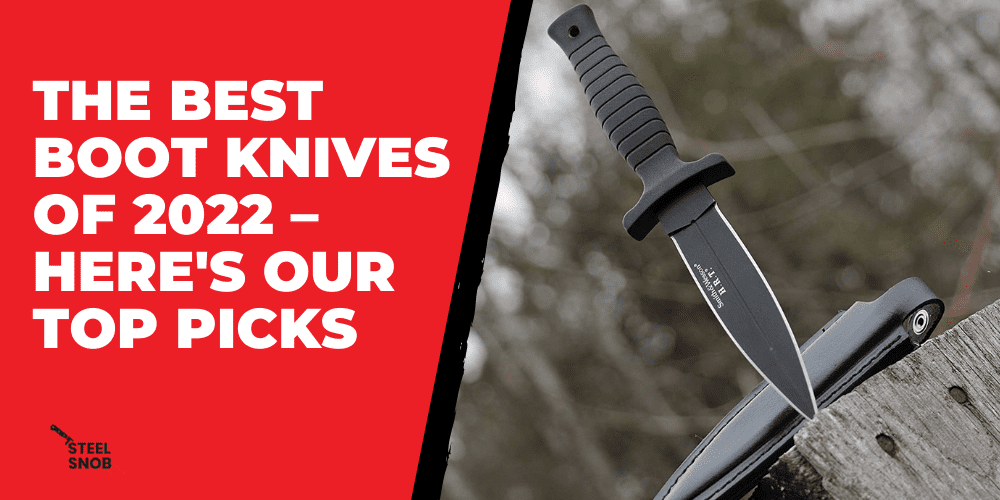
| Smith & Wesson H.R.T. SWHRT9B | Double | 3.3 in | 7Cr17MoV | Try-before-you-invest dagger | Cheapest entry |
| Benchmade Mini SOCP | Double | 2.22 in | 440C | Deep concealment, minimal print | Smallest carry |
| Benchmade 125BK Azeria | Single | 2.9 in | N680 | Duty-belt backup, corrosion resistance | Best backup blade |
Single edge versus double edge is not a small detail. A double-edged dagger is often classed legally as a dagger or dirk, and those are restricted or banned in more states than single-edged knives, so read the legality section before you buy a double edge.
The Boot Knives, Reviewed
Gerber Ghoststrike (Best All-Around)
The Ghoststrike is the knife we recommend to anyone buying their first boot knife. The 3.3-inch drop-point blade is 420HC with a black ceramic coating, and the modular sheath is the real reason to buy it. The kit version ships with an ankle wrap plus belt and MOLLE hardware, so one knife covers boot, ankle, and belt carry without buying anything else. The diamond-texture grip stays locked in a wet hand, and retention is a firm friction click that will not shed the knife when you move.
Pros: Genuinely modular sheath, US made, grippy handle, single edge keeps it legal in more places.
Cons: 420HC is a mid-tier steel that needs touching up more often than premium stainless. The ankle wrap runs warm in summer.
Who it is for: Anyone who wants one knife that carries several ways and does not overthink steel.
Cold Steel Secret Edge (Best Value Single Edge)
At 2.4 ounces bare, the Secret Edge is one of the lightest fixed blades you can hang off an ankle and forget about. The 3.5-inch AUS-8A blade takes a keen edge and the Griv-Ex handle is slim enough not to print through a pant leg. The Secure-Ex sheath holds tight and rides flat. It is sold as a neck knife, but the sheath and profile make it an excellent single-edge boot carry that stays on the friendly side of most dagger laws.
Pros: Very light, slim print, AUS-8A holds an edge well for the price, versatile carry.
Cons: The thin handle gives up some grip security in a hard forward grip. Sheath clip is better suited to neck or waistband than deep boot carry.
Who it is for: Minimalists who want a legal single edge that disappears under clothing.
Kershaw Secret Agent (Best Budget Size)
The Secret Agent gives you a 4.4-inch blade for less than most 3-inch competitors. The 8Cr13MoV steel wears a non-reflective black-oxide finish, and the glass-filled nylon handle has a rubber overmold that grips well. The molded sheath is the standout at this price: it clips to a belt and has slots for leg straps, so it carries as a boot knife or a belt knife. That extra reach matters if you want a defensive blade with more presence than a 3-inch dagger.
Pros: Long blade for the money, dual-carry sheath, comfortable overmolded grip, single edge.
Cons: 8Cr13MoV is basic and rewards frequent stropping. The length makes it harder to conceal in low-cut footwear.
Who it is for: Buyers who want maximum blade length and carry options without spending much.
CRKT Sting (Toughest Build)
The Sting is one continuous piece of hot-forged 1050 carbon steel, blade and handle both, powder-coated against rust. There is no handle scale to loosen and no joint to fail, which makes it about as durable as a boot knife gets. The double-edged spear point is a defensive shape, and the tradeoff is that carbon steel demands wipe-downs and light oil or it will patina and rust. The one-piece build also means a harder bare grip, so a lanyard or wrap helps.
Pros: Near-indestructible one-piece build, aggressive spear point, holds a tough edge.
Cons: Carbon steel needs maintenance, hard bare grip, double edge triggers dagger restrictions in many states.
Who it is for: People who prioritize durability and do not mind steel upkeep.
Benchmade SOCP Dagger (Best Deployment)
The SOCP was designed by Greg Thompson for the Army Special Operations Combatives Program, and everything about it serves fast deployment. The 3.22-inch skeletonized 440C blade weighs almost nothing, and the signature finger ring lets you draw and index the knife by feel without seeing it. The ambidextrous sheath clips to a belt, waistband, or gear and retains hard. It is a purpose-built defensive tool, not a utility knife, and it excels at the one job it was built for.
Pros: Fastest, most repeatable draw here, extremely light, US made, ambidextrous retention.
Cons: Double-edged dagger with real legal exposure, skeleton grip is thin, no utility use.
Who it is for: Trained carriers who want the fastest possible defensive deployment.
Smith & Wesson H.R.T. SWHRT9B (Cheapest Entry)
The H.R.T. is the knife to buy when you want to learn whether boot carry fits your life before spending real money. It is a double-edged spear-point dagger in 7Cr17MoV with a rubber handle and a molded sheath that includes leg straps out of the box. The steel is soft and the fit and finish are what you expect at the price, but it holds a working edge and the sheath actually retains. Treat it as a trial piece, not a lifetime carry.
Pros: Cheapest way in, includes leg straps, light, functional retention.
Cons: Soft steel dulls fast, budget fit and finish, double-edge legal issues apply.
Who it is for: First-time buyers testing the concept, or anyone who wants a knife they will not cry over losing.
Benchmade Mini SOCP (Smallest Carry)
The Mini SOCP shrinks the full SOCP to a 2.22-inch 440C blade for the deepest concealment on this list. It keeps the finger ring and the fast draw but prints almost nothing, which makes it a strong choice for low-cut shoes, dress carry, or a secondary blade when a full-size boot knife is too much. The short blade is the obvious limit: it is a very close-range tool with little reach.
Pros: Minimal print, keeps the fast finger-ring draw, US-made 440C, very light.
Cons: Short reach, double edge, purely defensive with no utility.
Who it is for: Deep-concealment carriers and anyone layering a small backup blade.
Benchmade 125BK Azeria (Best Backup Blade)
The Azeria is the outlier here and the one to choose as a duty-style backup. It is a single-edged 2.9-inch wharncliffe in N680, a nitrogen-alloyed steel chosen for corrosion resistance, which matters when the knife lives against sweaty skin all day. The angled wharncliffe gives a strong tip and a straight cutting edge, and the Grivory handle is grippy. As a single edge, it dodges most of the dagger-law problems that dog the double-edged options above.
Pros: Excellent corrosion resistance, strong tip, single edge for broader legality, quality build.
Cons: Short blade, wharncliffe shape is less of a classic defensive dagger, harder to find as stock varies.
Who it is for: Duty carriers and anyone who wants a rust-resistant single-edge backup.
What Makes a Good Boot Knife
Most boot-knife failures are not about the blade. They are about the three things below.
Sheath Retention
The sheath is more important than the knife. A boot knife rides through walking, running, sitting, and driving, and a sheath that lets go is worse than no knife because you will not notice it is gone until you need it. Look for positive retention: a friction click, a molded pressure fit, or a strap. Before you carry, invert the sheathed knife and shake it hard, and if it moves or drops, fix the retention first. A good boot knife also draws cleanly with one hand, because the other hand is often busy when you need the blade.
Size and Weight
Concealment and comfort come from a slim profile and low weight, not from a long blade. A 3 to 3.5-inch blade under about 4 ounces sits against a calf or ankle without printing or flopping. Longer blades reach farther but print more and are harder to draw from a low-cut shoe. Handle shape matters as much as blade length: a slim handle conceals, but you still need enough grip to hold the knife securely in a hard forward grip, so check that the handle fills your hand and has real texture.
Legality
This is not legal advice, and carry laws vary widely by state, county, and city. Boot-knife legality turns on three things: concealment, blade length, and whether the blade is double edged. Concealed carry of a fixed blade is restricted in many places even when open carry is fine. Blade-length limits differ state to state, so a knife legal in one is illegal one border over. The biggest trap is the double edge: double-edged blades are frequently classified as daggers, dirks, or stilettos, which are banned or heavily restricted in many states, which is why several of the double-edged knives above carry more legal risk than the single-edged ones. Read your state and local statutes yourself, and if you are unsure, choose a single edge and keep the blade short. See our knife laws overview for a starting point, then confirm your own jurisdiction.
How We Evaluate
Every knife on this list was judged on manufacturer specifications, independent tests and owner reports, not on a spec sheet alone. Here is what we score.
- Retention: Whether the sheath holds the knife upside down and through a day of walking, sitting, and stairs without rattling loose, as owners report it.
- Draw and deployment: How cleanly the knife draws one-handed from boot and ankle positions, and whether it indexes correctly by feel.
- Edge and steel: Out-of-box sharpness, edge retention through repeated cutting, and how the steel handles sweat and moisture over time.
- Concealment: Print and comfort under normal pants and in different footwear, because a knife you leave at home protects no one.
- Build integrity: Handle security, tang construction, and finish durability under real carry.
Products here are named on merit and nothing else.
Frequently Asked Questions
Is it legal to carry a concealed boot knife?
It depends entirely on your state and local law. Many places restrict concealed fixed blades, limit blade length, or ban double-edged daggers outright, while others are permissive. Concealment itself is often the trigger for restrictions. Check your own jurisdiction before carrying, and treat this article as information, not legal advice.
Single edge or double edge, which should I pick?
For most carriers, single edge. A single edge covers defensive use, gives you a spine for thumb pressure, and stays legal in more places. A double edge deploys and penetrates well but is frequently classified as a restricted dagger, and it offers no utility function. Choose double edge only if it is legal where you are and defense is the sole purpose.
Can I fly with a boot knife?
No. Fixed-blade knives are prohibited in carry-on luggage. You may transport a boot knife in checked baggage if it is securely sheathed and permitted at your destination, but never in the cabin and never through a checkpoint.
What blade length should a boot knife be?
Three to three and a half inches is the sweet spot for most people: long enough to be effective, short enough to conceal and to stay under common length limits. Longer blades add reach but print more and are harder to draw from low footwear. Always check your local length limit first.
What steel is best for a boot knife?
Corrosion resistance matters more than raw edge retention because a boot knife lives against sweat. Stainless steels like N680, AUS-8A, and 440C resist rust well. Carbon steels like 1050 are tough but need wiping and oiling. A mid-tier stainless you actually maintain beats a premium steel you neglect.
How should I carry and maintain a boot knife?
Mount the sheath so the handle is accessible with a natural reach, and verify retention with a shake test before every carry. Wipe the blade down after sweaty days, keep a light film of oil on carbon steel, and touch up the edge before it goes dull rather than after. Inspect the sheath periodically for wear that could reduce retention.
The Bottom Line
For most people, the Gerber Ghoststrike is the right first boot knife: a legal single edge, a modular sheath, and a price that does not sting. If you want the lightest legal carry, the Cold Steel Secret Edge disappears against an ankle. If defense is the entire point and you have confirmed your local law allows it, the Benchmade SOCP deploys faster than anything else here. Whatever you choose, the sheath keeps the knife on you and the law keeps you out of trouble, so weigh both before the blade.
For more on carrying fixed blades and everyday cutting tools, see our guides to the best fixed blade knife, the best EDC knife, and the best survival knife.
About this guide
Steel Snob Editorial
Researched from manufacturer specifications, independent tests and owner reports, and edited for accuracy by the Steel Snob team.