
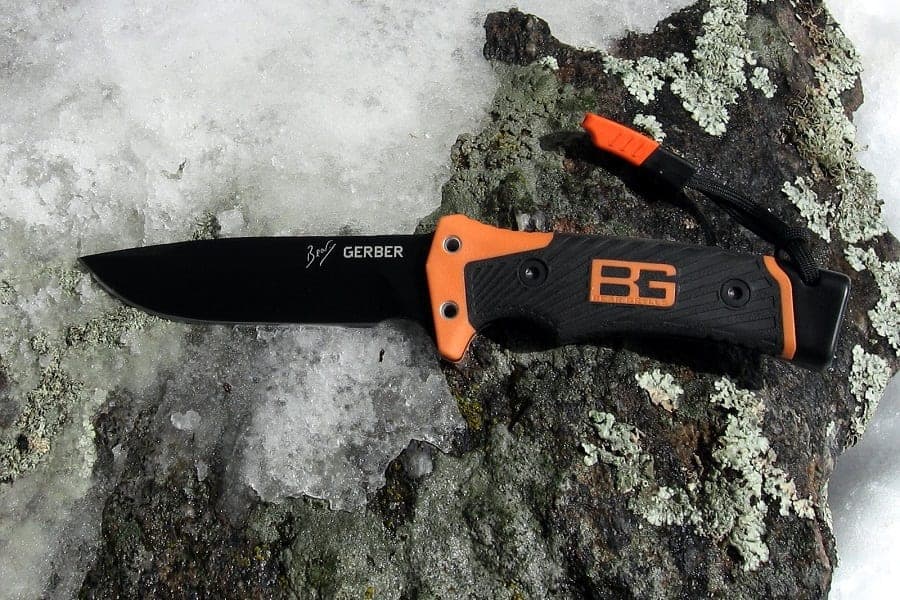
If you searched for the best survival knife, you want one fixed-blade tool that will not fail when you are cold, wet, tired, and a long way from help. This guide covers the survival knives with the strongest record for batoning, feathersticking, and general abuse, and it explains the construction details that separate a knife you can trust from one that looks the part.
This guide looks at survival knives with an eye on steel and heat treatment rather than marketing. Below you will find a comparison table, short reviews of seven current knives, a buyer’s section on the details that actually matter, our evaluation method, and answers to common questions.
Survival Knife Comparison Table (2026)
| Model | Steel | Blade Length | Tang | Grind | Best For | Verdict |
|---|---|---|---|---|---|---|
| ESEE-6 | 1095 carbon | 6.5 in | Full | Flat saber | Hard use, batoning | The workhorse benchmark |
| Morakniv Garberg | 14C28N stainless | 4.3 in | Full | Scandi | Bushcraft, value | Best all-round value |
| Ka-Bar Becker BK2 Campanion | 1095 Cro-Van | 5.25 in | Full | Flat saber | Chopping, prying | Overbuilt tank |
| Fallkniven F1 | Laminated VG10 | 3.8 in | Full | Convex | Cold weather, corrosion resistance | Refined and tough |
| Benchmade Bushcrafter 162 | CPM-S30V stainless | 4.4 in | Full | Flat/convex | Edge retention, fine work | Premium bushcraft |
| TOPS BOB Fieldcraft | 1095 carbon | 4.6 in | Full | Scandi | Fire and feathersticks | Thoughtful survival design |
| Gerber StrongArm | 420HC stainless | 4.8 in | Full | Flat | Budget hard use, tactical | Best budget full tang |
Every knife on this list is a full-tang fixed blade. That is not a coincidence. For a true survival tool, it is the baseline I will not compromise on, and the buyer’s section below explains why.
The Best Survival Knives Reviewed
ESEE-6: The Workhorse Benchmark
The ESEE-6 is the knife we recommend when people ask what a hard-use survival blade should feel like. It is 1095 carbon steel, full tang, with a flat saber grind and a thick spine that shrugs off batoning through seasoned hardwood. The 1095 runs on the softer side of the hardness range, which means it takes a keen edge quickly in the field and rarely chips, even when you hit a hidden knot. The trade is corrosion: bare 1095 will rust if you leave it wet, so it lives on a light coat of oil.
Pros: Genuinely tough, easy to sharpen with a stone, excellent warranty backing, comfortable Micarta scales.
Cons: Heavy for its length, powder coat wears on the flats, carbon steel demands maintenance.
Who it is for: The person who wants one knife to baton, chop, and process wood for a decade and does not mind wiping it down at the end of the day.
Morakniv Garberg: Best All-Round Value
Mora built its reputation on partial-tang bushcraft knives, but the Garberg is their full-tang answer, and it changes the conversation. You get 14C28N stainless, a true Scandi grind, and a spine ground square enough to throw sparks off a ferro rod. The Scandi grind is the reason woodcarvers love it: it registers on the wood, cuts feathersticks cleanly, and is trivial to maintain because you lay the whole bevel flat on the stone.
Pros: Outstanding value, excellent stainless edge holding for the class, square spine for fire-starting, sharpens fast.
Cons: Shorter blade limits chopping, the polymer sheath is bulky, not built for heavy prying.
Who it is for: Bushcrafters and beginners who want a do-everything camp knife that stays sharp and does not rust.
Ka-Bar Becker BK2 Campanion: The Overbuilt Tank
The BK2 is almost comically thick, and that is the point. This is a 1095 Cro-Van full-tang blade a quarter-inch thick that you can baton, pry, and dig with when a lesser knife would fold. Cro-Van adds a touch of chromium and vanadium to plain 1095, giving slightly better corrosion resistance and toughness. It is not a slicer, but it is the knife to want if your task list is closer to demolition than carving.
Pros: Nearly indestructible, superb for splitting and chopping, backed by a strong warranty, affordable.
Cons: Heavy, thick geometry cuts poorly at fine tasks, stock grip scales are basic.
Who it is for: Anyone who abuses knives and wants one that abuses back. Truck kit, base camp, and heavy wood processing.
Fallkniven F1: Refined and Tough
The F1 is the Swedish military pilot survival knife, and it earns that role. The blade is laminated VG10, a hard stainless core sandwiched between softer stainless flanks, ground to a convex edge. That construction gives you the edge retention of a hard steel with the shock resistance of a soft one, so it takes a beating without becoming brittle in the cold. The convex grind glides through material and strengthens the edge for chopping small wood.
Pros: Excellent corrosion resistance, tough laminated core, superb cold-weather performance, compact and carryable.
Cons: Convex edge takes practice to maintain, shorter blade, premium price for the size.
Who it is for: Cold-climate and maritime users who need a stainless knife that will not let them down and appreciate refined geometry.
Benchmade Bushcrafter 162: Premium Bushcraft
If the Garberg is value bushcraft, the Bushcrafter 162 is the premium end. It runs CPM-S30V, a powder-metallurgy stainless that holds an edge far longer than the budget stainlesses, with a full tang and a grind that blends flat and convex for clean slicing. The G10 handle fills the hand well and the spine is finished for ferro-rod use. This is a knife for someone who values a long-lasting edge and fine control over brute chopping.
Pros: Exceptional edge retention, excellent ergonomics, strong corrosion resistance, precise cutting.
Cons: S30V is harder to resharpen in the field, premium price, not a chopper.
Who it is for: Experienced hands who want top-tier steel for carving, food prep, and detailed camp work and can maintain a harder edge.
TOPS BOB Fieldcraft: Thoughtful Survival Design
The Brothers of Bushcraft knife was designed by people who actually teach survival, and it shows. It is 1095 carbon, full tang, with a Scandi-style grind, a notched thumb ramp, a bow-drill divot in the handle for friction fire, and a squared spine for scraping tinder and striking a ferro rod. Nothing on it is decoration. Every feature exists to help you build a fire and process wood when it counts.
Pros: Purpose-built survival features, tough carbon steel, comfortable Micarta, holds a working edge well.
Cons: Carbon steel needs care, thicker coating, mid-length blade limits heavy chopping.
Who it is for: Fire-and-shelter minded users who want a knife designed around the survival skill set rather than tactical looks.
Gerber StrongArm: Best Budget Full Tang
The StrongArm is proof you do not need to spend a fortune for a legitimate full-tang fixed blade. It uses 420HC stainless with a coating, a flat grind, and a rubberized diamond-texture handle that stays put in wet hands. The 420HC is a modest steel, but with Gerber’s heat treatment it holds a usable edge and resists rust well, and the modular sheath system is genuinely good for belt or MOLLE carry.
Pros: Affordable, full tang, secure grip, versatile sheath, corrosion resistant.
Cons: 420HC edge retention is average, less refined geometry, coating wears with use.
Who it is for: First-time buyers and anyone building an emergency kit who wants a dependable full-tang knife without overspending.
How to Choose a Survival Knife: The Details That Matter
Full Tang Is Not Negotiable
The tang is the part of the steel that extends back into the handle. A full tang runs the entire length and width of the grip, so the blade and handle are effectively one continuous piece of steel. That is what you want in a survival knife, because the failure point on cheaper knives is the joint where a partial or rat-tail tang meets the handle. Under batoning or prying loads, a partial tang can loosen, wobble, or snap, and a broken knife in the field is worse than no knife. Every recommendation above is full tang for exactly this reason.
Fixed Blade vs Folding
A folding knife has a pivot, and a pivot is a moving part that can collect grit, work loose, or close on your fingers under hard use. For survival, a fixed blade is stronger, easier to clean, and always ready. Folders are excellent everyday carry tools and fine as a backup, but they should not be your primary survival knife. When the task is batoning firewood or prying, you want no joint between edge and handle.
Steel: Carbon vs Stainless
This is the trade every buyer faces. Carbon steels like 1095 and 1095 Cro-Van are tough, easy to sharpen on a simple stone, and forgiving under impact, which is why so many hard-use knives use them. Their weakness is corrosion: leave them wet and they rust, so they need oil and attention. Stainless steels like 14C28N, VG10, S30V, and 420HC resist rust and are lower maintenance, which matters in wet or coastal environments. The higher-end stainlesses hold an edge longer but can be harder to resharpen in the field. There is no universally best steel. Choose carbon if you value toughness and field sharpening; choose stainless if you value corrosion resistance and low upkeep.
Blade Length and Grind
For a general survival knife, a blade between four and six inches is the sweet spot. Shorter blades excel at carving and control; longer blades chop better but lose finesse. Under four inches struggles to baton; much over six inches becomes unwieldy for detail work. On grind, a Scandi is easy to maintain and superb for woodwork, a flat or saber grind balances slicing and strength for general use, and a convex grind is the toughest for chopping while still cutting well. A drop-point or clip-point tip with a squared spine for ferro-rod striking rounds out a practical survival blade.
How We Evaluate
I do not score knives from a spec sheet alone. Each blade is judged on manufacturer specifications, independent tests and owner reports about how it performs when carried and used the way it is meant to be used: spine and tang strength when batoning seasoned hardwood, grind geometry and edge keenness when cutting feathersticks, and whether the spine is ground square enough to strike a ferro rod. I look at edge retention after wood processing and how the steel behaves on a stone, how quickly corrosion sets in on carbon blades and how the coating holds up, and how the handle behaves with wet and gloved hands, because a handle that is fine dry can be dangerous slick. Only after that do I weigh steel, heat treatment, and price against real performance. Marketing claims and celebrity names carry no weight here.
Frequently Asked Questions
What size survival knife is best?
For most people, a blade of four to six inches is ideal. It is long enough to baton and chop small wood, short enough to carve and do detailed work, and balanced for all-day carry. Very long blades sacrifice control; very short ones sacrifice utility.
Is carbon or stainless steel better for a survival knife?
Neither is strictly better. Carbon steel is tougher and far easier to sharpen in the field, but it rusts without care. Stainless resists corrosion and needs less maintenance, and the premium stainlesses hold an edge longer. Pick carbon for toughness and simple upkeep, stainless for wet climates and low maintenance.
Why does full tang matter so much?
A full tang means the steel runs the full length and width of the handle, so there is no weak joint to fail under batoning or prying. Partial and rat-tail tangs are the most common breakage point on survival knives, which is why every knife I recommend for survival is full tang.
Can I use a folding knife for survival?
A quality folder is a fine backup and an excellent everyday tool, but the pivot is a weak point and a moving part that can fail or collect debris. For a primary survival knife, a fixed blade is stronger, easier to clean, and more reliable under hard use.
How do I keep a survival knife sharp in the field?
Carry a small stone or a pocket sharpener. Scandi grinds are easiest because you lay the whole bevel flat and follow the existing angle. Flat and saber grinds are straightforward with a little practice. Convex edges need a strop or sandpaper over a soft backing and take more skill. Softer carbon steels come back to sharp faster than the hard stainlesses.
What is the difference between a survival knife and a tactical knife?
A survival knife is built for outdoor tasks: batoning wood, carving, fire-starting, and food prep. A tactical knife is designed with defensive or duty use in mind, often with a pointed profile and rugged coating. There is overlap, and a knife like the Gerber StrongArm bridges both, but the priorities differ. For the woods, favor a design built around bushcraft work.
Related Guides
- For dedicated woodcraft and carving, see our best bushcraft knife guide.
- Comparing fixed blades across categories? Start with the best fixed blade knife roundup.
- To go deeper on metallurgy, read our knife steel guide.
- For heavy clearing and chopping, our best machete guide covers larger tools.
About this guide
Steel Snob Editorial
Researched from manufacturer specifications, independent tests and owner reports, and edited for accuracy by the Steel Snob team.