
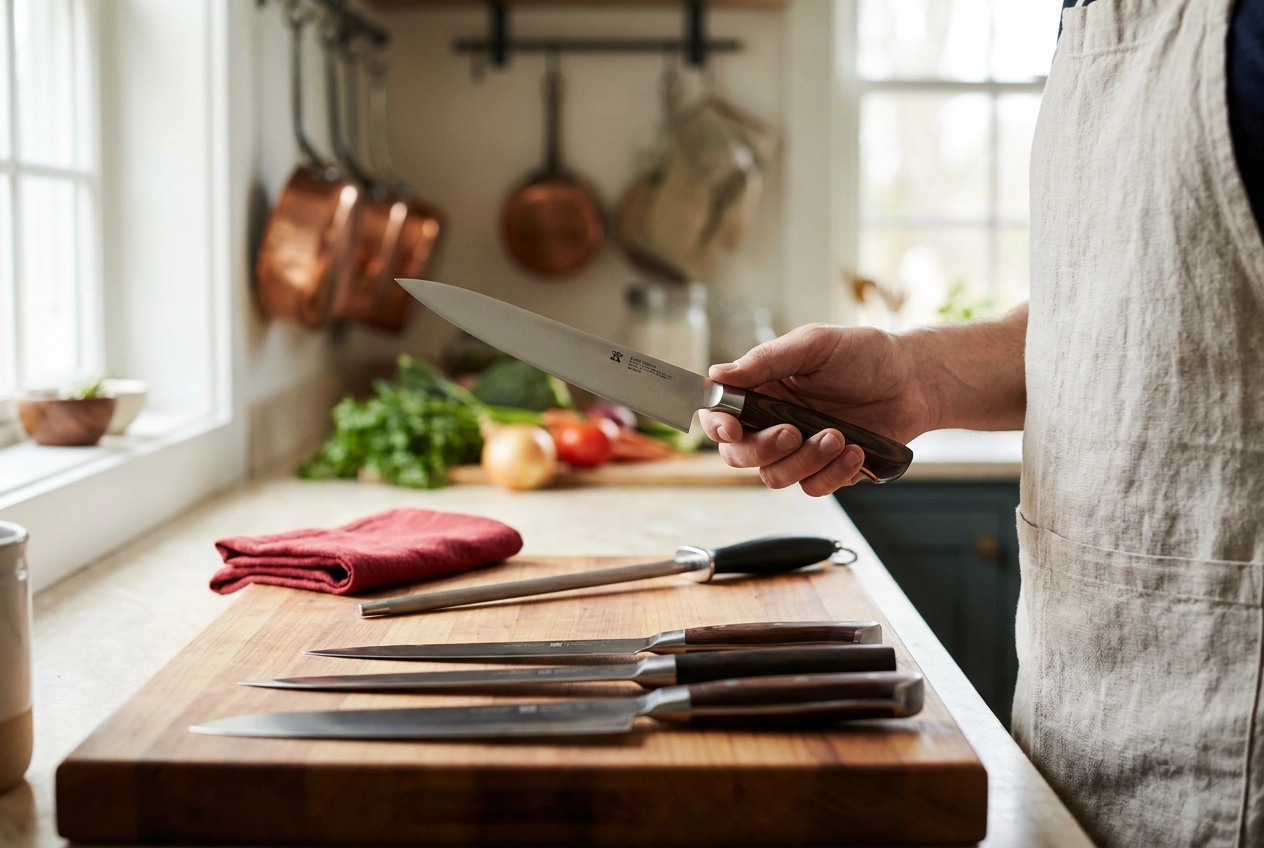
Most kitchen knife set reviews will tell you to spend more, buy Japanese, and trust the brand with the prettiest block. We disagree. After researching manufacturer specifications, independent tests and owner reports across price points, steel grades, and kitchen sizes, we found that the best kitchen knife set for most UK home cooks has nothing to do with prestige and everything to do with whether the knives actually suit the food you cook every day.
In this guide, we cut through the marketing noise with a ranked, researched breakdown built around real criteria: steel quality, balance, ergonomics, and value. You will learn exactly which steel grades matter and why, which knives UK home cooks genuinely reach for, and how to store and maintain your set in a British kitchen where hard water and limited worktop space are facts of life.
Whether you are buying your first proper set or replacing a tired block that never quite worked for you, this guide gives you the information to choose confidently. No aspirational brand bias. No filler picks. Just clear, practical rankings that put performance first.
What actually makes a good kitchen knife set
Three criteria drive every ranking in this guide.
Steel grade and what it means in practice. Steel hardness (measured on the Rockwell HRC scale) determines how long an edge stays sharp and how prone it is to chipping. Metallurgical testing distinguishes toughness from edge retention as separate properties: a steel can hold a fine edge but chip on hard foods, or resist chipping but need frequent honing. Budget sets often sacrifice one for the other.
Balance and handle ergonomics under real use. A knife that feels comfortable on first grip can cause fatigue after 15 minutes of continuous chopping. We assess handle material, bolster weight, and balance point as owners report them under sustained cutting, not just on first grip.
Task coverage. Which knives will you actually reach for? A 15-piece block including six steak knives and kitchen scissors has a very different task-coverage ratio than a five-piece set built around a chef knife, bread knife, and paring knife.
One thing we do not score: how the block looks on a worktop. Plenty of sets are marketed on worktop appeal first and knife performance second. That is the aesthetics trap, and it inflates perceived value without improving what happens when steel meets food.
This guide covers sets across three budget bands (under £50, midrange, and premium) and explains when spending more is genuinely justified by steel grade and ergonomics. Our research criteria cover repetitive chopping tasks, edge retention after extended use, fatigue under sustained cutting, and slip risk on wet handles. For a full breakdown of how we evaluate knife sets, that methodology page covers the detail.
How we researched these knife sets
Here is what every set in this guide was judged on, using manufacturer specifications, independent tests and owner reports.
Cutting tasks. We looked for evidence across five tasks drawn from real UK home-cook prep: dicing onions continuously for ten minutes, breaking down bone-in chicken thighs, slicing a whole sourdough loaf, fine-chopping a bunch of flat-leaf parsley, and peeling root vegetables by hand. Those tasks were chosen because they mirror what most UK home cooks actually do several times a week. Abstract produce-weight targets tell you less than knowing whether a blade still bites cleanly into an onion after ten minutes of repetitive contact.
Ergonomics under fatigue. Every knife was assessed on reports from sustained sessions, not on first grip. Handle materials, bolster weight, and balance point all feel different once your hand is fifteen minutes into continuous chopping. A handle that feels solid in a shop will telegraph vibration, hotspots, or slippage once fatigue sets in. That difference is what we look for.
Edge retention. Blades were assessed on reports of extended use without resharpening. Steel hardness, measured on the Rockwell C scale (HRC), is the core variable here. Harder steel holds a sharper edge longer but is more brittle. Softer steel dulls faster but is more forgiving. The full research approach is documented on the About page if you want the detail.
UK-specific conditions. We weighed how each steel copes with being rinsed in hard tap water and left to air-dry, a habit common in UK kitchens. Mineral deposits from hard water accelerate surface dulling and can compromise blade finish faster than most buyers expect.
Exclusion criteria. Three categories were removed before ranking: sets whose primary marketing centred on block aesthetics rather than blade specification, sets that padded knife count with items no home cook reaches for, and sets whose manufacturers declined to disclose steel grade or alloy.
Steel grades explained: what VG-10, German stainless, and high-carbon mean for your kitchen
Steel hardness is measured on the Rockwell C scale (HRC), with direct consequences for every knife in your block.
German stainless (X50CrMoV15 and similar alloys) typically sits at 56 to 58 HRC. The softer steel resists chipping but the edge rolls rather than holds, so regular honing is needed. For most UK home cooks that toughness is an asset: it handles hard root vegetables and bone-adjacent cuts without complaint.
Japanese stainless like VG-10 runs harder, typically 60 to 62 HRC. A harder edge holds sharpness longer, but the same hardness makes it brittle. Drop it on tile, use it on frozen food, or drive it into a bone and you risk chipping rather than rolling.
High-carbon steel ranges from roughly 58 HRC to 65 HRC depending on the alloy. It takes the finest edge of the three, but contains little or no chromium. Chromium is what makes steel stainless: without it, blades oxidise quickly in humid conditions, and the UK’s hard tap water accelerates that process on blades left air-drying. High-carbon steel rewards cooks who wash, dry immediately, and oil the blade. It punishes cooks who leave knives in the sink, which is a realistic habit in most households. For a deeper look at how steel grade affects dinner-table knives, the best steak knives guide covering steel grades and edge types applies the same framework.
One point most sets ignore: not every knife needs the same steel. A bread knife works by serrated abrasion, not a sustained fine edge, so high hardness is largely wasted on it. A chef knife rewards every HRC point it can hold. Sets using a single steel family across all blades are making a manufacturing convenience choice, not an optimal one.
Which knives do UK home cooks actually use
Steel choice matters, but it only pays off if you are reaching for the right knife in the first place.
The core three are all most home cooks need. A chef knife, a bread knife, and a paring knife cover roughly 90 per cent of everyday prep: chopping vegetables, slicing a loaf, peeling and trimming. Every other blade in a block is a nice-to-have at best. If you want to go deeper on exactly which knives earn their place, our guide to which knives you actually need lays it out by task.
The santoku deserves a mention as a chef knife alternative, particularly in UK kitchens. Its blade typically runs 165mm to 180mm, which suits the smaller chopping boards common on British worktops. The flat edge profile also matches the push-chop motion most home cooks use naturally, rather than the rocking motion a longer Western chef knife is designed for.
Steak knives are padding. Most block sets include four to six of them. They inflate the piece count on the box, contribute nothing to prep, and should be ignored entirely when you are assessing a set’s value.
The boning knife is conditional. It earns its slot if you regularly break down whole chickens or bone out joints. If your meat comes pre-butchered from a supermarket, which describes the majority of UK shopping habits, it will sit unused.
This brings us to the most useful way to compare any set: the task coverage ratio. Divide the number of knives you will realistically use by the total knife count. A five-piece set where four knives get regular use outperforms a fifteen-piece set where only five do. A higher count on the box is not a better score.
Best overall kitchen knife set for UK home cooks
With that task-coverage thinking in mind, here is our top-ranked set for most UK home cooks.
The Victorinox Fibrox Pro 5-piece block set is our overall pick. It uses high-carbon stainless steel hardened to approximately 56 HRC, carries five knives (20 cm chef, bread, paring, boning, and a utility knife), and fits Fibrox thermoplastic handles throughout.
Who this is for
The home cook who wants a reliable, low-maintenance set. You can keep these knives sharp with a honing rod every few sessions and an occasional pass on a 1000-grit whetstone, without needing precise angle control or specialist equipment.
Who should skip it
Cooks chasing Japanese-steel sharpness. At 56 HRC, this steel is forgiving, not fine. If you sharpen on a whetstone regularly and want an edge that rewards that effort, step up to a harder steel. Also skip it if your household needs more than five knives at once.
Steel breakdown
56 HRC German-pattern stainless sits at the tougher, softer end of the hardness scale. It will not hold an ultra-fine edge, but it will not chip on a butternut squash or a chicken joint either. The chef knife handles repetitive dicing without blade fatigue. The bread knife’s serrations stay effective across extended use. The paring knife holds its edge well between monthly sharpenings.
Ergonomics and balance
The Fibrox handle is textured polymer, secure even on wet hands. The balance point sits just ahead of the bolster, keeping the knife blade-forward without tipping into unwieldy. Owners report that grip comfort holds through long chopping sessions. There is no full-bolster heel, so sharpening the full edge length is straightforward. For a deeper look at what separates a good paring knife from filler, see our best paring knife guide.
Best budget kitchen cooking knife set
If the overall pick sits above your current budget, this tier is where most first-time buyers should start.
The pick: a five-piece set built on standard German-style stainless steel, typically in the 420-series or equivalent chromium-bearing alloy, sitting around 54 to 56 HRC.
Included knives generally cover an 8-inch chef knife, a bread knife, a paring knife, a utility knife, and a carving knife, housed in a basic wooden block.
The steel compromise
At this price point, manufacturers reduce chromium content and soften the alloy to lower production costs. The result is a blade that arrives reasonably sharp but loses its edge faster than a midrange option. Expect to hone weekly if you cook regularly. The softer HRC means the steel deforms rather than chips under stress, which is forgiving for beginners but limits ultimate sharpness.
Who this is for
First-time buyers stepping off supermarket knives, students equipping a first kitchen, or cooks who want a functional set before committing further. You will notice a real improvement over a supermarket block without taking on maintenance you are not ready for.
Who should skip it
Cooks who already sharpen on a whetstone. Softer stainless at this price point does not hold a refined whetstone edge well; it rounds off quickly. You will get more from spending in the midrange tier.
Value per task
The chef knife and bread knife carry most of their cost honestly. The paring knife is usable but unremarkable. The carving knife is serviceable for a Sunday roast. The utility knife is largely redundant if you own the chef knife, and steak knives included in some budget sets add nothing to prep work. For dedicated steak knives, our review of budget steak knife options covers that ground.
The wooden block protects edges adequately and keeps the worktop tidy.
Best midrange knife set for kitchen use
Where the budget pick ends, this tier begins. The step up is not about prestige; it is about what the steel does under weekly use.
The midrange pick is a German stainless set built around a high-carbon stainless alloy, typically sitting at 56 to 58 HRC. That two-to-three point HRC advantage over most budget steels translates to a finer, more stable edge that holds longer between honing sessions. Handle construction uses either full-tang riveted pakkawood or reinforced polymer, both of which distribute weight more predictably than the hollow or partial-tang handles common in budget sets.
The specific reason this tier earns its place: grind geometry. Budget sets are frequently hollow-ground to create an impressive first impression, but that thin geometry collapses quickly under repeated use. Midrange German stainless is typically flat- or convex-ground, producing an edge thicker behind the bevel and more resistant to rolling or micro-chipping during daily prep.
Who this is for
Home cooks who prepare meals three or more times a week, have already worn through the edge on a budget set, and want a knife that responds well to a honing rod. Regular honing every few sessions keeps the edge performing reliably.
Who should skip it
Cooks comfortable with whetstone work and drawn to Japanese steel. If VG-10 at 60 to 62 HRC is your target, this tier will feel like a compromise within a year. Our guide to the best chef knife: a no-affiliate guide to what actually matters covers that upgrade decision in full.
Ergonomics across a prep session
The bolster on a midrange set adds 7 to 15 grams at the balance point. After 20 minutes of dicing, the knife sits more naturally in a pinch grip and your forearm does less corrective work. Budget handles frequently balance behind the bolster, pushing fatigue into the wrist. The midrange bolster shifts balance forward to the blade-handle junction, where a controlled pinch grip absorbs it efficiently.
Best Japanese-steel kitchen knife set for serious home cooks
If the midrange tier leaves you wanting a sharper, thinner edge and you are prepared to maintain it properly, a Japanese-steel set is the logical next step.
The pick here is built around VG-10 stainless steel, a Japanese alloy that typically sits between 60 and 62 HRC. That extra hardness, compared to German stainless at around 57 HRC, allows blades to be ground to 15 degrees per side rather than the 20-degree bevel common on European knives. Thinner grind plus harder steel equals a noticeably sharper edge out of the box that holds longer between sharpening sessions.
Who this is for
Cooks who already own a whetstone and use it. You should be comfortable sharpening at a consistent angle and willing to hand-wash and dry immediately after every use. If that describes you, a VG-10 set will reward you with precision slicing a German-steel set at the same price cannot match.
Who should skip it
Dishwasher users, sink-leavers, and anyone relying on a pull-through sharpener. At 61 HRC, VG-10 is more brittle than softer German stainless. Hit a frozen ingredient or press down on bone and you risk a chip rather than a roll. A chip requires whetstone work to fix, not a few passes on a honing rod.
UK-specific note: hard water and Japanese steel
Most of England sits in a hard or very hard water zone. Mineral deposits trap moisture against thin, hard Japanese steel, initiating surface staining and edge degradation over time. Wipe and dry immediately after rinsing. That single habit separates a set that ages well from one that looks neglected within a year.
For context on supporting knives, our Steak knives: the Steel Snob buyer’s guide explains why steak knives in many Japanese-steel blocks rarely match the chef and utility blades, and what to look for if you want the table knives to justify their slot count.
Best kitchen block knife set for small UK kitchens
If the Japanese-steel section showed you how demanding a knife can be, this section is about a different constraint: counter space.
The pick here is a compact five-knife block set with a slim, upright footprint, typically around 15 cm wide and 20 cm deep. That is roughly half the counter area of a standard 12-slot block. For a galley kitchen or a one-bedroom flat with 60 cm of usable worktop between the hob and the sink, that difference is real.
Who this is for: flat dwellers, galley-kitchen cooks, and anyone who has ever had to choose between a knife block and a bread bin. Five knives covering chef, bread, paring, utility, and a santoku is enough for most home cooks. The task-coverage rationale from section four applies directly here.
Who should skip it: cooks who want every blade in one purchase. Compact sets cap out at five knives or fewer. If your household runs a full prep-and-cook operation with multiple people using different blades simultaneously, a compact block will frustrate you quickly.
Storage geometry matters
Vertical-slot blocks hold the blade edge away from the slot wall as the knife rests. Horizontal-slot designs can press the edge against the wood under gravity, gradually rolling the edge over time. For thinner blades, particularly the santoku geometry common in UK sets, vertical storage is the better choice.
A magnetic wall strip saves all counter space and suits the narrow walls common above UK kitchen worktops. One caution: not all stainless alloys are strongly magnetic. Austenitic stainless steels, including many Japanese alloys, have low ferromagnetic response. Some knives will not hold reliably on a standard magnetic strip. Check whether your knives are described as ferritic or martensitic stainless before buying. German stainless sets typically hold well. Japanese VG-10 sets often do not. A quick test with a fridge magnet before mounting the strip saves a damaged blade.
Block, magnetic strip, or loose storage: which is right for a UK kitchen
Storage format is a practical choice, not an afterthought. The right option depends on your kitchen layout, your blade steel, and how you actually handle knives day to day.
Block storage protects edges well because each blade sits in its own slot with no contact against other metal. The set stays organised and accessible in a single unit. The trade-off is counter space, which is genuinely scarce in many UK kitchens. There is also a moisture concern specific to the UK climate: wooden slots can trap water if knives are returned before they are fully dry, and in a humid kitchen that retained moisture sits against the blade. Wipe blades dry before slotting them back in.
Magnetic strip storage frees up the worktop and suits the wall-mounted layouts common in UK flats and galley kitchens. It also lets you mix knives from different sets, which matters if you build your collection gradually. The caution raised in the previous section applies here: confirm your blade steel holds strongly to a magnet before relying on a strip. Edge protection depends entirely on how carefully you mount each knife. Place the spine to the strip first, then rotate the edge away. Dropping or sliding a blade onto the magnet damages the edge.
Loose storage covers two options. A knife roll is the most portable choice and protects edges well when the blade pockets are used correctly. A drawer insert keeps knives out of sight but requires individual edge guards on each blade. Without guards, blades knock against each other and dull faster.
By kitchen type: choose a block if you have counter space and want a self-contained set. Choose a magnetic strip for compact kitchens with a spare wall section. Choose a knife roll or drawer insert if you need portability or prefer knives stored out of sight.
Maintaining your knife set in a UK kitchen: hard water, dishwashers, and sharpening
How you store your knives matters. How you maintain them matters more.
Hard water is a genuine threat to your blades. The UK average water hardness sits around 406 mg/l calcium carbonate, making it among the hardest in Europe. When water evaporates on a blade, it leaves mineral deposits that accelerate surface corrosion and micro-abrade the edge between uses. The fix is simple: rinse and dry each knife immediately after use. Do not leave them on a drying rack.
Never put knives in the dishwasher. This applies to every steel grade without exception. Hot wash cycles cause thermal expansion and contraction that weakens the edge geometry over repeated cycles. Abrasive detergent compounds the damage, and contact with other utensils during the cycle introduces micro-chips. One dishwasher run will not ruin a knife; fifty will. The habit is the problem.
Honing and sharpening are not the same task. A honing rod realigns the edge without removing metal. Use it every two or three cooking sessions to keep the edge tracking straight. Sharpening removes metal to restore a geometry that honing can no longer recover. For regular home use, sharpening on a whetstone every few months is sufficient.
For whetstone work, start at 1000 grit to restore a dull edge, then refine on 3000 to 6000 grit. Japanese steels, which are harder and ground thinner, require a more consistent angle and a lighter touch than softer German stainless. Inconsistent angle on a hard steel produces micro-chips rather than a clean apex.
Our sharpening and maintenance guides cover honing technique, full whetstone progression, and correct edge angle by steel type in detail.
Knife sets to avoid and the warning signs to look for
Good maintenance habits protect the set you buy. Bad purchasing decisions mean no habit saves you. Here are the five warning signs to filter out before you spend anything.
“Stainless steel” with no alloy name or HRC. Steel grade is the single most important specification on a knife. If a listing says only “stainless steel,” the manufacturer is either using an alloy too undistinguished to name, or actively hoping you will not ask. Either way, you cannot assess edge retention, hardness, or corrosion resistance without a grade. Walk away.
Piece-count inflation. A “15-piece set” that includes four steak knives, a pair of scissors, a honing steel, and a wooden block contains, at most, eight cutting blades, often fewer worth using. Count the actual prep knives, then check whether they cover the core tasks. A five-piece set with four genuinely useful blades beats a fifteen-piece set built around a padded headline number.
Hollow-ground budget blades. Hollow grinding cuts a concave bevel into the blade face, producing a visually dramatic, razor-thin edge. On a hard steel it can work. On the soft, cheap stainless used in budget sets, that thin geometry collapses quickly under normal chopping. It looks impressive in a photograph; it does not last through a fortnight of regular use.
Block-first marketing. If the primary selling point is the block’s finish, colour, or worktop aesthetic, the manufacturer’s confidence is in the packaging, not the knives. Lead with the steel; buy for the steel.
No warranty or returns information. A credible manufacturer stands behind their product with at least a limited warranty. Absence of any warranty terms is a signal that the manufacturer expects problems they prefer not to honour.
Frequently asked questions about kitchen knife sets
How many knives do I actually need?
Three to five covers most UK home cooks. The chef knife, bread knife, and paring knife are non-negotiable. A santoku or utility knife rounds out a practical set. Everything beyond five is largely filler.
Is a Japanese knife set worth it for a UK home cook?
Yes, with conditions. Japanese sets reward cooks who hand-wash, dry immediately, and sharpen on a whetstone. If your habits include the dishwasher, leaving knives in the sink, or reaching for a pull-through sharpener, the harder steel will chip and the edge will degrade faster than a forgiving German stainless would. The maintenance commitment is real, not a disclaimer.
What is the difference between a knife set and a knife block set?
A knife block set includes the storage block as part of the package. A knife set may ship without any storage solution. Neither term signals better or worse knives. Judge the steel and the blades, not the packaging format.
Can I mix knives from different sets?
Yes, and for many cooks this is the smarter approach. Buy the three core knives in a steel grade that suits your habits, then add a magnetic strip or block separately. Mixing lets you allocate budget where it counts rather than subsidising knives you will never use.
How do I know if a knife set is good quality before buying?
Four checks: the product listing discloses a specific steel grade or alloy name; the spine shows a consistent grind with no visible wobble; the handle is full-tang or the construction method is clearly described; and the manufacturer offers a warranty. If any of these are missing, treat it as a warning sign, not a minor oversight.
The bottom line on kitchen knife sets for UK home cooks
The questions above have a common thread: matching what you buy to how you actually cook. That is the whole argument of this guide, and it holds at every price point.
The ranked picks, in brief:
- Overall best: the set whose midrange German stainless balances forgiveness with edge retention, suits regular home use, and rewards consistent honing
- Budget: a capable starter set for first kitchens; soft enough stainless to be forgiving, limited enough in scope to keep costs honest
- Midrange: the meaningful upgrade for anyone cooking three or more times a week; better steel geometry, better handle construction, and a clear step up from supermarket blocks
- Japanese steel: the right choice if you hand-wash, dry immediately, and sharpen on a whetstone; the wrong one if you do not
- Compact storage: five knives or fewer in a smaller block footprint, suited to galley kitchens and flat dwellers who cannot spare the counter space
The practical split is straightforward. First-time buyer: start with the budget pick, then replace the chef knife with a better single blade once you know your preferences. Cook three or more times a week on a supermarket block: the midrange set will produce a noticeable, immediate difference.
Maintenance is not optional. Hand-wash, dry straight away, and use a honing rod every few sessions. That single habit extends edge life more than any steel upgrade.
For deeper reading, Steel Snob’s honing guide, whetstone sharpening walkthrough, and individual chef knife reviews cover any single blade in more detail than a set roundup can.
Conclusion
A good knife set does not need to be expensive; it needs to match how you actually cook. Buy to your real habits, not your aspirational ones. Prioritise steel quality and handle comfort over block size and knife count. And commit to basic maintenance, because a honed budget knife will always outperform a neglected premium one.
The right choice is simpler than the marketing suggests. First-time buyers should start modest and upgrade selectively. Regular home cooks will feel the difference a midrange set brings within a week. Serious cooks ready to commit to proper care will find Japanese steel genuinely rewarding.
Pick the set that fits your kitchen, your routine, and your budget. Then sharpen it, hone it, and use it. The best knife set is the one that makes you want to cook more often.