
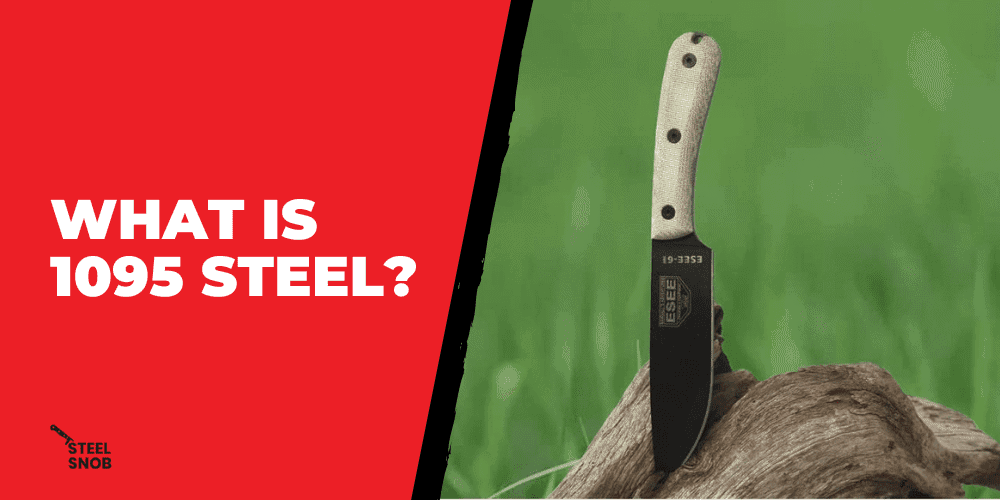
1095 steel is one of the most widely used and time-tested carbon steels in knife making. Prized for its simplicity, excellent edge-taking ability, and easy sharpening, 1095 has been the go-to steel for knife makers, blacksmiths, and outdoor enthusiasts for over a century. In this complete 2026 guide, we break down 1095 steel’s composition, performance properties, how it compares to other popular steels, and the best 1095 knives you can buy today.
Written by the Steel Snob editorial team. This guide draws on manufacturer specifications, independent tests and owner reports for 1095 steel knives used in field conditions, and is updated for 2026.
What is 1095 Steel?
1095 steel is a high-carbon steel belonging to the 10xx series of steels (SAE/AISI designation). The naming convention tells you its composition: the first two digits “10” indicate a plain carbon steel with no significant secondary alloying element, and the last two digits “95” indicate approximately 0.95% carbon content.
This makes 1095 one of the highest-carbon steels in the 10xx family. For comparison, 1060 has 0.60% carbon and 1080 has 0.80% carbon. The higher carbon content gives 1095 greater hardness and edge retention, but at the cost of some toughness.
1095 is classified as a simple carbon steel — it contains only iron, carbon, and a small amount of manganese. This simplicity is actually an advantage: it makes the steel straightforward to heat treat, forge, and sharpen. It has been used in everything from kitchen knives and hunting blades to swords and machetes.
Chemical Composition of 1095 Steel
1095 steel has a remarkably simple chemical composition:
- Carbon (0.90-1.03%): The primary hardening element. Provides excellent hardness and edge retention.
- Manganese (0.30-0.50%): Adds hardness and helps with heat treatment response. Also improves tensile strength.
- Phosphorus (≤0.04%): Trace element that slightly increases strength.
- Sulfur (≤0.05%): Improves machinability.
- Balance — Iron: The remaining composition is iron.
Notice what’s missing: there is no chromium, vanadium, molybdenum, or other alloying elements found in modern stainless and tool steels. This is what makes 1095 a “simple” steel — and why it has no corrosion resistance beyond its own iron oxide layer.
1095 Steel Properties
Hardness
1095 steel can be heat treated to a hardness of 56-61 HRC, though most knife makers target the 58-60 HRC range for optimal performance. At this hardness level, the blade is hard enough for excellent edge retention while maintaining reasonable toughness.
Edge Retention
This is one of 1095’s strong suits. The high carbon content allows the steel to achieve a very sharp edge that holds up well during cutting tasks. While it won’t match modern super steels like S90V or Rex 121 in edge retention, 1095 outperforms many other carbon steels and budget stainless steels like 420HC.
Toughness
1095 has moderate toughness. Among the 10xx steels, it is actually one of the less tough options — 1075 and 1080 offer better toughness with slightly lower edge retention. For heavy chopping or batoning, steels like 5160 are better suited. However, for general knife use including outdoor tasks, 1095’s toughness is perfectly adequate.
Corrosion Resistance
This is 1095’s biggest weakness. With zero chromium content, 1095 steel has virtually no corrosion resistance. It will develop surface rust quickly if exposed to moisture without protection. All 1095 blades require regular oiling and immediate drying after use. Many 1095 knives come with protective coatings (like black oxide or Cerakote) to help mitigate this issue.
Ease of Sharpening
1095 is one of the easiest steels to sharpen in the knife world. Its simple composition and lack of hard carbides mean it responds beautifully to whetstones, diamond plates, and even field sharpeners. A skilled sharpener can restore a razor edge in minutes. This is a major reason 1095 remains popular with bushcraft and survival enthusiasts — you can maintain your edge with minimal equipment in the field.
1095 Steel Comparison
1095 vs 1080
1080 has 0.80% carbon compared to 1095’s 0.95%. This makes 1080 slightly tougher and more forgiving, while 1095 holds a better edge. For large chopping blades, 1080 is often preferred. For smaller knives where edge retention matters more, 1095 is the better choice.
1095 vs 5160
5160 steel is a chromium-vanadium spring steel with much greater toughness than 1095. It’s the preferred choice for large knives, machetes, and swords that need to withstand heavy impacts. 1095 offers better edge retention and easier sharpening, but 5160 wins on toughness and has slightly better corrosion resistance.
1095 vs 420HC
420HC is a stainless steel with far better corrosion resistance. However, 1095 beats it in hardness, edge retention, and ease of sharpening. Choose 420HC for wet environments where rust is a concern; choose 1095 for maximum cutting performance when you don’t mind the maintenance.
1095 vs Damascus Steel
1095 is actually one of the most common steels used IN Damascus steel construction, typically paired with 15N20. On its own, 1095 offers similar edge retention at a fraction of the price. Damascus adds toughness through layering and superior aesthetics.
Best 1095 Steel Knives in 2026
Best Overall: Ka-Bar USMC Fighting Knife
The legendary Ka-Bar USMC is perhaps the most iconic 1095 steel knife ever made. Designed for the U.S. Marines in World War II, this 7-inch fixed blade has proven itself in combat and field use for over 80 years. The Cro-Van (1095) blade is coated for corrosion resistance, and the leather washer handle provides a secure, comfortable grip.
Price: Around $80-$100
Check price on Amazon
Best Budget: Ontario Knife Company RAT-5
The OKC RAT-5 is a rugged, no-nonsense fixed blade with a 5-inch 1095 blade and a full tang construction. It comes with a black powder coat for rust protection and a MOLLE-compatible nylon sheath. Outstanding value for a serious outdoor knife.
Price: Around $55-$70
Check price on Amazon
Best Bushcraft: Condor Tool & Knife Bushlore
The Condor Bushlore is a purpose-built bushcraft knife with a 4.3-inch 1095 blade at a convex grind — ideal for wood carving and general camp tasks. The walnut handle is comfortable for extended use, and the blade geometry is perfect for bushcraft techniques like feather sticking and batoning small wood.
Price: Around $45-$60
Check price on Amazon
Best Large Blade: Cold Steel Trail Master
Cold Steel’s Trail Master features a massive 9.5-inch 1095 blade with their proprietary heat treatment. It’s a serious big knife for serious outdoor work — capable of chopping, batoning, and even light machete duties. The Kray-Ex handle provides excellent grip in all conditions.
Price: Around $120-$150
Check price on Amazon
How to Maintain 1095 Steel
Because 1095 has no corrosion resistance, proper maintenance is essential:
- Dry immediately. After any use, especially involving moisture, wipe the blade completely dry. Even fingerprints contain enough moisture and acid to start rust spots.
- Oil regularly. Apply a thin layer of mineral oil, camellia oil, or a dedicated blade oil like Tuf-Glide after every use and before storage. Avoid cooking oils — they can go rancid.
- Force a patina. Many 1095 users deliberately force a patina (controlled surface oxidation) using mustard, vinegar, or hot coffee. A patina actually helps protect the blade from deeper, destructive rust.
- Avoid prolonged moisture. Don’t leave your knife in a wet sheath, and never store it without drying and oiling first.
- Use a protective coating. If your 1095 blade doesn’t come with a coating, consider applying Renaissance Wax or a similar microcrystalline wax for additional protection.
Who Should Choose 1095 Steel?
1095 steel is perfect for:
- Bushcraft and survival enthusiasts who value easy field sharpening above all else
- Knife makers and blacksmiths who appreciate its simple, forgiving heat treatment
- Collectors who enjoy developing a unique patina on their blades
- Military and tactical users — 1095 has proven itself in combat for 80+ years
- Budget-conscious users who want excellent cutting performance without premium steel prices
1095 is not ideal for: users who want low-maintenance stainless steel, wet/marine environments, or people who tend to neglect blade care.
Frequently Asked Questions
Is 1095 steel good for knives?
Yes, 1095 is an excellent knife steel that has been used in blades for over a century. It offers great hardness (58-60 HRC), outstanding edge retention for a carbon steel, and is extremely easy to sharpen. Its main drawback is poor corrosion resistance, which requires regular maintenance.
Is 1095 steel stainless?
No. 1095 is a plain carbon steel with no chromium content, which means it is not stainless and will rust if exposed to moisture without protection. All 1095 knives require regular oiling and drying.
What is 1095 steel used for?
1095 steel is used primarily in knives (hunting, bushcraft, tactical, kitchen), machetes, swords, and various cutting tools. It’s also used in springs and other applications requiring hardness and wear resistance.
Is 1095 or 1080 better for knives?
It depends on the knife type. 1095 is harder and holds a better edge, making it ideal for smaller knives and blades where cutting performance is key. 1080 is tougher and more impact-resistant, making it better for large blades, machetes, and swords that will see heavy chopping use.
How hard is 1095 steel?
1095 steel can be heat treated to 56-61 HRC, with most knife makers targeting 58-60 HRC for the best balance of hardness and toughness. At 60 HRC, 1095 is harder than most stainless steels used in knives.
About this guide
Steel Snob Editorial
Researched from manufacturer specifications, independent tests and owner reports, and edited for accuracy by the Steel Snob team.