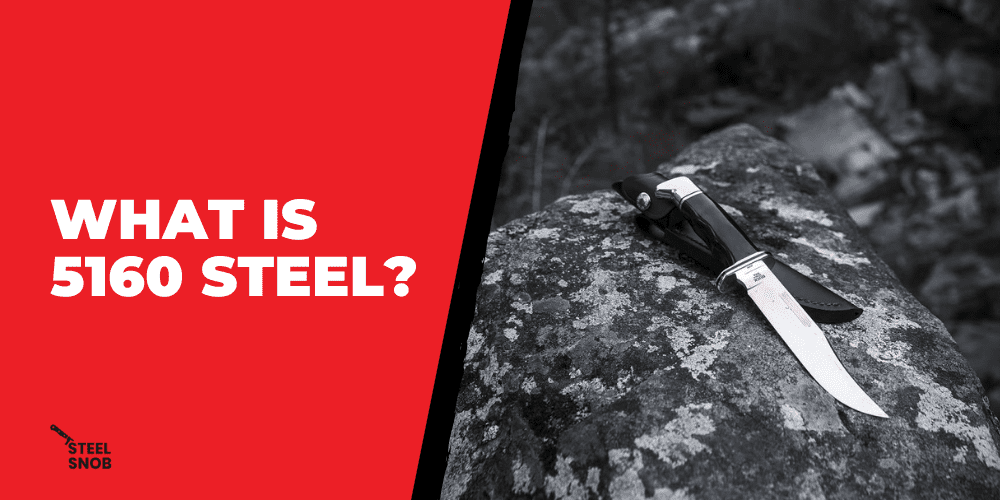
5160 steel is a high-performance spring steel that has earned a devoted following among knife enthusiasts, sword makers, and large blade aficionados. Known for its extraordinary toughness, flexibility, and durability, 5160 is the steel of choice for blades that need to survive heavy impacts without breaking. In this complete 2026 guide, we explore 5160’s composition, properties, and the best knives made from this legendary spring steel.
Written by the Steel Snob editorial team. This guide draws on manufacturer specifications, independent tests and owner reports for 5160 steel blades used in demanding chopping, batoning, and survival work, updated for 2026.
What is 5160 Steel?
5160 steel (AISI 5160) is a chromium-carbon spring steel originally developed for automotive leaf springs. Its combination of high toughness, good fatigue resistance, and excellent ductility made it perfect for springs that need to flex millions of times without breaking — and those same properties make it outstanding for large knives and swords.
In the knife world, 5160 is most commonly found in large fixed blades, chopping knives, machetes, survival knives, and swords. It’s less common in small EDC knives or folders because its strengths (toughness and flexibility) matter most in bigger blades that endure heavy impacts.
Chemical Composition of 5160 Steel
- Carbon (0.56-0.64%): Provides hardness and edge retention. The moderate carbon level is key to 5160’s balance of hardness and toughness.
- Chromium (0.70-0.90%): Adds some corrosion resistance, improves hardenability, and contributes to edge retention and wear resistance.
- Manganese (0.75-1.00%): Enhances hardness, tensile strength, and helps with heat treatment response.
- Silicon (0.15-0.30%): Increases strength and acts as a deoxidizer during steel production.
- Phosphorus (≤0.035%): Trace element that adds some strength.
- Sulfur (≤0.040%): Improves machinability.
The key feature of 5160’s composition is its moderate carbon with chromium addition. The chromium isn’t enough to make it stainless (that requires 10.5%+), but it does improve hardenability and provides marginally better corrosion resistance than plain carbon steels like 1095.
5160 Steel Properties
Hardness
5160 steel is typically heat treated to 57-59 HRC for knife applications. Some makers push it to 60 HRC, but this reduces the toughness that makes 5160 special. At 57-58 HRC, 5160 offers a sweet spot where the blade is hard enough to hold a working edge while remaining extremely tough and flexible.
Edge Retention
Edge retention is moderate — not 5160’s strongest attribute. Compared to higher-carbon steels like 1095, 5160 dulls somewhat faster. However, this is an intentional trade-off: the lower hardness that results in less edge retention is exactly what gives 5160 its legendary toughness. For the type of work 5160 knives are designed for (chopping, batoning, heavy cutting), this is an acceptable trade-off.
Toughness
This is where 5160 absolutely excels. It is one of the toughest knife steels available, period. The spring steel heritage means 5160 blades can flex significantly without breaking, absorb heavy impacts without chipping, and endure abuse that would destroy most other steels. If you browse any knife forum, you’ll find stories of 5160 blades surviving unbelievable punishment — batoning through hardwood knots, chopping through nails, being flexed nearly 90 degrees and springing back to true.
Corrosion Resistance
5160 has low corrosion resistance. While the 0.70-0.90% chromium content gives it slightly better rust resistance than plain carbon steels like 1095 or 1080, it is far from stainless. 5160 blades require regular oiling and should be dried after use. Many 5160 knives come with protective coatings to help prevent rust.
Ease of Sharpening
5160 is easy to sharpen. The moderate hardness and simple composition mean it responds well to whetstones, diamond plates, and field sharpeners. While not quite as easy to sharpen as 1095, 5160 can still be brought to a keen edge without specialized equipment.
5160 Steel Comparison
5160 vs 1095
1095 has higher carbon content and achieves greater hardness, giving it better edge retention. However, 5160 is significantly tougher and more flexible. For small knives and precision cutting, 1095 is superior. For large blades and chopping tools, 5160 is the clear winner.
5160 vs 1084
1084 is another popular knife making steel with 0.84% carbon. It offers better edge retention than 5160 but less toughness. 1084 is considered one of the easiest steels to heat treat, making it a favorite of beginner bladesmiths. 5160 is preferred when maximum toughness is the priority.
5160 vs 80CrV2
80CrV2 is often considered an upgrade over 5160, offering similar toughness with better edge retention due to higher carbon (0.80%) and vanadium additions. If you want the toughness of 5160 with improved cutting performance, look for knives in 80CrV2 steel.
5160 vs 420HC
These are very different steels for very different purposes. 420HC is a stainless steel with excellent corrosion resistance but moderate toughness — ideal for everyday folders and hunting knives. 5160 is a non-stainless spring steel with extreme toughness — ideal for large, hard-use fixed blades.
5160 vs Damascus Steel
5160 is sometimes used as a component in Damascus steel. On its own, 5160 offers comparable or better toughness at a fraction of the price. Damascus provides superior aesthetics and, depending on the component steels, potentially better edge retention.
Best 5160 Steel Knives in 2026
Best Overall: Ka-Bar Becker BK2 Campanion
The Becker BK2 is a tank of a knife — 5.5 inches of thick 5160 steel with a flat grind, designed for heavy-duty survival use. Ethan Becker designed this blade to be virtually indestructible, and it delivers. The 0.25-inch thick spine means you can baton through just about anything. It comes with a hard plastic sheath and is an outstanding value.
Price: Around $75-$95
Check price on Amazon
Best Chopper: Cold Steel Trail Boss
The Cold Steel Trail Boss is actually a hatchet, but it uses 5160 steel for the head, demonstrating how well this steel handles heavy chopping impacts. At under two pounds with a hickory handle, it’s a versatile camp tool that chops, splits, and carves effectively.
Price: Around $30-$40
Check price on Amazon
Best Budget: Ontario Knife Company SP-2 Survival Bowie
The OKC SP-2 is a 10-inch bowie knife in 5160 steel with a full tang and Kraton handle. It’s a big, capable blade at an extremely reasonable price. The black powder coat helps with corrosion resistance, and the thick blade geometry makes it ideal for hard use.
Price: Around $60-$80
Check price on Amazon
Best Tactical: Ka-Bar Becker BK9 Combat Bowie
The BK9 takes the Becker design philosophy to a larger scale with a 9-inch 5160 blade. It’s a serious combat bowie that can handle anything from camp chores to emergency breaching. The 5160 steel ensures it can take extreme abuse without failing.
Price: Around $100-$130
Check price on Amazon
How to Maintain 5160 Steel
- Oil after every use. Apply mineral oil, blade oil, or even a light coat of food-grade mineral oil to prevent rust.
- Dry immediately. Don’t leave a 5160 blade wet. Wipe it down thoroughly after any contact with moisture.
- Force a patina. Like 1095 steel, 5160 benefits from a forced patina that provides a protective oxide layer. Use mustard, vinegar, or hot apple cider vinegar for interesting patterns.
- Maintain the coating. If your 5160 blade has a protective coating, be aware that heavy use will wear it away in high-contact areas. Touch up with cold blue or consider re-coating.
- Store in a dry environment. Avoid leather sheaths for long-term storage, as leather can trap moisture. Use a plastic or Kydex sheath, or store the blade separately with oil applied.
Who Should Choose 5160 Steel?
- Survival and bushcraft users who need a blade that won’t break under heavy use
- Chopping enthusiasts who want maximum toughness in a large fixed blade
- Sword collectors and practitioners — 5160 is one of the most popular sword steels
- Budget-conscious users who want proven performance without exotic steel prices
- Anyone who battons firewood regularly — 5160 is built for this kind of abuse
5160 is not ideal for: small EDC knives, applications requiring maximum edge retention, or users who want stainless/low-maintenance steel.
Frequently Asked Questions
Is 5160 steel good for knives?
Yes, 5160 is an excellent steel for large knives, especially survival knives, choppers, and bowies. Its outstanding toughness makes it one of the best choices for blades that need to withstand heavy impacts and hard use. It’s less ideal for small knives where edge retention matters more than toughness.
Is 5160 steel stainless?
No. Despite containing chromium, 5160 only has 0.70-0.90% — far below the 10.5% required for stainless classification. 5160 will rust if not properly maintained and requires regular oiling.
Is 5160 or 1095 better for a knife?
It depends on the application. 5160 is significantly tougher and more flexible, making it better for large blades and heavy chopping. 1095 has better edge retention and is harder, making it better for smaller knives and detailed cutting work.
What is 5160 steel commonly used for?
5160 steel is commonly used for automotive leaf springs, large knives, survival blades, swords, machetes, and heavy-duty cutting tools. Any application that demands extreme toughness and impact resistance is a good fit for 5160.
How tough is 5160 steel compared to other knife steels?
5160 is among the toughest knife steels available. It consistently ranks in the top tier for impact resistance, alongside steels like 52100, 80CrV2, and 3V. Its spring steel origins give it flexibility that most knife steels simply cannot match.
About this guide
Steel Snob Editorial
Researched from manufacturer specifications, independent tests and owner reports, and edited for accuracy by the Steel Snob team.