
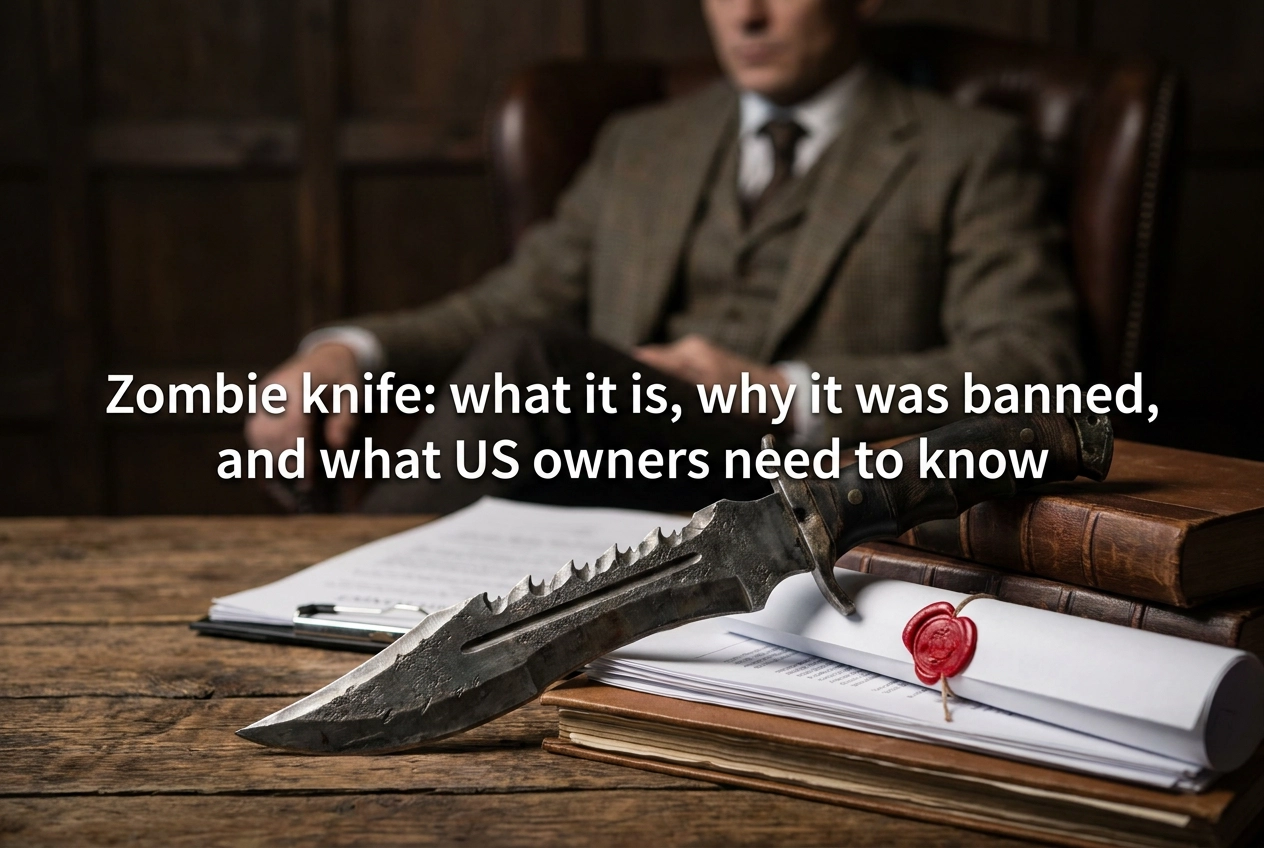
Picture a blade designed to look like it came straight out of a horror movie, complete with serrated edges, aggressive styling, and imagery celebrating violence. This is the zombie knife, and it has sparked serious legal debates on both sides of the Atlantic.
Originally marketed as a collector’s novelty or costume prop, the zombie knife quickly became a genuine public safety concern. The United Kingdom moved to ban it outright, and several US states have followed with their own restrictions. Yet many American owners still have these blades sitting in their homes without fully understanding the legal risks they carry.
If you own one, are thinking about buying one, or simply want to understand what all the controversy is about, this guide is for you. We will break down exactly what defines a zombie knife, explain why governments have moved to prohibit it, and walk you through what current US laws mean for owners and collectors. By the end, you will have a clear, practical understanding of where things stand and what steps you may need to take.
Where the name came from
“Zombie knife” is a retail label, not a blade category, a legal term, or a metallurgical classification. Understanding that distinction up front will save you a lot of confusion, because the term gets used to describe everything from a cheap flea-market novelty to a serious fixed blade with aggressive styling. The name means exactly as much as whoever is selling the knife wants it to mean.
The label tracks directly to the early-2010s zombie-fiction boom. The Walking Dead debuted on AMC in 2010, World War Z hit theaters in 2013, and dozens of survival video games made undead-apocalypse imagery a mass-market visual language practically overnight. Budget importers, selling primarily through online marketplaces, recognized a ready-made consumer appetite and began branding large fixed-blade knives to match it. The design language they borrowed was entirely visual: toxic green or biohazard-yellow handles, skull motifs stamped into the grip, jagged cutouts along the spine. None of those features served a cutting purpose. They existed to signal the aesthetic, nothing more.
Gaming accelerated that demand independently. Titles like Counter-Strike: Global Offensive exposed millions of players to fictional knife skins built around wild geometry and vivid, non-functional coloring. That created a civilian market for real objects that matched those visuals, separate from any practical use case. The “zombie” branding tied the two cultural threads together neatly. As one discussion on the Way with Words radio community noted, Americans unfamiliar with UK knife debates recognized these objects immediately as the impressive-looking but deeply impractical items sold at flea markets, having simply lacked a word for them.
Because the label was marketing-driven from the start, no agreed design specification ever existed in the trade. Regulators, not the industry, were eventually forced to create one. When the UK moved to ban these knives, officials had to enumerate the specific features themselves, a process still being operationalized as recently as August 2024, as documented in this walkthrough of the UK government’s final definition document. The Wikipedia entry on zombie knives confirms that formal prohibition history in the United Kingdom. As of 2026, no equivalent statutory definition exists in any US federal law.
That marketing-first origin explains why the category remains so elastic. Any large fixed blade dressed in aggressive styling can be sold under the zombie-knife label regardless of steel quality, blade geometry, or actual construction. For a buyer trying to understand what they own, or what they are buying, that ambiguity matters. The name tells you about the marketing, not the knife.
What makes a blade qualify as zombie-style
The UK government’s 2024 ban gives us the most precise structural definition of zombie-style that any government body has ever put in writing. Use it as your baseline, even if you are shopping in the US where no equivalent federal rule exists.
The length threshold comes first
The definition starts with blade length. Under the Criminal Justice Act 1988 amendment announced by the UK government, any fixed blade over 8 inches is already at the first threshold. That measurement alone does not seal the classification, but nothing qualifies without it. Think of 8 inches as the floor, not the finish line.
Design features that push a blade over the line
Beyond length, the UK guidance enumerates specific structural characteristics. A blade qualifies when the over-8-inch length combines with any of the following:
- More than two sharp points on the blade
- A serrated spine (teeth running along the non-cutting, back edge)
- Fullers (longitudinal grooves machined or ground into the flat of the blade)
- Decorative cutouts (holes or slots cut through the blade itself)
The combination rule matters here. A knife does not need all four features. One is enough, paired with the length threshold.
How US-market blades actually look
In practice, zombie-style knives sold through US retailers cluster between 9 and 14 inches of blade. Tanto and clip-point profiles are most common, usually modified with spine serrations and at least one row of cutouts. Multi-point tips, double or triple forward-facing points built into the tip geometry, appear frequently.
Cosmetic details are not structural qualifiers
Bright colors, skull graphics, horror-themed etching, and paracord handle wrapping are not part of any legal definition. They are marketing signals, not structural features. The Bedfordshire Police guidance on the UK ban focuses entirely on blade geometry, not aesthetics. A plain black blade with a serrated spine and cutouts qualifies just as fully as a neon-green skull-wrapped one. The visuals get your attention in a retail listing. The geometry is what the law, and this guide, actually cares about.
The UK ban: what it covers and what it does not
On 24 September 2024, zombie-style knives and machetes became prohibited weapons under the Criminal Justice Act 1988, as amended by The Criminal Justice Act 1988 (Offensive Weapons) (Amendment, Surrender and Compensation) Order 2024. Both possession and sale became illegal from that date. There was no grandfather clause. Anyone holding a qualifying blade after midnight on 24 September 2024 was immediately liable to prosecution, with possession carrying a maximum penalty of up to four years in prison. A surrender and compensation scheme ran from 26 August through 23 September 2024, giving owners a window to hand in qualifying weapons at designated police stations. Once that window closed, the amnesty ended.
The government framed the ban explicitly as part of a stated target to halve knife crime over a decade. NPCC Commander Stephen Clayman, the National Police Chiefs’ Council lead on knife crime, stated publicly that many zombie-style knives “are clearly designed to intimidate and cause harm, rather than serve any practical purpose.” That framing is important. It shaped the legislative justification and explains why the ban targets the physical features of the blade rather than any specific manufacturer or brand. The legislation followed an extensive public consultation in 2023, developed jointly by the Home Office and the NPCC Knife Crime Working Group.
What the ban does and does not capture
The ban applies only to blades that meet all three baseline criteria plus at least one specified feature. The baseline: a plain cutting edge, a sharp pointed end, and a blade over 8 inches in length. The specified features include a serrated spine, cutouts, spikes, or more than two sharp points. A large, plain-edged fixed blade that clears none of those feature thresholds is not captured by this specific ban. That matters for collectors and outdoors users evaluating large working knives. However, other UK knife law remains fully in force. Section 139 of the same Act makes it an offence to carry any bladed article in a public place without good reason, regardless of length.
The ban applies in England and Wales only. It does not extend to Scotland or Northern Ireland under the same instrument. Both nations have their own knife-crime legislation. If you are a UK reader outside England and Wales, you need to check the statute that applies to your specific jurisdiction. This is general information, not legal advice. Confirm current law with a qualified solicitor or by consulting the relevant government source directly.
A direct note for US readers
If you found this article after following UK news coverage of the ban, here is the short answer: the Criminal Justice Act 1988 amendment is UK domestic law. It has zero direct legal effect in the United States. Your situation is governed entirely by federal law and the knife statutes of your own state. We cover US knife law in the next section.
Australia’s parallel regulation
The UK was not alone in moving on this blade category. New South Wales Police published a dedicated FAQ on the zombie knives legislative amendment, filing it under the Firearms Registry portal rather than general crime guidance. That placement matters. It signals that NSW regulators treated zombie-style blades as a discrete legal category requiring formal public instruction, not simply an extension of existing prohibited-weapons rules.
The timing lines up closely with the UK action. The UK Home Office announced its ban in January 2024, with enforcement beginning 24 September 2024. NSW flagged significant changes to its knife laws in May 2024, and the zombie-knife amendment followed. The UK Youth Endowment Fund confirmed that the new legislation banning zombie-style knives had come into effect, and Australian regulators were moving on a parallel track within the same calendar window. Two major common-law Anglophone jurisdictions, operating independently, reached the same regulatory conclusion about this blade category in close succession. That pattern is worth noting.
A direct caveat for Australian readers: the substantive text of the NSW FAQ was not fully reproducible at time of publication. Do not rely on any summary here. Read the live NSW Police guidance directly and consult the relevant state legislation for the operative definitions and restrictions that apply to you.
For US readers, none of this is binding law. It is a trend signal. No US state has enacted a zombie-knife-specific ban as of 2026. AKTI, which has tracked state knife legislation since 1998, has not reported any state-level bills targeting this blade category. That can change, and the Anglophone convergence is a reasonable reason to keep watching. AKTI’s state-law update pages are the practical resource for staying current. Knife-law content here is general information only. Always confirm current statutes with your state and local authorities before carrying any fixed blade.
US federal law: what actually applies to fixed blades
No US federal statute names, defines, or bans a zombie knife. The phrase does not appear in any federal code. The primary federal knife law is the Switchblade Knife Act of 1958, codified at 15 U.S.C. Chapter 29 and amended in 2009. That act governs knives whose blades open automatically, either by a button or device in the handle, or by inertia or gravity. A zombie-style knife is a fixed blade. It has no folding mechanism, no opening mechanism, and no automatic action whatsoever. It falls entirely outside the Switchblade Knife Act’s statutory definition. The American Knife and Tool Institute’s overview of the Federal Switchblade Act confirms that the act targets interstate commerce in automatic-opening knives, not fixed blades of any kind.
The 2009 amendment to that act added one more clarification: spring-assisted knives that require manual blade pressure to overcome a bias-toward-closure mechanism are also excluded from the switchblade definition. Again, this has nothing to do with fixed blades. Knife Rights maintains a parallel summary of the Federal Switchblade Act that reinforces the same reading.
Beyond the Switchblade Knife Act, federal law imposes very few restrictions on fixed blades in civilian hands. The narrow exceptions are specific and location-based: federal government buildings, school zones under the Gun-Free School Zones Act, and federal territories and special maritime jurisdiction. There is no federal blade-length limit for fixed blades. There is no federal prohibition on serrated spines, multiple points, or decorative spine cutouts. The aesthetic features that define zombie styling are invisible to federal law.
The practical takeaway for a US owner is straightforward. Federal law is almost never the issue with a zombie-style knife. State and local law is where the real legal exposure sits, and that landscape is fragmented, frequently amended, and varies sharply by jurisdiction.
This piece is general information, not legal advice. We cannot tell you that your specific blade is legal in every US state or locality. Before you carry or transport a zombie-style fixed blade anywhere, check the current statutes for every state and municipality involved. Laws change, and what is lawful in one jurisdiction may not be lawful in the next.
US state law: the real risk matrix for large fixed blades
No US state has enacted a zombie-knife-specific ban as of 2026. That sentence matters because a lot of buyers, spooked by UK news coverage, assume the same regulatory logic applies here. It does not. But that does not mean a zombie-style blade is legally clean to carry across the United States. The risk comes from three variables that already exist in state law: blade length, carry mode, and knife type classification.
Blade length: the most common trigger
Blade-length thresholds are where most people run into trouble first. States including California, New York, and others set hard limits on the length of blade that can be carried in public, with separate and usually stricter limits for concealed carry. A zombie-style blade typically runs 8 to 14 inches. That range almost certainly exceeds the concealed-carry limit in every state that has one. It may also exceed open-carry limits in some jurisdictions. The threshold is usually measured from the tip to the guard or handle junction, not overall blade-plus-handle length, but statutes vary, so read the actual code for the state you are in.
Dangerous weapon statutes: the second exposure
Even where no blade-length cap exists, dangerous weapon and deadly weapon statutes create a second layer of legal risk. Many states define these terms broadly. A large fixed blade with multiple sharp points, a serrated spine, cutouts, and an aggressive visual profile can fall inside that definition at prosecutorial discretion, even when no law names the specific knife type. The appearance of the blade is not irrelevant to how a charge gets framed. This is not theoretical; it is a documented pattern in knife case law across restrictive jurisdictions.
New York City as a case study in local complexity
New York illustrates how municipal enforcement can extend well beyond state statute. New York City has a documented history of aggressive knife enforcement, and a large fixed blade with threatening aesthetics carries elevated risk of a dangerous-weapon charge there even when no individual feature matches a named prohibited category. This matters because state law and city ordinance can diverge significantly, and the city-level standard is what you will encounter on the street.
Interstate transport: no federal safety net
Interstate transport adds another layer that most buyers overlook entirely. There is no federal safe-passage provision for fixed blades comparable to the provision that exists for legally owned firearms under federal code. If you drive a large fixed blade across state lines, every state your route passes through applies its own standard. Origin and destination laws are not enough. You need to map the whole route.
Where to check current statutes
The American Knife and Tool Institute (AKTI) has tracked state knife law developments since 1998 and publishes freely accessible state-by-state summaries at akti.org. Their database is the most current consolidated reference available to US readers. Use it as your starting point, then confirm against the actual state code. Do not rely on any summary site, including this one, as your final legal reference. Statutes change, enforcement patterns shift, and the only document that governs your situation is the current text of the relevant state or municipal law. This section is general information, not legal advice. If you have a specific carry question, consult a licensed attorney in the relevant jurisdiction.
Does the design actually work? A functional critique
Start with what the features actually do, or in most cases, what they fail to do.
Spine serrations: functional in one context, decorative in almost every other
Purpose-built rescue and wilderness blades sometimes carry a serrated section on the spine. The logic is sound: a spine-side edge angled toward the user can catch and cut rope, webbing, or a seatbelt strap when the blade tip is obstructed. Knives designed this way place those serrations deliberately, at a specific angle, ground to a consistent geometry. On a zombie-style blade, the spine treatment is something else entirely. The serrations are shaped for visual aggression, not for a defined cutting task. They are positioned where they look dramatic, not where a user’s grip and blade angle would make them effective. The practical result is a feature that adds nothing to performance and creates a real problem the moment you try to maintain the edge. Sharpening irregular spine serrations without a matched conical rod or custom tool is genuinely difficult. Most budget zombie knives will never be properly resharpened after the factory edge degrades.
Blade cutouts: the structural cost of cosmetic steel removal
Removing steel from the flat of a blade to create voids, skull profiles, or biohazard shapes is a purely aesthetic decision. There is no cutting task, no grip function, and no ergonomic rationale that benefits from a hole in the blade. The engineering consequence is straightforward. Steel removed from the flat creates stress-concentration points, locations where lateral force is not distributed evenly across the cross-section but instead focuses at the edge of each void. In high-quality, properly heat-treated steel, this is a manageable risk. In the low-alloy stainless that dominates the budget end of this market, where heat treatment is inconsistent and carbide distribution is uneven, those stress risers become crack initiation sites under real load. No professional knife design in agriculture, rescue, culinary, or military application uses decorative blade cutouts. The reason is not aesthetic conservatism. The reason is that they compromise the blade.
Multiple points: diminishing returns past two
A single fine tip is the most versatile point geometry a fixed blade can carry. It allows detail work, piercing, and controlled entry cuts. A second sharpened point, as on a double-edged dagger, has documented historical and tactical rationale: it extends cutting options on the draw stroke, which is why the form has persisted across centuries of fighting-knife design. Three or more forward-facing points add nothing. Each additional tip contributes another stress riser to the geometry and creates a blade profile that performs no cutting, slicing, or outdoor task better than a single well-ground tip. The multi-point look is borrowed directly from zombie-genre visual design, games, and film, where blades are drawn to communicate threat, not to cut efficiently.
Serration quality: the execution problem
Serrated cutting edges work well when the gullets are consistently ground to a uniform depth and angle, and when the teeth are shaped to slice rather than catch. That standard is achievable and several task-oriented blades meet it. Budget zombie-style knives largely do not. At the price points where most of these blades sell, grinding tolerances are wide and quality control is minimal. The Ka-Bar zombie knife line represents the more credible end of the novelty category, built on patterns with real cutting geometry behind them. The bulk of the market sits far below that standard. Poorly executed serrations tear fibrous material rather than cutting it cleanly, and restoring them requires a matched sharpening tool and the technique to use it correctly. Most owners will not have either.
The bottom line is direct: every design feature that defines the zombie-knife aesthetic is borrowed from fiction, not from ergonomic research or field performance. A buyer looking for a capable large fixed blade for camp work, outdoor carry, or even display is better served by any blade designed around a specific cutting task. The visual language of the zombie knife is its entire product. The function, in most cases, exists to intimidate rather than to perform.
Steel and construction quality on budget zombie-style blades
Most zombie-style knives sold in the US at budget price points use low-grade stainless steel. The packaging usually reads “3Cr13,” “5Cr15MoV,” or something vague like “420-type stainless.” These designations tell you a lot. The carbon content in these alloys runs roughly 0.3 to 0.5 percent, which is low. Manufacturers choose them for three reasons: low sourcing cost, easy processing at high volume through stamping and grinding, and strong corrosion resistance. That last point is worth examining carefully, because rust resistance sounds like a benefit. In this context, it mostly functions as a cover. A blade that never shows surface rust gives the impression of quality even when the owner never sharpens or maintains it. The weakness stays hidden until you actually put the edge to work.
What low-carbon stainless costs you at the edge
The practical penalty is edge retention. Low-carbon stainless in this category typically lands in the low to mid 50s on the Rockwell C scale (HRC). At HRC 52 to 54, the steel is relatively soft. Edges deform and roll under real cutting loads rather than holding a crisp bevel. For a blade that lives on a wall or a display stand, this never becomes obvious. For a blade used on outdoor tasks, the dullness arrives fast and returns quickly after sharpening.
Heat treatment compounds the problem. A steel formulated to reach HRC 57 or 58 can easily perform at HRC 52 if the heat treatment is executed poorly, and inconsistent heat treatment is common in high-volume import production. The number printed on the packaging reflects a theoretical ceiling, not what the blade in front of you actually achieved. Without independent hardness testing, there is no way to confirm the real figure. Buyers are trusting marketing copy, and that copy is frequently optimistic.
How the zombie aesthetic undermines the structure
The design features that define zombie-style knives create a third layer of concern. Decorative cutouts, additional blade points, serrated spines, and aggressive contouring all require removing steel from the blank during production. Less material at critical cross-sections means reduced structural rigidity at exactly the points that take the most stress under load. Pair that thinned geometry with low-carbon alloys and inconsistent hardening, and tip breakage or blade flex under pressure becomes a realistic outcome rather than an edge case.
Collector use versus field use
If you are buying a zombie-style blade to display, the steel grade is a secondary concern. Corrosion resistance keeps a wall piece looking clean with minimal upkeep, which is genuinely useful. If you plan to carry or use one outdoors, the budget zombie-style market has real limitations that no amount of aggressive styling can offset.
The honest alternative, if the large fixed-blade format is the actual draw, is a working knife built from mid-carbon or high-carbon steel. Steels in the 1075 or 1080 range offer meaningfully better toughness and edge retention. They are available in non-decorative working formats at comparable price points. The trade-off is that they require more maintenance to prevent rust, but they hold an edge, and they will not flex or chip when you ask them to perform.
What US collectors and owners should confirm before carrying or transporting
The previous sections covered what the law says at the federal and state levels in broad terms. This section is about what you personally need to verify before a zombie-style blade leaves your property.
Blade-length limits vary by state, and zombie-style dimensions almost always breach concealed-carry thresholds
Start with your state legislature’s official website. Search the statutory code for “fixed blade,” “dangerous weapon,” and “concealed carry.” Most states publish their statutes in full, and blade-length ceilings are usually stated in plain numeric terms. A zombie-style blade in the 9- to 14-inch range will almost certainly exceed the concealed-carry limit in any state that sets a numeric ceiling. Depending on the jurisdiction, it may also exceed open-carry limits. Do not assume that open carry is automatically legal for a blade of this size. Some states restrict both modes, and the thresholds are not always the same number.
State law is not the whole picture if you are in or near a major city
Many cities layer ordinances on top of state statute, and those local rules can be more restrictive than state law. New York City and Chicago are the most cited examples, but they are not the only ones. If you live in a major metropolitan area, or if your route passes through one, you need to check the relevant municipal code, not just the state statute. Official city legal databases are the right source. Third-party summaries go stale.
Home possession, transport, and public carry are three different legal situations
Keeping a large fixed blade in a locked storage case at home is almost never a legal problem under US law. The risk profile changes the moment the blade goes into a vehicle or onto your person in a public space. Understand how your state and municipality define “transport” and “carry” before you move the knife anywhere.
Interstate transport has no federal safety net for fixed blades
The federal safe-passage provision under the Firearms Owners Protection Act applies to firearms, not knives. There is no equivalent federal statute for fixed blades. If you drive through multiple states with a zombie-style knife in your vehicle, the knife laws of every state on that route apply to you, not just your home state and your destination. Research each state individually before you travel.
None of the above is legal advice. It is a framework for knowing which questions to ask. Statutes change, local ordinances are amended, and enforcement practice does not always match the written law. Confirm current state and local statutes directly, and consult qualified legal counsel in the relevant jurisdiction when the stakes are significant.
The bottom line
“Zombie knife” is a marketing label attached to large, aggressively styled fixed blades. The design features, serrated spines, cutouts, horror-themed grinds, exist to sell the aesthetic, not to improve cutting performance. Budget versions in the under-$50 range are typically built from low-grade stainless steel that loses its edge faster and resists chipping less effectively than working-knife alternatives at the same price point. If you buy one expecting serious outdoor performance, the steel will disappoint you.
The UK ban is not rumor and not pending. It took effect on 24 September 2024 under the Criminal Justice Act 1988, and possession in England and Wales now carries a maximum penalty of four years in prison. That ban has no direct legal effect in the United States, but the global news coverage has created real confusion about what US law actually says.
Here is what US law says: no federal statute and no state statute, as of 2026, specifically names or bans zombie-style knives. That does not mean you have no legal exposure. Large fixed blades with aggressive profiles can fall under existing blade-length limits, dirk-and-dagger statutes, or dangerous-weapon definitions depending on where you are. The risk is sharpest around carry and interstate transport. Confirm your current state and local statutes before a blade like this leaves your property. This site provides general information, not legal advice.
If the appeal is functional, look at purpose-built designs in 1075 or 1080 high carbon steel. Both deliver better toughness and edge retention than the typical zombie-aesthetic import. If the appeal is purely the aesthetic, collect and display responsibly, and know exactly which statutes govern where you live.