
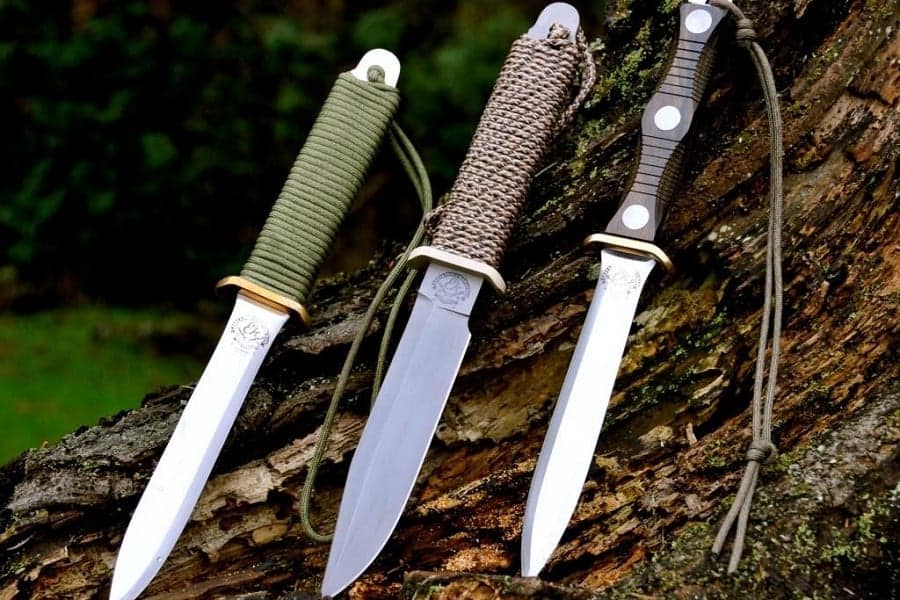
A dagger is a double-edged, symmetrical, pointed blade built for one job above all others: driving a thrust into a target. “Knife” is the broad parent category, and most knives are single-edged, utility-focused tools meant for cutting, slicing, and general work rather than stabbing. That single distinction, edges and intent, is the whole argument, and everything below is me unpacking what it means at the bench, in the field, and in the law.
The confusion between the two is understandable. A dagger technically is a knife, the way a square is a rectangle. But when someone asks me the difference between a dagger and a knife, they are really asking what separates a purpose-built weapon from the everyday blade in their pocket. Let me lay it out the way I would at the counter, without the gloss.
The Short Definition
A dagger is a knife whose defining traits are a double edge, a symmetrical profile, and a fine point optimized for penetration. A standard knife is anything else in the family: chef’s knives, hunting knives, pocket folders, fillet blades, and the rest. The dagger sits inside the category “knife” as a narrow, specialized branch. Every dagger is a knife. Very few knives are daggers.
This matters because the two are designed against opposite priorities. A utility knife is built to cut material efficiently and survive rough handling. A dagger is built to concentrate force at a point and cut both ways on the withdrawal. Once you see that split, the geometry, the history, and the legal treatment all fall into place.
Blade Geometry: Where the Real Difference Lives
Talk to anyone who grinds steel and they will tell you the same thing: the shape decides the function. A dagger and a standard knife look different in the hand because they are solving different problems.
Single Edge vs Double Edge
A standard knife almost always has one sharpened edge and a flat or rounded spine on top. That spine is structural. It lets you brace a thumb for control, baton the blade through wood, or press down without slicing your own hand. A dagger, by contrast, is sharpened on both sides. There is no safe spine to hold. Both edges run to the tip, which makes the blade cut on the push and the pull but removes almost every option for controlled utility work.
Symmetry and Taper
A dagger is symmetrical along its centerline. Draw a line from the tip to the handle and both halves mirror each other. The taper is aggressive and even, narrowing steadily from the guard to a needle-like point. That symmetry is what makes a dagger track straight when thrust. A utility knife is usually asymmetrical: a belly on the cutting edge for slicing, a straighter or clipped spine, and a taper tuned for the task rather than for penetration.
The Point
The point tells you nearly everything. A dagger point is fine, centered, and reinforced by the diamond or lens-shaped cross section that comes from grinding both edges. It is meant to enter and to resist snapping under thrust load. A standard knife point varies with the job, a drop point for control, a clip point for detail work, a tanto for durability, but it is rarely the centered spike you see on a dagger, because most knife work does not revolve around piercing.
If you want to go deeper on how point and edge geometry change the way a blade performs, our guide to the best fixed blade knife breaks down the common grinds and where each one earns its keep.
Purpose: Cutting Tool vs Thrusting Weapon
Here is the honest core of it. A knife is a tool. A dagger is a weapon. Everything else is a consequence of that.
A utility or outdoor knife is a general-purpose cutting instrument. You use it to prepare food, process game, cut cordage, carve, and handle the hundred small jobs that come up in a day. It rewards a stout spine, a single durable edge, and a point you can lean on without fear. When judging a field knife, the questions are how it batons, how it holds an edge through dirty work, and how comfortable it is over long sessions.
A dagger is optimized for thrusting and self-defense. The double edge and centered point exist to penetrate, and the symmetrical grind means it slices on the draw as well as the drive. That same design makes it a poor daily tool. Two live edges give you nowhere to place a guiding hand, the fine point is fragile against hard material, and the thin cross section is not built for prying or batoning. The dagger trades away versatility to become very good at one narrow thing.
This is why I steer most people toward a solid utility blade. If self-defense is the real concern, a controllable fixed blade or a well-built folder covers far more ground than a dagger, and our roundup of the best tactical knife options walks through blades that balance defensive capability with everyday usefulness.
A Short History of the Dagger
The dagger is one of the oldest weapon forms we have. Flint and bone versions date back to the neolithic, and once metalworking arrived it became a fixture of nearly every warrior culture. What interests me is how many distinct regional forms evolved, each tuned to a specific fighting context.
The Stiletto
The stiletto is the dagger stripped to its purest thrusting intent. It emerged in Renaissance Italy with a long, thin, often needle-like blade and little or no cutting edge at all. It was designed to punch through the gaps in armor and heavy clothing where a broad blade could not reach. The stiletto sacrifices slicing ability entirely in exchange for penetration, and its narrow profile made it easy to carry and conceal, which is part of why the name still carries a shadowy reputation.
The Dirk
The dirk is the long dagger of the Scottish Highlands, a stout companion blade carried alongside the broadsword. Longer and heavier than most daggers, it served as both a secondary weapon and a working tool in a way many daggers never did. The dirk shows how the line between weapon and utility blade could blur when a design had to earn its place in a hard life.
The Rondel
The rondel dagger takes its name from the round disc guards at either end of the grip. It was the sidearm of medieval knights and men-at-arms, built with a stiff, tapering blade meant to find the joints of plate armor. The disc guards let the user put full body weight behind a thrust without the hand sliding onto the blade. The rondel is the dagger at its most industrial: a specialized armor-defeating tool with no pretense of being anything else.
Dagger vs Knife vs Bowie vs Stiletto: The Comparison
To make the distinctions concrete, here is how the main types stack up on the traits that actually matter. The legality column is a general note for the United States, not legal advice, and I will expand on that below.
| Type | Edges | Point | Primary Purpose | Typical Legality Note |
|---|---|---|---|---|
| Dagger | Double | Fine, centered, symmetrical | Thrusting, self-defense | More restricted in many states; double-edge carry often limited |
| Standard knife | Single | Varies (drop, clip, tanto) | Utility, cutting, everyday tasks | Generally the least restricted category |
| Bowie | Single (sometimes false top edge) | Clipped, forward-swept | Large utility, hunting, historical fighting | Size may trigger blade-length limits in some states |
| Stiletto | Minimal or none | Very fine, needle-like | Pure thrusting | Often heavily restricted; associated with switchblade laws |
The pattern is clear. The more a blade leans toward a fine point and a double edge, the more scrutiny it tends to draw. The Bowie is interesting because it is a large single-edged utility and fighting knife; some versions grind a “false edge” on the upper clip, which sharpens part of the spine without making the blade a true double-edged dagger.
The Legal Angle
This is where I have to be careful, because I am a knife reviewer, not a lawyer, and knife law in the United States is a patchwork. What I can give you is the general shape of it, and the strong recommendation that you confirm your own state and local rules before carrying anything.
As a broad pattern, double-edged blades and daggers face more restriction than single-edged utility knives. Many states single out “dirks,” “daggers,” and “double-edged knives” by name in their concealed-carry statutes, and some limit or prohibit carrying them concealed even where a single-edged knife of the same length would be fine. The symmetrical thrusting design is what the law tends to react to, because historically these blades were weapons first and tools second.
Blade length limits, open versus concealed carry rules, and restrictions on specific mechanisms like automatic opening all layer on top of the double-edge question. A blade that is perfectly legal to own at home may be illegal to carry in your pocket, and rules can change at the city or county level. None of this is uniform, and none of it should be taken from an article as gospel.
For a fuller treatment of how these rules vary and what terms to watch for, see our overview of knife laws. Treat it as a starting point for your own research, then verify with your local jurisdiction.
So Which Should You Own?
For nearly everyone, the answer is a good utility knife, not a dagger. A well-made single-edged blade handles food prep, outdoor tasks, and general cutting far better than any dagger, and it carries a lighter legal burden almost everywhere. A dagger is a specialist. Collecting, historical interest, or a specific trained purpose are legitimate reasons to own one, but do not mistake it for a do-everything blade.
If your real goal is preparedness rather than fighting, a dependable fixed blade covers far more scenarios. Our guide to the best survival knife models focuses on blades built to work hard across a wide range of conditions, which is exactly what a dagger is not designed to do.
Frequently Asked Questions
Is a dagger a knife?
Yes. A dagger is a specific type of knife, defined by its double edge, symmetrical profile, and fine thrusting point. “Knife” is the broad category that contains it. So every dagger is a knife, but the vast majority of knives are not daggers.
What makes a knife a dagger?
Three traits together: two sharpened edges instead of one, a symmetrical shape along the centerline, and a fine centered point built for penetration. A single-edged blade, even a very pointed one, is generally not a true dagger. It is the combination of double edge and symmetry aimed at thrusting that defines the form.
Are daggers legal to own?
In most of the United States, owning a dagger is legal, but carrying one, especially concealed, is where restrictions appear. Many states name daggers and double-edged blades specifically in their carry laws. Because the rules vary by state, city, and county, you should confirm your local statutes rather than rely on a general answer. This is informational, not legal advice.
What is the difference between a dagger, a dirk, and a stiletto?
All three are thrusting weapons in the dagger family. A stiletto is the narrowest, often with a needle-like blade and little cutting edge, built almost purely to penetrate. A dirk is a long Scottish dagger, stouter and more tool-capable than most. A plain “dagger” is the general double-edged form that sits between them. Think of dirk and stiletto as regional and functional specializations of the broader dagger.
Are daggers good for utility or everyday tasks?
No, and this is the point most people miss. The double edge leaves nowhere safe to place a guiding hand, the fine point is fragile against hard material, and the thin cross section is poor for prying or batoning. A single-edged utility knife outperforms a dagger at nearly every daily task. If you want one blade for general use, a dagger is the wrong choice.
Is a dagger better for self-defense than a knife?
Not for most people. A dagger’s double edge and thrusting design demand real training to use safely, and the same features that make it dangerous to a threat make it dangerous to an untrained owner. For most, a controllable single-edged fixed blade or a quality folder is a more practical and more legally defensible choice. Effectiveness in defense comes from training and judgment far more than from having two edges.
The Bottom Line
The difference between a dagger and a knife comes down to intent expressed as geometry. A dagger is a double-edged, symmetrical, pointed thrusting weapon, a narrow specialist with a long history from the stiletto to the dirk to the rondel. A knife is the broad category of single-edged, utility-focused cutting tools that most of us actually need. A dagger is a knife, but treating the two as interchangeable is how people end up with the wrong blade for the job, and sometimes the wrong blade for the law. Choose based on what you actually intend to do, and in almost every case that points you toward a well-made utility knife rather than a dagger.
About this guide
Steel Snob Editorial
Researched from manufacturer specifications, independent tests and owner reports, and edited for accuracy by the Steel Snob team.