
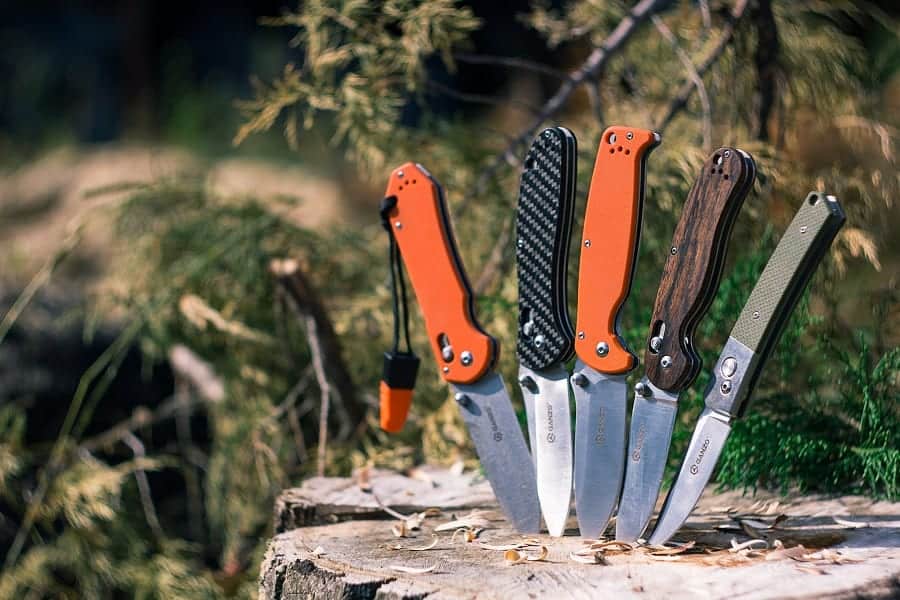
A gravity knife is a folding knife whose blade deploys out of the handle by the force of gravity or centrifugal (centripetal) force rather than by hand, then snaps into a locked position ready to use. Release a catch, let the blade drop or flick it outward, and a second catch locks it open, no thumb stud or nail nick required.
That single-motion, hands-free deployment is the whole point of the design, and it is also why gravity knives have spent most of the last century tangled up in laws written by people who never handled one. I have taken apart enough of these to know the mechanism is simpler than its reputation suggests. This guide covers how a gravity knife works, where it came from, how it differs from the switchblades and balisongs people confuse it with, and where it sits legally in 2026. Read the legal section as background, not as advice.
What Is a Gravity Knife?
A gravity knife is defined by one behavior: the blade moves from closed to open using gravity or momentum, not muscle applied directly to the blade. You unlock it, and physics does the opening. Some designs drop the blade straight out of the bottom of the handle; others swing it out on a pivot when you flick your wrist. Either way, the user is not pushing the blade open with a thumb, and there is no spring driving it, which is the line that separates a gravity knife from a switchblade.
The term “gravity blade knife” gets used loosely for anything that flops open when you shake it, but a true gravity knife is engineered for it: a release catch frees the blade, and a separate locking catch secures it open. Without that second lock, you just have a floppy folder. The classic example, the one every other design traces back to, is the German paratrooper knife of the Second World War.
How a Gravity Knife Works
The mechanism has three jobs: hold the blade closed, release it on command, and lock it open. On the archetypal side-opening German pattern, the blade rides inside a channel in the handle rather than folding flat against a backspring. A spring-loaded catch, usually a lever on the spine, holds the blade retracted. Release that lever and the blade is free to travel.
From there, gravity or a flick does the work:
- Drop deployment. Point the handle down, release the catch, and the blade slides out under its own weight until it reaches full extension.
- Centrifugal deployment. Hold the release, snap your wrist, and momentum throws the blade out. This is faster and the motion most people associate with the knife.
Once the blade reaches the open position, a second catch drops into a notch and locks it, so the blade will not fold on your fingers under load. To close it, you disengage the lock, invert the handle, and let the blade slide back into the channel. Out-the-front variants use the same logic on a linear track instead of a pivot, with the blade shooting straight forward rather than swinging to the side.
Two things are worth flagging. First, no spring propels the blade in a genuine gravity knife; if a spring launches it, you are holding an automatic, legally a different animal. Second, wear matters. As the channel and catches wear, some folding knives that were never meant to open by gravity begin to do so, which is exactly the ambiguity that has fueled so many legal fights.
History: The Fallschirmjager-Messer
The gravity knife was born as a paratrooper’s tool. In the late 1930s, German designers developed the Fallschirmjager-Messer, the paratrooper knife issued to Luftwaffe airborne troops. A paratrooper who landed tangled in his own lines needed to cut himself free with one hand, often the only hand he could spare. A conventional two-hand folder was useless in that moment.
The solution was elegant. The blade lived in a channel in the handle and deployed by gravity when the trooper released the catch, no second hand needed. Most examples also carried a folding marlinspike for working knots and rigging. The knife was a rescue and utility tool first, a weapon a distant second, an origin easy to lose under the modern legal baggage.
The design spread. Allied forces developed their own airborne knives, and British paratrooper variants and Italian alpine patterns followed the same single-hand deployment idea. After 1945, surplus and civilian copies reached the United States, and the mechanism that had been a lifeline for a man hanging in a tree became, in the eyes of postwar lawmakers, something to prohibit.
Gravity Knife vs Switchblade vs Assisted vs Butterfly
People conflate these four constantly, and the distinctions actually matter, both mechanically and legally. Here is the clean version.
Gravity knife
Blade deploys by gravity or centrifugal force once a catch is released. No spring drives the blade. The user provides no direct force to the blade itself beyond releasing the catch and, on flick designs, the wrist motion.
Switchblade (automatic)
A spring or other stored-energy mechanism drives the blade open when you press a button or lever. The defining feature is the spring doing the work. This is the category the US federal Switchblade Knife Act was written to address, and gravity knives got swept in alongside it.
Assisted-opening knife
You start the blade moving with a thumb stud or flipper, and a torsion bar finishes the motion once you pass a detent. The blade will not move at all until you manually push it past that point, so courts and statutes generally treat assisted openers as manual folders, not automatics. This is why an assisted-opening knife is legal in many places where a switchblade is not.
Butterfly knife (balisong)
Two counter-rotating handles swing around the blade’s tang to expose or conceal the edge. No spring, no gravity release, no lock catch of the gravity-knife type; opening is pure hand skill and momentum. Legally it is often lumped with other restricted knives, but mechanically it has nothing in common with a gravity knife beyond looking dramatic in motion.
The short test: a spring launches an automatic; gravity or a flick with no spring is a gravity knife; if you have to start the blade yourself it is assisted or manual; if the handles fold around the blade it is a balisong.
Comparison Table
| Type | Mechanism | Legality note | Typical use |
|---|---|---|---|
| Gravity knife | Blade drops or flicks out via gravity or centrifugal force, then locks; no spring | Restricted under US federal law and some states; famously deregulated in New York in 2019; varies widely elsewhere | One-hand deployment; historical military and rescue tool; collecting |
| Switchblade (automatic) | Spring drives the blade open at the press of a button or lever | Restricted under the US federal Switchblade Knife Act; many state limits, some easing | Fast one-hand deployment; duty and utility where legal |
| Butterfly (balisong) | Two handles rotate around the tang to reveal the blade; hand-powered | Restricted or banned in several states and countries; treated as a dangerous weapon in some codes | Manipulation, flipping, EDC where legal |
| Assisted-opening | User starts the blade with a stud or flipper; a spring finishes past a detent | Generally legal as a manual folder in most US states; check locally | Everyday carry, work, general one-hand use |
Gravity Knife Laws: What You Should Know
This section is informational. It is not legal advice, and knife law changes faster than most articles get updated. Confirm your own local statutes before you buy, carry, or ship anything.
At the US federal level, gravity knives are addressed by the Switchblade Knife Act, which restricts the manufacture, sale, and interstate transport of knives that open automatically by hand pressure on a button, or by operation of inertia, gravity, or both. The federal law primarily governs interstate commerce, importation, and federal jurisdictions rather than ordinary in-state possession, which is left largely to the states.
The most instructive story is New York. For decades the state enforced its gravity-knife ban using a “wrist-flick test”: if an officer could flick a folder open with one motion, it could be charged as an illegal gravity knife, even if the knife was sold as an ordinary work folder. Because worn folders can flick open, thousands of people, disproportionately tradespeople carrying common lock-back knives, were arrested over the years. After sustained legal challenges, New York repealed its gravity-knife ban in 2019. It is the clearest illustration of why the category is legally fraught: the definition can catch tools nobody designed as a gravity knife.
Beyond that, the picture is a patchwork. Some US states still restrict or ban gravity knives outright, some restrict carry but not possession, and many say nothing specific, leaving them under general dangerous-weapon language. Outside the US, rules differ again: several countries treat gravity knives as prohibited weapons, others allow them with restrictions on carry in public. The mechanism that is perfectly legal to own at home in one place can be a criminal charge two states or one border away.
If you collect, carry, or travel with any one-hand-opening knife, read the actual statute for your jurisdiction rather than relying on a summary, and re-check it periodically. Our overview of knife laws is a starting point, not a substitute for the current text of your local code.
Modern Gravity and Paratrooper-Style Knives
Genuine gravity knives are a niche today, driven by legal restrictions and by the fact that assisted and manual flippers now deliver fast one-hand opening without the same baggage. Still, the paratrooper lineage lives on.
The original German Fallschirmjager-Messer remains the reference design and a serious collector’s item, especially wartime Luftwaffe examples and their marlinspike variants. Postwar and reproduction paratrooper knives, including the later Bund (Bundeswehr) gravity knives issued to German forces, keep the drop-out-the-bottom mechanism alive and are far more attainable than the original wartime pieces.
On the modern side, brands associated with hard-use knives, such as Microtech with its out-the-front designs, echo the single-hand deployment concept even when the mechanism is technically an automatic rather than a pure gravity knife. If your interest is the one-hand-opening capability rather than the specific gravity mechanism, a well-built manual or assisted folder will serve you better day to day and keep you clear of the murkiest part of the law. For that kind of carry, look at a solid pocket knife or a purpose-built EDC knife instead.
Frequently Asked Questions
Is a gravity knife legal?
It depends entirely on where you are. US federal law restricts the sale and interstate transport of gravity knives under the Switchblade Knife Act, and some states ban or restrict them while others do not. New York, once the strictest enforcer, repealed its ban in 2019. Always check your specific state and local statute first. This is informational, not legal advice.
What is the difference between a gravity knife and a switchblade?
A switchblade uses a spring to drive the blade open at the press of a button. A gravity knife has no spring; it opens by gravity or a centrifugal flick once you release a catch, then locks. The presence or absence of a spring is the core distinction, even though the law often treats both as automatics.
Are gravity knives still made?
Yes, in small numbers. Original and reproduction German paratrooper knives are still traded, and later military patterns like the Bundeswehr gravity knife remain available to collectors. Legal restrictions and the rise of assisted and manual flippers have pushed genuine gravity knives to a collector niche rather than a mainstream carry option.
How does a gravity knife work?
You release a spring-loaded catch that holds the blade retracted in the handle. Gravity drops the blade out, or a wrist flick throws it out by centrifugal force, and a second catch then locks it open. To close it, you release the lock, invert the handle, and let the blade slide back in. No spring propels the blade.
Why was New York’s gravity-knife law so controversial?
New York enforced its ban with a wrist-flick test: if an officer could flick a folder open in one motion, it could be charged as a gravity knife, regardless of the maker’s intent. Worn everyday folders often pass that test, so thousands of ordinary tradespeople carrying common work knives were arrested. That unfairness drove the 2019 repeal.
Is a gravity knife a good everyday carry option?
Usually not. The legal status is uncertain in many places, and modern assisted-opening and manual flipper knives deliver the same fast one-hand deployment with far less legal risk and often better ergonomics. For daily use, a quality assisted or manual folder is the more practical choice; save the gravity knife for collecting or for jurisdictions where it is clearly legal.
About this guide
Steel Snob Editorial
Researched from manufacturer specifications, independent tests and owner reports, and edited for accuracy by the Steel Snob team.