
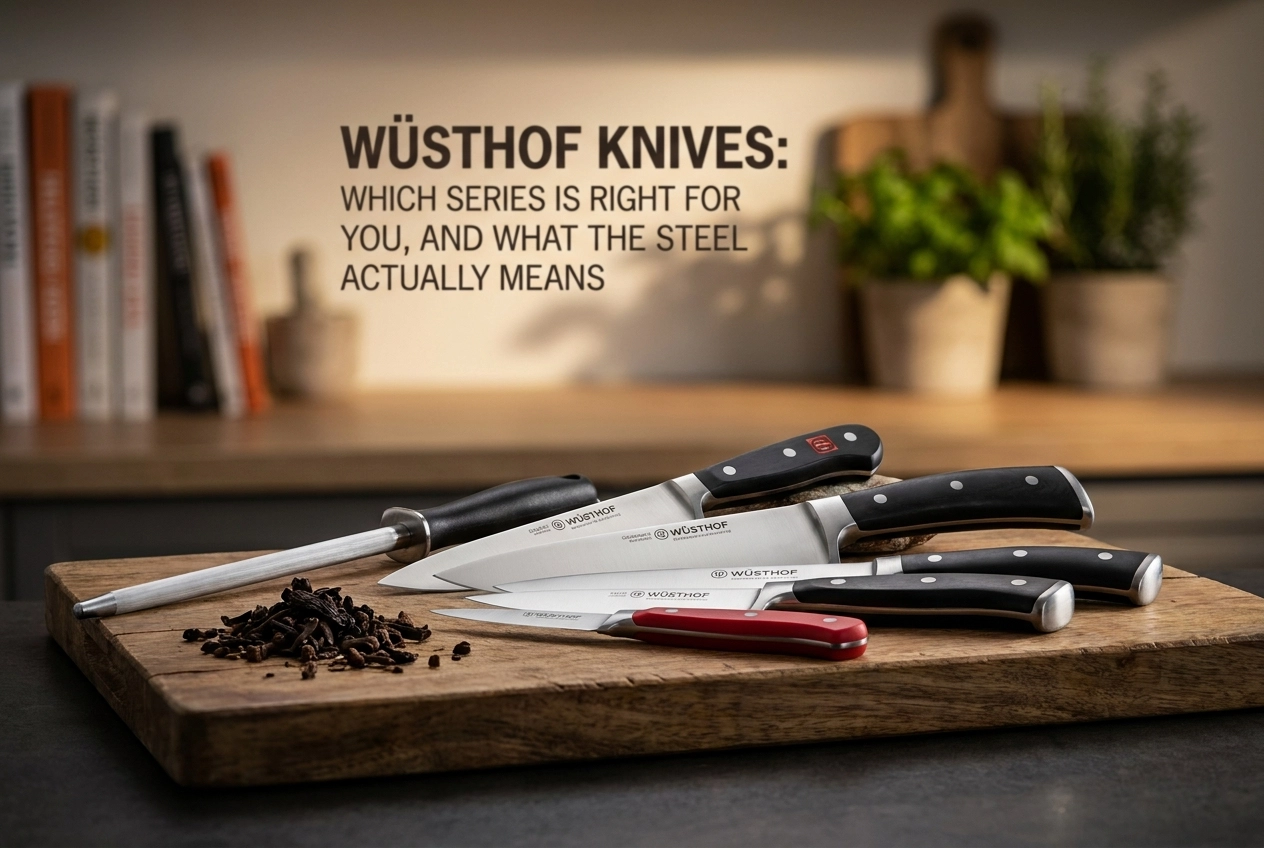
Few knife brands inspire as much loyalty, or as much confusion, as Wüsthof. Walk into any serious kitchen retailer and you’ll find multiple lines sitting side by side, each with a slightly different name, price point, and steel specification. For anyone who already knows their way around a cutting board and wants to invest in quality, the choices can feel overwhelming rather than helpful.
Understanding Wüsthof knives goes beyond picking a handle style you like. The steel composition, heat treatment, and blade geometry all vary between series, and those differences have real consequences for how a knife performs, how long it holds an edge, and how much maintenance it demands from you.
This guide breaks down the most important Wüsthof series, explains what the steel designations actually mean in practical terms, and helps you match the right line to your cooking habits and sharpening routine. Whether you are eyeing the Classic, considering the Ikon, or wondering if the Performer series justifies its premium, you will leave with a clear framework for making a confident, well-informed decision.
What X50CrMoV15 steel means for your kitchen
Every Wüsthof knife in the Classic lineup is built from X50CrMoV15, and the name tells you most of what you need to know before you ever pick up the blade.
Reading the alloy designation
The designation is a European EN/DIN chemical shorthand. Work through it left to right. The X flags this as a high-alloy stainless steel under the EN classification system. The 50 encodes a target carbon content of roughly 0.50%, with published composition tables placing the actual range at approximately 0.45 to 0.55% (per vendor-sourced spec data derived from EN/DIN conventions; confirm against a primary mill certificate or the EN 10088 standard entry for 1.4116 before treating those figures as exact). Carbon drives hardness potential. More carbon generally means a harder, more wear-resistant edge, but it also makes the steel more brittle if pushed too far.
Cr is chromium, and the 15 suffix indicates roughly 14 to 15.5% chromium by weight. That level sits well above the approximately 13% threshold at which a steel earns its stainless classification, so corrosion resistance is genuine, not nominal. The Mo addition (molybdenum, approximately 0.50 to 0.80%) improves hardenability and adds strength at the grain level. The V addition (vanadium, approximately 0.10 to 0.20%) refines grain structure and adds modest wear resistance. The steel is also designated DIN 1.4116. Those four elements working together explain why this formula has become the standard alloy for German cutlery.
What 58 HRC feels like in practice
Wüsthof heat-treats X50CrMoV15 to a target of approximately 58 HRC on the Rockwell C scale. That number sits in a deliberate sweet spot: hard enough to hold a working edge through regular kitchen use, soft enough to remain genuinely tough under impact. Knife Forest’s breakdown of X50CrMoV15 describes the design philosophy clearly: a kitchen knife should be reliable, easy to maintain, and ready for everyday cooking.
In practical terms, 58 HRC means three things. First, the edge responds well to a standard whetstone without requiring diamond plates or specialized equipment. A 1000-grit stone followed by a 3000-grit stone will restore the edge cleanly. Second, the steel resists chipping when the blade contacts a chicken bone, a hard winter squash, or a thick rind. A harder Japanese steel at 61 to 63 HRC holds a finer edge but micro-chips under that same lateral stress. Third, you do not need to store the knife with the obsessive care that harder blades demand. A magnetic strip is fine. A wood block is fine. The edge tolerates minor contact without rolling catastrophically.
The 15 to 20 degree bevel
Wüsthof grinds its Classic series to a 15 to 20 degree edge angle, wider than the 12 to 15 degree geometry common on Japanese knives. A wider bevel does several things simultaneously. It creates a thicker edge cross-section that pushes food aside as the blade passes through, which assists momentum during chopping. It distributes lateral stress across more steel, so the edge survives the sideways torque that happens when you rock through a dense carrot or twist slightly while cutting. The trade-off is straightforward: a 15 to 20 degree edge does not bite into food as aggressively on the first pass as a 12 to 15 degree edge does. For push-cutting delicate protein or paper-thin cucumber slices, the Japanese geometry has the advantage. For general prep work, the German geometry holds its own and forgives errors.
A note on the data
The alloy percentages above are implied by the EN/DIN designation and corroborated by publicly available composition tables. They are not drawn from an independently verified primary mill specification. Edge retention intervals that circulate online, including the 12 to 16 week estimates between sharpenings, originate from a single commercial sharpening operator, not from controlled lab testing. We flag those figures rather than repeat them as benchmarks. When Steel Snob cites a figure, it comes from an independent test or a named source, and that is the figure we stand behind.
The practical bottom line
X50CrMoV15 at 58 HRC is a forgiving, long-lived, maintainable steel. It suits the cooking habits of most US home cooks who do not yet have a consistent sharpening routine. You can hone it weekly on a smooth honing rod, touch it up on a whetstone a few times a year, and the blade will perform reliably for a very long time. That is not a compromise. That is the right engineering decision for the job.
Forged vs. stamped: why construction matters more than marketing
How a blade is made matters more than any marketing claim. Construction method determines balance, repairability, and how the knife behaves after ten years of sharpening, not just on day one.
Forged construction: Classic, Classic Ikon, and Ikon
Wüsthof’s forged lines start with a single steel billet. That billet is heated and shaped under pressure, a process that aligns the grain structure of the metal and produces a blade with a full bolster, a denser spine, and a heel-to-tip taper. That taper is not just a feel preference. As you sharpen a forged blade over years, the geometry changes in a controlled, predictable way. The edge profile stays coherent because the blade was designed with progressive wear in mind. The bolster also shifts the balance point toward the handle, which most home cooks find more comfortable at the pinch grip during extended prep sessions.
Stamped construction: the Gourmet line
The Gourmet series takes a different path. A blade blank is punched from a rolled steel sheet, then ground and heat-treated. The process is less labor-intensive and the result is lighter and thinner. That is not a flaw. A lighter knife reduces fatigue during high-volume tasks, and the Gourmet line uses the same X50CrMoV15 steel as the forged range. What you give up is the heel-to-tip taper and the mass-forward balance of a forged blade. The balance point sits closer to center, which feels less intuitive at a pinch grip but suits cooks who prefer a lighter tool.
The bolster problem every sharpener knows
A full bolster protects your fingers and feels solid, but it creates a long-term sharpening issue. Every whetstone session removes metal from the cutting edge. The bolster, however, does not sharpen. After years of use, a concave gap opens between the edge and the heel, leaving the last inch of the blade unusable. Correcting it requires a choil grind or professional bolster removal, neither of which is free or simple. Half-bolster and no-bolster designs avoid the gap entirely, though they feel less substantial in the hand.
Wüsthof addresses this distinction directly on their own site, and it is worth reading their framing alongside independent sharpening guidance before you commit to a line.
Longevity and the practical decision
One professional sharpener has assessed Wüsthof’s forged lines as capable of 20-plus years of service under real-world kitchen conditions, including abuse. Stamped knives can last many years with proper care, but they are not rated to the same standard in available source data. The geometry that makes a forged blade repairable over decades is simply not present in a stamped blank.
The practical call is straightforward. If you are buying one knife that will see daily use for the next decade, the forged lines justify the premium. If you need a bread knife, a boning knife, or any specialty blade that comes out twice a week, the Gourmet stamped line is a sensible and honest choice. Match the construction to the workload, not to the price point you assume you should be at.
Series-by-series breakdown: which Wüsthof line fits your kitchen
Wüsthof’s lineup has expanded considerably over the years, and the number of active series can make a straightforward purchase decision feel more complicated than it needs to be. The core question is simple: which construction method, handle material, and steel specification actually matches how you cook? The series breakdown below answers that directly, with a clear note on who each line serves and who should move on.
Classic: the benchmark
The Classic is where every Wüsthof comparison starts, and for good reason. It is forged, carries a full bolster, uses a black polyoxymethylene (POM) handle, and is built from X50CrMoV15 steel hardened to 58 HRC. Those specs, covered in the metallurgy section above, translate to a blade that holds an acute edge without the brittleness risk you get from harder Japanese steels. The POM handle is inert, dishwasher-safe in practice (though hand-washing is still better), and built to outlast most kitchens it ends up in. This is the most widely reviewed series in the lineup and the one with the deepest community track record behind it.
Who this is for: Home cooks who want one knife to carry them through 20-plus years of daily use. The Classic rewards consistent maintenance and forgives the occasional rough treatment.
Who should skip it: Cooks who sharpen exclusively on a whetstone. The full bolster blocks the heel of the blade from making full contact with the stone, which means you either flatten the bolster over time or accept an uneven bevel near the handle. If whetstone sharpening is your practice, look at options below.
Classic Ikon: ergonomics first
The Classic Ikon is built on the same forged platform and uses identical X50CrMoV15 steel at 58 HRC. The meaningful difference is the handle. The contoured double-bolster design, available in black or creme, distributes weight differently from the single-bolster Classic and fits a broader range of hand sizes more naturally. Cooks who spend extended time at a cutting board often report less fatigue with the Ikon handle shape.
One notable development: Wüsthof has listed a Classic Ikon Asian Utility Knife as new on the 2026 official site. That is a signal worth paying attention to. It suggests Wüsthof is deliberately moving German-forged construction into Japanese-influenced blade profiles, a direction that will likely expand within this line. If you prefer a lighter, more nimble profile for fine vegetable work, watch this series closely as it develops.
Who this is for: Home cooks logging longer prep sessions, or anyone who found the Classic handle uncomfortable in extended use.
Who should skip it: Cooks on a strict budget; the Ikon handle commands a price premium for what is, mechanically, the same steel and the same forged construction.
Ikon Blackwood: premium handle, real maintenance commitment
The Ikon Blackwood puts an African blackwood handle on the same forged, X50CrMoV15 platform. Blackwood is dense and stable for a natural material, but it is still a natural material. It responds to water, heat, and detergent differently than POM. In a dry kitchen environment with consistent hand-washing and occasional oiling, the handle will develop a grip feel that synthetic options cannot replicate. That tactile quality is a legitimate functional variable, not purely cosmetic.
A note on availability: as of the current site navigation, Ikon Blackwood does not appear in the primary series listing on wusthof.com. Confirm current availability with Wüsthof or an authorized retailer before purchasing. Residual stock at third-party retailers does not mean a series is still actively supported.
Who this is for: Cooks who want the durability of German forged construction with a handle that feels warmer and more organic in the hand.
Who should skip it: Anyone who leaves knives in a sink, soaks cutting boards while a knife sits nearby, or uses a dishwasher. Blackwood and water are a slow-moving problem.
Gourmet: the accessible entry point
The Gourmet is stamped rather than forged. It is the lowest price tier in the Wüsthof lineup and carries a synthetic handle. As discussed in the forged versus stamped section, stamping produces a thinner, lighter blade that behaves differently through the cut and has less mass behind the bolster and heel. The Gourmet is a reasonable utility knife or a starter option for a cook not yet ready to invest in a forged primary.
One important caveat: the specific steel alloy and heat treatment for the Gourmet line are not confirmed in current publicly available source data. Do not assume it shares the X50CrMoV15 specification at 58 HRC. Confirm steel specification directly with Wüsthof before purchase if metallurgy is a factor in your decision.
Who should skip it: Anyone making a single premium purchase and expecting the balance, weight distribution, and long-term repairability of a forged knife. The Gourmet is not that knife.
Performer: verify before you buy
The Performer is listed as an active series on the 2026 official site. Trade coverage has associated some Performer editions with NITRO-B super steel, a high-alloy stainless with meaningfully different hardness and edge geometry characteristics compared to X50CrMoV15. Steel Snob has not independently verified the alloy or hardness for the current Performer lineup. If NITRO-B is confirmed, the performance profile differs enough from the Classic and Classic Ikon that it warrants separate evaluation, particularly around sharpening requirements and edge maintenance.
Do not buy the Performer on the assumption that it behaves like a Classic. Confirm the steel specification directly with Wüsthof first.
Crafter: oak handle, deliberate care required
The Crafter uses a smoked oak handle on a forged construction. Like the Ikon Blackwood, it may not appear prominently in the current official site navigation; confirm availability before purchasing. The oak handle is the entire differentiator here. If you want the tactile character of natural wood and are disciplined about hand-washing and drying your knives immediately after use, the Crafter delivers that warmth on a proven forged platform.
Who this is for: Home cooks who prioritize feel and aesthetics and are committed to the maintenance.
Who should skip it: Semi-professional or professional users cycling knives through a sink multiple times per service.
Classic Color: same knife, different finish
Classic Color uses the same forged construction, X50CrMoV15 steel, and 58 HRC hardness as the standard Classic. The handles come in seasonal colorways; Fresh Rosemary is the current summer 2026 offering. Functionally, this is a Classic. The color is the only variable. That is not a criticism. If kitchen aesthetics matter to you and you want the full Classic specification underneath, Classic Color is a legitimate choice, not a compromised one.
A note on lineup stability
Wüsthof has retired multiple series in recent years while launching new ones. The Wüsthof series buying guide from EverythingKitchens still references series such as Epicure, Grand Prix, and Pro that no longer appear on the current official site, which illustrates how quickly the lineup turns over. Treat any list of active series, including this one, as a snapshot. Verify current availability on wusthof.com or with an authorized retailer before purchasing. A discontinued series appearing at a retailer under residual stock is not the same as an actively supported product line.
Wüsthof vs. Shun: a straight answer on the German vs. Japanese debate
This comparison comes up constantly, and it deserves a direct answer rather than a diplomatic non-answer. The two knives are built on genuinely different technical foundations. Those differences have real consequences at the cutting board, and the right choice depends on how you cook, not on which brand has better marketing.
The numbers, plainly stated
Shun Classic uses VG-MAX steel hardened to approximately 61 HRC. The edge is ground to 12 to 15 degrees per side. An 8-inch chef’s knife comes in at roughly 5 to 6 oz. Wüsthof Classic uses X50CrMoV15 steel, the same alloy covered earlier in this guide, hardened to approximately 58 HRC. The edge runs 15 to 20 degrees per side. The same 8-inch format weighs 7 to 8 oz. These are measurable variables. They are not marketing positions.
What hardness actually means in use
Three points on the Rockwell scale is not a rounding error. At 61 HRC, the Shun takes a finer initial edge and holds it longer under clean, controlled cutting conditions. The tradeoff is brittleness. Hit a seed, contact a bone, or drag the edge across a frozen food crust and you risk micro-chipping or worse. At 58 HRC, the Wüsthof is tougher. It will not take quite as keen an initial edge, but it absorbs incidental hard contact without failing. A cook who occasionally does things a knife instructor would wince at is far better served by the German steel.
What edge angle actually means in use
The narrower Shun geometry rewards technique. Fine protein work, thin vegetable slices, tasks where the blade separates fibers by geometry rather than force: this is where a 12 to 15 degree edge earns its reputation. The wider Wüsthof angle does something different. It adds chopping momentum and tolerates the sideways stress that comes with a rocking-chop motion. Lateral pressure that would micro-chip a Japanese edge simply does not threaten the German geometry. If you learned to cook using a rocking technique and you are not planning to change, the Wüsthof angle works with you rather than against you. You can watch this geometry difference demonstrated practically in this side-by-side video comparison of Shun and Wüsthof.
Weight: neither lighter nor heavier is automatically correct
A 1.5 to 2 oz difference sounds modest on paper. Across a full prep session, it is not. Cooks who rely on the mass of the blade to drive a rocking chop tend to find Wüsthof’s weight an asset, not a burden. Cooks who use a push-cut or pull-cut style, especially those doing a lot of fine slicing, often prefer the lighter Shun because less dead weight means less fatigue over time. Be honest about how you actually cook, not how you intend to cook.
The edge retention figures deserve a caveat
One sharpening-service operator puts Wüsthof at 12 to 16 weeks between full sharpenings and Shun at 8 to 12 weeks. Treat those numbers as directional at best. The source has a direct commercial interest in shorter sharpening intervals. No independent lab protocol produced them. Steel Snob applies the same evidence standard to every figure it cites, and we flag it clearly when a cited figure comes from a party with skin in the game. The broader principle is sound: harder steel can hold a working edge longer under ideal conditions, but the gap narrows significantly if the Shun user is chipping the edge through misuse.
The verdict
For a first serious kitchen knife, Wüsthof Classic is the more forgiving choice. The steel tolerates imprecise technique. The geometry works with common cutting styles. The weight helps rather than fights. For a cook who already hones consistently, understands what a 15-degree bevel requires, and does a significant amount of fine slicing work, Shun is a legitimate alternative, not a compromise. The practical answer most experienced cooks arrive at is that these knives solve different problems. The question is which problem you actually have.
Wüsthof vs. the alternatives at the same price point
The Wüsthof Classic 8-inch chef’s knife sits firmly in the midrange to premium band. At that price, you are not shopping in a vacuum. Three names come up consistently in the same conversation: Henckels Professional S, MAC Professional, and Victorinox Fibrox Pro. They are not equally valid comparisons, and treating them as interchangeable does the buyer a disservice.
Henckels Professional S
This is the most direct comparison. Henckels Professional S uses a German steel formulation and a forged construction philosophy that closely mirrors the Wüsthof Classic. The differences are real but incremental. Handle geometry varies slightly, the balance point shifts a fraction toward the handle on some Henckels editions, and Wüsthof carries a longer track record of independent review coverage at the series level. Some Henckels editions also run a marginally softer heat treatment than the Classic’s consistent 58 HRC, though this varies by production run and should be verified against current spec sheets before purchase.
Neither knife is objectively superior. If you can handle both in a store, that is the only test that matters for this comparison. Grip preference and balance feel will settle it faster than any specification chart.
MAC Professional
MAC Professional is a different proposition entirely. The steel runs harder, typically in the 61 to 62 HRC range, the body is lighter, and the geometry is Japanese-influenced with a thinner grind and a more acute edge angle. For cooks who rely on a forward push-cut stroke, it is an excellent knife. The edge is noticeably more refined out of the box.
The tradeoff is maintenance. A harder steel at a thinner grind chips more readily on hard produce and requires a more careful sharpening routine. Freehand sharpening at the correct angle, or a quality guided system, is not optional with MAC Professional. It is a commitment. For a cook who already has that routine in place, MAC Professional is a strong alternative at a comparable price point. For someone buying their first serious kitchen knife, the maintenance demands are closer to what you would expect from a Shun than from a Wüsthof. The Classic is more forgiving, and that forgiveness has real value over a decade of daily use.
Victorinox Fibrox Pro
This knife belongs in a separate conversation. It is a legitimate workhorse, stamped rather than forged, running a softer steel, and available at a fraction of the price of the Wüsthof Classic. Recommending it as a direct alternative conflates budget bands in a way that does not help the buyer make a clear decision. If your budget is under $50, Victorinox Fibrox Pro is worth serious consideration on its own terms. It is not a cheaper version of the Classic. It is a different class of tool built to a different standard.
Practical guidance
If you are committing midrange to premium dollars to a single chef’s knife, the Wüsthof Classic justifies the price through construction quality, documented longevity, and the depth of independent review support it has accumulated. A Food & Wine staff writer documented nearly a decade of continuous daily use without replacing the knife, which is the kind of real-world evidence that matters more than a lab figure.
If you are building a two-knife setup, the calculus shifts. A German workhorse for breaking down protein and rough prep, paired with a lighter, harder Japanese-influenced blade for detail work and fine slicing, is a genuinely functional combination. In that context, MAC Professional or a Shun entry model works well as a complement to the Classic rather than a replacement for it. That is a more advanced purchasing decision, and it only makes sense once you have the sharpening discipline to maintain both edges correctly.
Honing and sharpening X50CrMoV15 at 58 HRC: practical guidance
X50CrMoV15 at 58 HRC is one of the most maintenance-friendly kitchen knife steels available. It responds well to standard honing and sharpening tools, tolerates minor technique variation, and does not demand the specialized equipment or careful handling that harder Japanese alloys require. What follows is a practical guide tied directly to the metallurgy and construction of the Wüsthof Classic.
Rod selection for routine honing
Use a smooth or lightly ridged honing steel for regular maintenance. At 58 HRC, the edge is malleable enough that a plain steel rod realigns the apex effectively without removing meaningful metal. A ceramic honing rod is also a sound choice; it introduces light abrasion at each pass, which is entirely appropriate at this hardness and provides a slight refresh to the edge geometry beyond pure realignment. What to avoid is a diamond-coated rod for everyday honing. Diamond rods are aggressive. They remove more metal than the situation warrants on a steel this forgiving, and over months of regular use that cumulative loss adds up without any corresponding edge-quality benefit. Save a diamond rod for re-profiling a badly damaged edge, not routine maintenance.
Honing angle
Match the factory bevel. Wüsthof has refined its edge geometry in recent years, and the Classic line now comes ground to roughly 14 to 17 degrees per side from the factory. A maintenance target of 15 to 17 degrees per side is appropriate for most home cooks and keeps you consistent with the original geometry. The moderate hardness of X50CrMoV15 means minor angle variation will not immediately ruin the edge. The steel is forgiving in that regard. The caveat is that inconsistency compounds. Hone at a slightly different angle every session and you gradually round the bevel, eventually requiring more aggressive whetstone correction to restore a clean apex. Consistency is worth the discipline.
Whetstone progression
X50CrMoV15 cuts quickly on abrasive stones, which works in your favor. After significant edge degradation, start at 1000 to 1200 JIS grit to re-establish the bevel. This steel responds rapidly at that grit; you rarely need to go coarser in a home kitchen context. Move to a 3000 to 4000 grit stone to refine and smooth the bevel, then finish on 6000 to 8000 grit for a polished working edge. That progression is sufficient for demanding home use. Ultra-fine finishing stones above 10,000 grit are not necessary unless you are specifically pursuing a shaving edge; the steel’s moderate hardness means it benefits less from extended fine-grit work than harder Japanese alloys at 61 HRC and above.
Bolster awareness on the Classic
The Classic’s full bolster creates a specific sharpening challenge. Because the bolster sits proud of the heel, flat-stone sharpening from heel to tip will gradually produce a hollow gap at the blade’s base. To avoid this, work from the center of the blade forward on a flat stone and address the heel separately, or use a guided angle system that maintains consistent contact regardless of bolster geometry. After several years of regular sharpening cycles, a professional bolster grind is worth considering to restore full heel-to-tip usability. This is not a flaw unique to Wüsthof; it is a structural reality of the full-bolster forged design.
How often to sharpen
Any fixed interval is directional only. The 12 to 16 week estimate cited by commercial sharpening operators reflects average residential use, not your kitchen specifically. The practical rule is straightforward: hone before or after every significant use session, and sharpen when honing no longer restores a working edge. Cutting surface matters enormously here. End-grain wood is least damaging to the edge; ceramic or glass surfaces will degrade it quickly regardless of steel quality. Technique and volume matter equally. A home cook prepping five dinners a week on a plastic board will sharpen far less often than someone breaking down proteins daily.
For step-by-step technique tied to these specifications, see the Steel Snob whetstone sharpening guide and honing rod explainer, which cover stone selection, angle-holding methods, and burr removal in detail suited to steels in the 56 to 60 HRC range.
Warranty and long-term ownership
Wüsthof backs its knives with a lifetime warranty against manufacturing defects. At the midrange to premium price point, that is not a trivial detail. It is one of the clearest signals the company gives that it expects these knives to outlast the average kitchen drawer rotation. Real-world evidence supports the claim: owners have reported successful warranty claims on Classic series knives that were two decades old, with handle defects covered at no cost. The warranty does not make the knife immortal, but it does make the ownership calculation meaningfully different from buying a budget blade.
What the warranty does not cover
The coverage applies to defects in materials and workmanship, not to damage you cause. Common exclusions in this product category include dishwasher use, contact with glass or ceramic cutting surfaces, prying with the blade, and cutting into frozen food. None of those are covered, and all of them can cause visible damage. Confirm the current terms and claim procedure directly at Wüsthof’s warranty page before you need it, as procedures can change. The warranty details page provides additional documentation.
Habits that protect the blade and the coverage
The practices that keep the warranty intact are the same ones that preserve the steel. Hand wash with mild soap and dry immediately; prolonged moisture accelerates corrosion even in a stainless alloy like X50CrMoV15. Store on a magnetic strip or in a blade guard. Loose storage in a drawer damages the edge and risks handle chips. Cut on wood or plastic boards only. Glass, ceramic, and stone surfaces destroy a 15 to 20 degree edge in a single session.
The per-year cost argument
A Wüsthof Classic 8-inch chef’s knife sits in the midrange to premium band. Maintained properly and sharpened on the schedule outlined in the previous section, it carries a credible path to 20-plus years of daily use. Divide that purchase price across two decades and the annual cost drops well below what most households spend replacing cheaper knives every two or three years. The math is straightforward, and the warranty is the underwriting on that calculation.
Who should buy Wüsthof, and who should skip the brand
Buy Wüsthof if
You are making your first serious knife purchase. You do not yet have a disciplined sharpening routine. You rely on a rocking-chop motion rather than a push-cut or pull-cut technique. You cook across a wide range of tasks, including occasional hard-material work like splitting small squash or breaking down a whole chicken. You want a knife that will still be serviceable in 20 years without treating it like a museum piece. The X50CrMoV15 steel at 58 HRC is genuinely forgiving. It will not chip if you hit a bone at a bad angle. It sharpens on standard equipment and does not demand a specialist to maintain it.
Skip Wüsthof if
You already have strong knife technique and know how to maintain a harder edge. You prefer a lighter blade for fine slicing work, the 7 to 8 oz weight of the Classic 8-inch is a real difference in the hand compared to lighter alternatives. You are drawn to harder Japanese steels and are prepared to maintain them properly on whetstones at the correct angle. You have wrist fatigue or an injury that makes a heavier forged knife a physical barrier over a long cooking session. None of those are criticisms of Wüsthof; they are honest use-case mismatches.
Series verdict
Start with the Classic series if you want one knife to do everything. Step up to Classic Ikon if ergonomics matter more than price. Treat the Gourmet as a secondary or budget entry, not a flagship. Investigate the Performer and Crafter only after verifying current steel specifications directly with Wüsthof before buying.
For further reading, see our German kitchen knives overview, whetstone sharpening guide, honing rod types explained, and X50CrMoV15 vs. VG-10 steel comparison.
Conclusion
Choosing the right Wüsthof series comes down to four things: your budget, your sharpening habits, how hard you use your knives, and the handle feel that keeps you cooking confidently. The steel composition is not just marketing; it directly shapes edge retention, corrosion resistance, and long-term durability. Higher-spec lines like the Performer deliver measurable performance gains, but the Classic remains a benchmark for good reason.
Do not let the range of options paralyze you. Use what you learned here to narrow your shortlist to two series, then handle them in person if possible. A knife you reach for every day will always outperform a technically superior one that feels wrong in your hand.
Invest deliberately, maintain consistently, and the right Wüsthof will reward you for decades.