
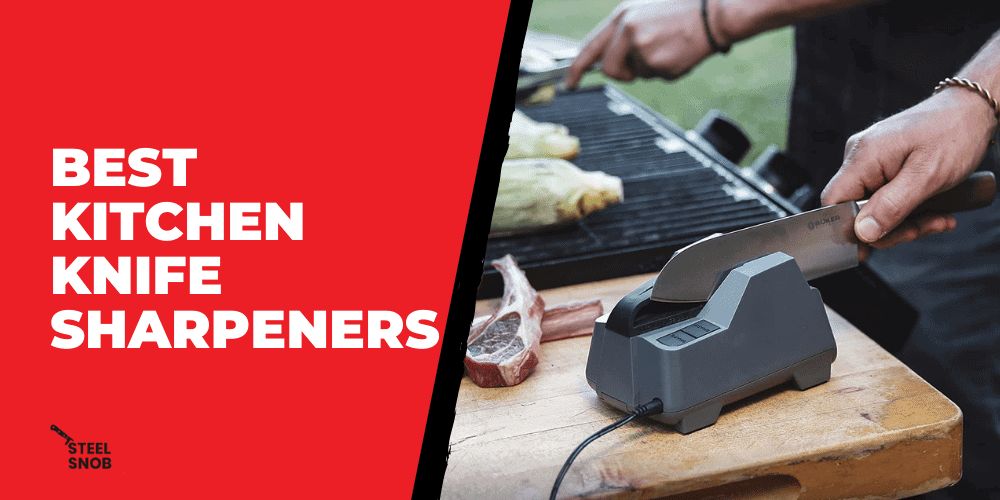
If you searched for the best knife sharpener, you want one clear answer: which tool will put a working edge back on your kitchen knives without wrecking them. This guide covers the sharpeners we recommend, sorted by type so you can match the tool to how you cook and how much you want to learn.
Below are eight sharpeners worth your counter space in 2026, plus the background you need to pick one and use it well. The verdicts draw on manufacturer specifications, independent tests and long-term owner reports.
Best Knife Sharpener 2026: Quick Comparison
Four families of tool do four different jobs. Electrics trade control for speed. Manual pull-throughs are cheap and fast but blunt in the wrong way if you lean on them. Whetstones give the best edge and the most control, and ask the most of you. Honing rods do not sharpen at all; they straighten an edge between sharpenings. Here is how the field stacks up.
| Model | Type | Best for | Verdict |
|---|---|---|---|
| Chef’sChoice Trizor XV EdgeSelect (Model 15) | Electric, 3-stage diamond | People who want a great edge with zero learning curve | The most foolproof edge on this list; converts to a 15-degree edge |
| Work Sharp Culinary E5 | Electric, flexible abrasive belt | Home cooks who want speed without over-grinding | Gentler on steel than most electrics; strong all-rounder |
| Presto EverSharp | Electric, 2-stage | Tight budgets and beater knives | Cheap, quick, and fine for tools you do not baby |
| Work Sharp Precision Adjust Elite | Manual, guided-angle abrasive | Anyone who wants whetstone-level control without the skill | The bridge between pull-through and stone; my pick for most people |
| Lansky BladeMedic | Manual pull-through, pocket | Field repairs and quick touch-ups | Rugged, tiny, and honest about what it is |
| Sharpal 162N Diamond Whetstone | Whetstone, 325/1200 diamond | Setting and refreshing edges fast, no soaking | Toughest entry point into stones; flattens nothing but your excuses |
| King KDS 1000/6000 Whetstone | Whetstone, water stone | Learning to sharpen and chasing a fine edge | The classic teaching stone; slow, forgiving, rewarding |
| Idahone Ceramic Honing Rod | Honing rod, fine ceramic | Daily edge maintenance between sharpenings | Not a sharpener; the tool that makes your sharpening last |
If you remember one thing: pick the type first, the model second. A middling whetstone beats a great pull-through for edge quality, and a honing rod cannot replace either. For a tool-by-tool primer, see our how to sharpen a knife guide.
Sharpener Types Explained
Understand what each family does to steel before you buy. This is the part most buyers skip, and it is why they end up disappointed with a good tool used for the wrong job.
Electric sharpeners
Electric machines drag your blade across motorized wheels or belts at a fixed angle. Fast, repeatable, and the least demanding to use. The trade-off is control: a machine removes metal on its own schedule, so a heavy hand or a cheap unit can grind away far more blade than a stone would. Good ones manage this with staged grits and spring-loaded guides. Bad ones eat knives.
Manual pull-through sharpeners
These are the bodies with V-shaped slots you drag a blade through. The best guided-angle versions are genuinely useful. The cheap fixed-slot ones set a crude edge with a coarse carbide that scrapes off a burr and calls it done: aggressive and imprecise. Treat them as a last resort, or buy a guided-angle system that behaves more like a stone.
Whetstones
A whetstone is a flat abrasive block you draw the blade across by hand, controlling the angle yourself. This is how professional edges are made: the sharpest, cleanest, most durable edge available and total command over the geometry. The cost is a learning curve and a few minutes per knife. Diamond plates cut fast and stay flat; water stones cut finer and teach better. More on stone selection lives in our best whetstone guide.
Honing rods
A honing rod, often miscalled a sharpening steel, does not remove meaningful metal. A working edge rolls over microscopically with use, and the rod pushes it back to center. Run your knife on a rod every few uses and it stays keen far longer between real sharpenings. Ceramic rods add a whisper of true sharpening; smooth steel rods only straighten. Either way, a rod extends an edge, it does not create one.
How We Evaluate Sharpeners
Every sharpener here earned its spot on manufacturer specifications, independent tests and owner reports, not on a spec sheet alone. Our criteria are boring on purpose, because boring is repeatable.
- Edge quality. Independent paper-slice, tomato-skin and rope-cut results for the coarser tools. A real edge bites without sawing.
- Consistency. The same knife, sharpened three times, should land in the same place. Tools that need a magic touch do not survive this step.
- Metal removed. A sharpener that removes twice the metal for the same edge is shortening the life of every knife you own.
- Edge retention. How the edge holds up over a week or more of cooking, as owners report it. An edge that folds by day three fails.
- Ease and safety. Guides, stable footing, finger clearance, and how badly a distracted user can go wrong.
Nothing here is scored on brand or price. If a cheap tool does the job, it says so below.
The Sharpeners, Reviewed
Chef’sChoice Trizor XV EdgeSelect (Model 15): best electric overall
If you want a great edge and refuse to learn a stone, this is the machine. Three stages of 100 percent diamond abrasive convert a tired blade to a keen 15-degree Trizor edge, and the spring guides hold the angle so you cannot fumble it. Cook’s Illustrated has named it their top electric for years, and owner reports agree: it is the closest an electric gets to a hand-set edge.
Pros:
- Genuinely sharp, consistent results with almost no skill required
- Diamond stages handle hard steels and even ceramic-hard edges
- Guides make a bad outcome nearly impossible
Cons:
- Removes more metal than a stone over the years
- Bulky, heavy, and not cheap
- Locks you toward a 15-degree edge whether your knives want it or not
Who it is for: the cook who wants a sharp knife tonight, every time, and is happy to trade a little blade life for that certainty.
Work Sharp Culinary E5: best electric for the money
Where the Chef’sChoice grinds with rigid wheels, the Work Sharp uses a flexible abrasive belt that conforms to the edge. It sharpens quickly while removing less steel than a wheel-based machine, and it happily touches up serrated blades and kitchen shears. My pick when someone wants an electric that will not eat their knives over a decade.
Pros:
- Fast, and gentler on steel than most electric sharpeners
- Flexible belt handles curved and serrated edges well
- Simple guided operation with a manual honing pass to finish
Cons:
- Belts wear and need replacing over time
- Less precise than a guided manual system
- Fixed angle range will not suit every Japanese blade
Who it is for: the busy cook who wants electric speed but cares about the long-term health of a good chef knife.
Presto EverSharp: best cheap electric
The EverSharp proves a useful electric does not have to cost much. Two stages, plastic guides, and a motor that brings a dull blade back to working sharp in seconds. Aggressive and not subtle, but for beater knives, a starter kitchen, or a drawer of hardware-store blades, it delivers for a fraction of the price of the machines above.
Pros:
- Very inexpensive and dead simple
- Fast enough for a full knife block in minutes
- Small footprint, easy to store
Cons:
- Coarse and metal-hungry; not for knives you value
- Plastic build feels disposable
- Edge is functional, not refined
Who it is for: tight budgets and knives you would rather replace than baby.
Work Sharp Precision Adjust Elite: best manual, and my pick for most people
This is the tool we recommend to anyone who wants a stone-quality edge without learning a stone. It clamps the blade and sets the angle for you across a range of degrees, then you draw graded abrasive plates and a ceramic rod along the edge by hand. You control pressure and pace, the jig controls the angle, and the result is a precise, repeatable edge that embarrasses every pull-through here. It bridges fixed-slot sharpeners and freehand stones better than anything at its price.
Pros:
- Adjustable angle, so it fits Western and Japanese edges
- Guided precision with the control of hand sharpening
- Graded abrasives take you from repair to a polished finish
Cons:
- Slower than an electric; you are doing the work
- Clamping and setup add a minute per knife
- Long blades need re-clamping partway
Who it is for: the cook who wants the best edge they can get without committing to freehand stones.
Lansky BladeMedic: best pocket pull-through
Every kitchen and pack should have one honest field tool, and the BladeMedic is mine. It packs a coarse and fine carbide slot, a ceramic slot, a diamond rod, and a serrated hook into a palm-sized body. It will not set a refined edge and is not meant to. It brings a dead blade back to cutting fast, and survives abuse that would crack a fancier tool.
Pros:
- Tough, tiny, and endlessly portable
- Covers straight and serrated edges plus a diamond rod
- Cheap enough to keep several around
Cons:
- Carbide slots are coarse and remove metal aggressively
- Angle is what your wrist makes it; no guide
- A recovery tool, not a finishing tool
Who it is for: quick touch-ups, camp knives, and anyone who wants an edge back now and a proper sharpening later.
Sharpal 162N Diamond Whetstone: best whetstone to start with
If a water stone sounds fussy, start here. The 162N is a double-sided diamond plate: 325 grit for setting an edge fast, 1200 for refining it. Diamond cuts hard steel effortlessly, needs no soaking, and stays dead flat forever, removing the one chore that scares people off stones. You still control the angle by hand, so you build real freehand skill minus the maintenance ritual.
Pros:
- Cuts fast and handles the hardest steels
- No soaking, no flattening; stays flat by design
- Two grits cover repair and refinement in one block
Cons:
- 1200 grit stops short of a truly polished finish
- Diamond edge is toothier than a fine water stone
- Freehand angle control still has a learning curve
Who it is for: the person ready for stones but not ready for the water-stone chores.
King KDS 1000/6000 Whetstone: best whetstone to learn on
The King is the stone a generation of cooks learned on. The 1000-grit side sets a clean edge; the 6000 side polishes it to a fine, keen finish no pull-through or electric can touch. Water stones cut slower and need soaking and occasional flattening, but that slowness is what makes them forgiving to learn on. Put the time in and this stone gives you the best edge in the guide.
Pros:
- Produces the finest, sharpest edge on this list
- Forgiving feedback that teaches good technique
- Inexpensive for the edge quality it delivers
Cons:
- Needs soaking, and dishes out, so it needs flattening
- Slowest path to sharp; pure freehand skill required
- Softer stone wears faster than diamond
Who it is for: anyone serious about learning to sharpen, especially owners of a fine kitchen knife set worth doing right.
Idahone Ceramic Honing Rod: best rod for daily maintenance
Not a sharpener, and the most important tool here anyway. A fine ceramic rod straightens the edge that rolls over with every cutting-board contact, and the ceramic adds a trace of true refinement a smooth steel cannot. A few strokes before or after cooking and you sharpen far less often. The Idahone is fine-grained, well balanced, and long enough for a chef knife.
Pros:
- Keeps a sharp edge sharp for weeks between sharpenings
- Fine ceramic refines as it straightens
- Simple, durable, and lasts for years
Cons:
- Does not sharpen a truly dull knife
- Ceramic can chip if dropped
- Requires a steady, consistent angle to help rather than harm
Who it is for: every cook with a sharp knife who wants to keep it that way.
How to Sharpen a Knife: the basics
Whatever tool you chose, the fundamentals are the same. Sharpening removes metal to form a fresh edge; honing straightens the edge you already have. Sharpen occasionally, hone often.
- Find your angle. Most Western knives want roughly 20 degrees per side; many Japanese knives want a shallower 15. Hold it consistently, because consistency matters more than the exact number.
- Work the coarse grit first. On a stone or guided system, start coarse to set the edge, then move to fine. On an electric, the staged slots do this for you.
- Raise a burr, then remove it. A tiny wire of metal along the far side tells you that side is done. Flip, repeat, then take the burr off with light finishing strokes.
- Test honestly. A sharp knife slices paper cleanly and glides through a tomato without sawing. If it does not, go back to the coarse grit.
- Hone between sharpenings. A few light passes on a rod every few uses keeps the edge true and stretches the time until you sharpen again.
Take your time the first few rounds. A slow, consistent angle beats a fast, wandering one every time. For a fuller step-by-step, our how to sharpen a knife guide walks through each stage.
Frequently Asked Questions
What is the best knife sharpener for beginners?
A guided manual system like the Work Sharp Precision Adjust Elite. It sets the angle for you, so you get most of a whetstone’s edge quality without the freehand skill. For zero effort, a good electric like the Chef’sChoice Trizor XV is the easy answer.
Are electric knife sharpeners bad for knives?
Cheap ones can be. They remove metal aggressively and, over years, wear a blade faster than a stone. A quality electric with staged diamond abrasives or a flexible belt is far gentler and fine for everyday knives. Just do not use a coarse machine on a knife you treasure.
Whetstone or electric sharpener, which is better?
A whetstone gives the sharpest, longest-lasting edge and removes the least metal, at the cost of skill and time. An electric gives a very good edge instantly with no learning curve. Choose the stone if you enjoy the craft; choose electric if you want sharp knives with no fuss.
Do I need a honing rod if I have a sharpener?
Yes, and they do different jobs. A sharpener creates a new edge; a rod straightens the edge you have so it stays sharp between sharpenings. Honing a few times a week means you sharpen far less often. They are partners, not substitutes.
How often should I sharpen my kitchen knives?
For a home cook, once or twice a year is usually enough if you hone regularly. Heavy daily use pushes that to every few months. Let the knife tell you: when honing no longer restores a clean slice, it is time to sharpen.
What angle should I sharpen a kitchen knife at?
Around 20 degrees per side for most Western knives, closer to 15 for many Japanese blades. When in doubt, match the angle the knife came with. Consistency matters more than hitting an exact degree.
The Bottom Line
Match the tool to the truth about yourself. If you will never learn a stone, buy the Chef’sChoice Trizor XV or the gentler Work Sharp E5 and get consistently sharp knives with no skill required. If you want stone-quality edges without freehand practice, the Work Sharp Precision Adjust Elite is the smartest buy here. If you want the best possible edge and enjoy making it, start with the Sharpal 162N and graduate to a King water stone. Whatever you sharpen with, keep an Idahone rod by the board, because the sharpest edge in the world is only worth having if you keep it that way.
About this guide
Steel Snob Editorial
Researched from manufacturer specifications, independent tests and owner reports, and edited for accuracy by the Steel Snob team.