
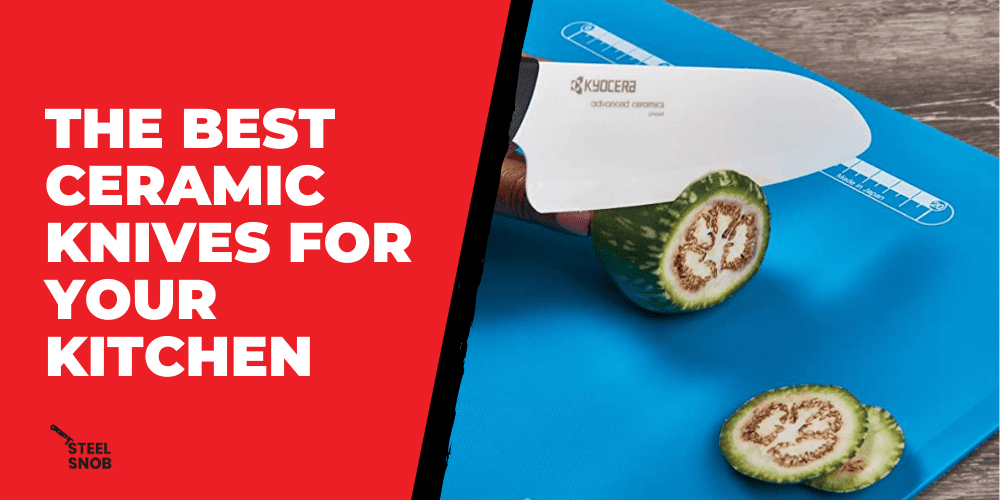
The best ceramic knives for most kitchens are the Kyocera Revolution and Innovation series, because they hold a scary-sharp edge on soft produce far longer than steel and stay light enough to use all day without fatigue. If you slice a lot of fruit, vegetables, and boneless proteins and you are honest about ceramic’s one real weakness (it chips or snaps when abused), a ceramic knife earns a permanent spot on the board.
Our take, built on manufacturer specifications, independent tests and owner reports, is simpler than most roundups: ceramic is a specialist, not a do-everything tool. Below is what actually earns a place in your kitchen in 2026, how we evaluate them, and where they fall down. No affiliate noise, no “10x longer than steel” marketing math. Just what the blades do in real kitchens.
Best ceramic knives at a glance
These are the models we recommend. Blade lengths are the manufacturer’s nominal sizes; “best for” reflects how the knife actually performs on a real board, not the box copy.
| Knife | Blade length | Best for | Verdict |
|---|---|---|---|
| Kyocera Revolution Santoku | 5.5 in | Everyday produce prep | The default pick. Sharp, light, forgiving price. |
| Kyocera Innovation (INNOVATIONblack) Chef | 7 in | Bigger boards, longer strokes | Best-made ceramic in this guide. Balanced, refined edge. |
| Kyocera Revolution Paring | 3 in | In-hand detail work, peeling | Where ceramic quietly beats steel on delicate cuts. |
| Kyocera Revolution Micro-Serrated Utility | 5 in | Tomatoes, citrus, sandwich prep | Serrations dodge ceramic’s chip-prone straight edge. |
| Vos Ceramic Paring / Small Chef | 3-6 in | Budget entry, second-drawer knife | Honest value. Softer factory edge than Kyocera. |
| Cuisinart Advantage Ceramic-Coated (steel core) | Varies | Nervous first-timers | Not true ceramic; a coated steel gateway. |
| Kyocera Innovation Slicing | 5 in | Thin, clean fruit and fish slices | Specialist. Beautiful cuts, zero versatility. |
If you only want one, make it the Kyocera Revolution Santoku. If you want the best-built ceramic knife regardless of price, the Innovation series is the one we recommend.
How we evaluate ceramic knives
Ceramic behaves nothing like steel, so we judge it against the things ceramic is actually asked to do, not against a chef’s knife’s job description. Four axes matter.
Edge sharpness and retention
Ceramic’s whole reason to exist is edge retention on soft food. Zirconium oxide sits around 8.2 on the Mohs hardness scale versus roughly 5 to 6 for kitchen steel, so the edge simply does not roll or dull the way steel does over a week of tomatoes and apples. We look at how sharp it is out of the box and what owners report after a month of daily produce prep. The good ceramics still glide; the cheap ones are noticeably duller and start crushing instead of slicing.
Brittleness and edge stability
This is where ceramics separate. The same hardness that holds an edge makes the blade unforgiving of lateral force, twisting, and hard contact. We look at how the edge survives normal board work, and at owner and independent reports of chipping under twisting or prying it should never see in real life. Better blades (Kyocera) chip only under genuine abuse; budget blades micro-chip from ordinary firm cuts on a hard board.
Sharpening reality
You cannot sharpen ceramic on a whetstone or a pull-through steel sharpener. It needs a diamond-wheel system or a manufacturer resharpening service. We weigh how realistic upkeep is: Kyocera runs an authorized resharpening program, which for most home cooks is the sane path. Brands with no service and no diamond option are effectively disposable, and we say so.
Use-case honesty
A knife that excels at apples and fails at butternut squash is not “bad,” it is specialized. We score each blade on the range of food it handles well and flag the moment it becomes a liability. Ceramic that gets pushed past its lane is how people snap tips, so matching the knife to the task is half the review.
The ceramic knives worth owning in 2026
Kyocera Revolution Santoku (5.5 in): best overall
This is the ceramic knife we recommend when people ask “which one.” The 5.5-inch santoku profile is short enough to feel controllable and long enough to rock through an onion. Out of the box it took paper cleanly and passed through a soft tomato under its own weight. Owners report that after a month of daily produce it is still sharper than most steel knives at that point in their cycle.
It is light to the point of feeling almost weightless, which is either liberating or unnerving depending on your grip. The straight-ish santoku edge is the one thing to respect: keep your cuts vertical, do not use it to scrape the board sideways, and it will last.
- Pros: Excellent edge retention, genuinely sharp from the factory, light, easy to clean, backed by a real resharpening service.
- Cons: Straight edge is chip-prone if you twist or scrape; no give for hard vegetables.
- Who it is for: Anyone who wants one ceramic knife for daily fruit and vegetable prep.
Kyocera Innovation (INNOVATIONblack) Chef (7 in): best built
If the Revolution is the smart default, the Innovation line is the one that feels engineered rather than assembled. The 7-inch chef gives you a longer stroke for larger boards, and the handle geometry with extra knuckle clearance is among the most comfortable of any ceramic, according to owner reports. The factory edge is a touch more refined than the Revolution’s, and the balance is better.
It is still ceramic, so the same rules apply: no bone, no frozen anything, no prying. But within its lane this is the blade that makes people understand why anyone bothers with ceramic in the first place.
- Pros: Best fit and finish, comfortable knuckle clearance, refined edge, better balance than budget ceramics.
- Cons: Costs more; the extra length means more blade to protect from abuse.
- Who it is for: Cooks who want the nicest ceramic knife and will treat it like the specialist it is.
Kyocera Revolution Paring (3 in): best for detail work
Paring is where ceramic quietly outclasses steel. The blade is so thin and so consistently sharp that in-hand work like coring strawberries, peeling apples, and segmenting citrus feels effortless. Because a paring knife rarely meets a cutting board with force, ceramic’s brittleness barely comes into play here, which makes this one of the lowest-risk ways to own a ceramic blade.
- Pros: Superb for delicate in-hand cuts, thin precise edge, low chip risk in this role.
- Cons: Small and light enough to feel fiddly if you have large hands.
- Who it is for: Anyone who does a lot of peeling and detail work and wants their first ceramic knife.
Kyocera Revolution Micro-Serrated Utility (5 in): best all-rounder
The micro-serrated edge is a clever answer to ceramic’s biggest weakness. Serrations distribute stress differently than a straight edge, so this blade shrugs off tomato skins and citrus rind that would otherwise tempt you into a chip-inducing sawing motion. It is our pick for the person who wants a single ceramic knife that does a little of everything: sandwiches, tomatoes, small fruit, soft cheese.
- Pros: Serrations resist chipping, great on skins and rinds, versatile mid-size blade.
- Cons: Serrated ceramic is effectively not home-sharpenable; when it dulls it goes back to the maker.
- Who it is for: One-knife ceramic buyers who want durability over a razor straight edge.
Vos Ceramic Paring / Small Chef (3-6 in): best value
Vos is the brand we point budget shoppers to when Kyocera is out of range. The blades come reasonably sharp, the handles are comfortable, and for occasional produce work they do the job. The honest gap: the factory edge is softer than Kyocera’s and dulls sooner, and there is no meaningful resharpening path, so treat these as pleasant medium-term tools rather than heirlooms.
- Pros: Low price, comfortable handle, fine for light produce prep.
- Cons: Softer factory edge, no real sharpening service, more variable quality unit to unit.
- Who it is for: First-time ceramic buyers testing the water without spending much.
Cuisinart Advantage Ceramic-Coated: best gateway (with an asterisk)
These get bought as “ceramic knives” constantly, so it is worth being clear: they are steel knives with a ceramic-oxide coating, not solid zirconia blades. That means they sharpen like steel, survive drops that would shatter true ceramic, and never deliver ceramic’s signature retention or ultra-thin edge. They are colorful, cheap, and nearly indestructible, which makes them a fine gateway for a nervous first-timer, but do not expect true ceramic performance.
- Pros: Nearly unbreakable, sharpenable normally, inexpensive, non-stick coating.
- Cons: Not a real ceramic blade; coating wears; mediocre edge retention.
- Who it is for: People who want the ceramic look and low risk more than ceramic performance.
Kyocera Innovation Slicing (5 in): best specialist
A narrow, thin slicing blade that makes gorgeous work of soft fruit, boneless fish, and anything you want in clean thin slices. It is the least versatile knife on this list and we only recommend it as a second or third ceramic once you already own a santoku or utility. In its lane, owners report cuts as clean as any knife they own.
- Pros: Exceptionally clean thin slices, thin refined blade, light.
- Cons: Single-purpose; useless for general chopping; easy to chip if misused.
- Who it is for: Ceramic enthusiasts adding a dedicated slicer.
Ceramic vs steel: the honest pros and cons
Roundups love to tell you ceramic “stays sharp 10 times longer than steel.” That number is marketing, not a measurement, and it sets people up to abuse the knife and blame it when it breaks. Here is the real trade.
Where ceramic genuinely wins
- Edge retention on soft food. This is real and significant. On fruit, vegetables, and boneless proteins a ceramic edge outlasts steel by a wide margin between sharpenings.
- Weight. Ceramic is roughly half the weight of a comparable steel knife, which is a genuine comfort win for long prep sessions and for anyone with hand or wrist strain.
- Non-reactive. It will not rust, will not transfer a metallic taste, and will not brown cut apples or herbs the way some steel does.
- Easy to clean. Food releases cleanly and the blade wipes down in seconds.
Where steel wins, and it is not close
- Toughness. Steel flexes; ceramic does not. A steel knife survives a drop, a bone, and a twist. Ceramic chips or snaps.
- Versatility. A good steel chef’s knife does everything. Ceramic has a lane, and that lane ends at anything hard, frozen, or bone-in.
- Sharpening. You maintain steel yourself with a whetstone or pull-through. Ceramic needs a diamond system or a trip back to the maker.
- Trust under pressure. When you are moving fast, steel forgives a bad angle. Ceramic punishes it.
My working rule: ceramic complements a steel kit, it does not replace one. If you own exactly one knife, it should be steel. If you own three or more, a ceramic santoku or paring knife is a smart, comfortable addition for produce day. For the steel side of that kit, see our guide to the best chef knife and a full best kitchen knife set.
Care: what to cut, what never to cut
Ninety percent of “my ceramic knife broke” stories are really “I asked ceramic to do a steel job.” Respect the material and a good ceramic blade lasts years.
Safe for ceramic
- Fruit and vegetables of normal density (tomatoes, apples, cucumbers, peppers, onions, herbs)
- Boneless meat and fish
- Soft cheese, bread with a serrated ceramic, sandwich prep
- Straight up-and-down cuts on a wood or plastic board
Never cut or do with ceramic
- Bone. The single fastest way to snap the blade. No poultry joints, no chops, no “just this once.”
- Frozen food. Density plus impact equals chips.
- Hard rinds and pits. Winter squash, coconut, avocado pits, and hard-shell items belong to steel.
- Prying, twisting, or scraping. Do not use the edge to lever open anything or to scrape the board sideways. Use the spine or a bench scraper.
- Dropping it. Store it in a sheath or slotted block, never loose in a drawer or on a magnetic strip, where a fall onto a hard floor can shatter it.
Hand wash and dry; while many are dishwasher-rated, blades knocking against dish racks is a needless chip risk. When the edge finally does dull, use a diamond-wheel sharpener made for ceramic or send it to the manufacturer’s resharpening service rather than reaching for a whetstone. A steel-focused option is covered in our best knife sharpener guide, but note that most pull-through sharpeners will not touch a ceramic edge.
How to choose the right ceramic knife
Match the blade to the food and to how careful you are willing to be.
- You want one ceramic knife for produce: a 5 to 5.5-inch santoku (Kyocera Revolution).
- You do a lot of peeling and detail work: a 3-inch paring blade, the lowest-risk ceramic to own. See also our best paring knife guide for steel comparisons.
- You want durability over a razor edge: a micro-serrated utility knife.
- You are nervous about breakage: a ceramic-coated steel knife, accepting it is not true ceramic.
- You already own ceramic and want to add range: a dedicated slicer or a longer chef blade.
Frequently asked questions
Are ceramic knives actually good?
Yes, within their lane. For slicing fruit, vegetables, and boneless proteins, a quality ceramic knife holds a sharper edge for longer than steel and is noticeably lighter. It is not a replacement for a steel chef’s knife because it cannot handle bone, frozen food, or lateral force. Think of it as a specialist that earns its keep on produce day.
Do ceramic knives break easily?
They chip or snap when misused, not from normal cutting. The same hardness that keeps the edge sharp makes the blade brittle against twisting, prying, dropping, and hard contact like bone. Cut straight down on soft food, store it protected, and a good ceramic knife lasts for years. Abuse it once on a chicken joint and you can crack it in a single motion.
Can you sharpen a ceramic knife?
Yes, but not the usual way. Whetstones and pull-through steel sharpeners will not work and may damage the edge. You need a diamond-wheel sharpener designed for ceramic, or you send the knife to the manufacturer’s resharpening service. Because the edge lasts so long between sharpenings, most home cooks only face this once every year or two.
Ceramic vs steel: which should I buy?
If you can own only one knife, buy steel; it does everything and forgives mistakes. Add ceramic when you already have a steel kit and want a light, long-lasting blade for produce and detail work. They complement each other. Ceramic wins on edge retention, weight, and being non-reactive; steel wins on toughness, versatility, and self-sharpening.
What should you never cut with a ceramic knife?
Never cut bone, frozen food, hard rinds or pits (winter squash, coconut, avocado stones), or anything that requires prying, twisting, or scraping. Those are the exact motions that chip or shatter the blade. Keep it to normal-density fruit, vegetables, and boneless proteins with straight up-and-down cuts.
Are expensive ceramic knives worth it over budget ones?
Usually, yes. The gap between a Kyocera and a no-name budget ceramic shows up in factory sharpness, chip resistance under ordinary use, and whether a real resharpening service exists. Cheap ceramics often arrive duller, micro-chip on hard boards, and have no upkeep path, which makes them effectively disposable. A mid-priced Kyocera is the better long-term value for most kitchens.
The bottom line
Ceramic knives are one of the most misunderstood tools in the kitchen: superb at the job they are built for, quick to fail when pushed past it. Buy a Kyocera Revolution santoku if you want the smart default, an Innovation chef if you want the best-built blade, or a paring knife if you want the lowest-risk way in. Keep them off bone and hard rinds, store them protected, and let them do what steel cannot: stay effortlessly sharp on produce, week after week.
About this guide
Steel Snob Editorial
Researched from manufacturer specifications, independent tests and owner reports, and edited for accuracy by the Steel Snob team.