
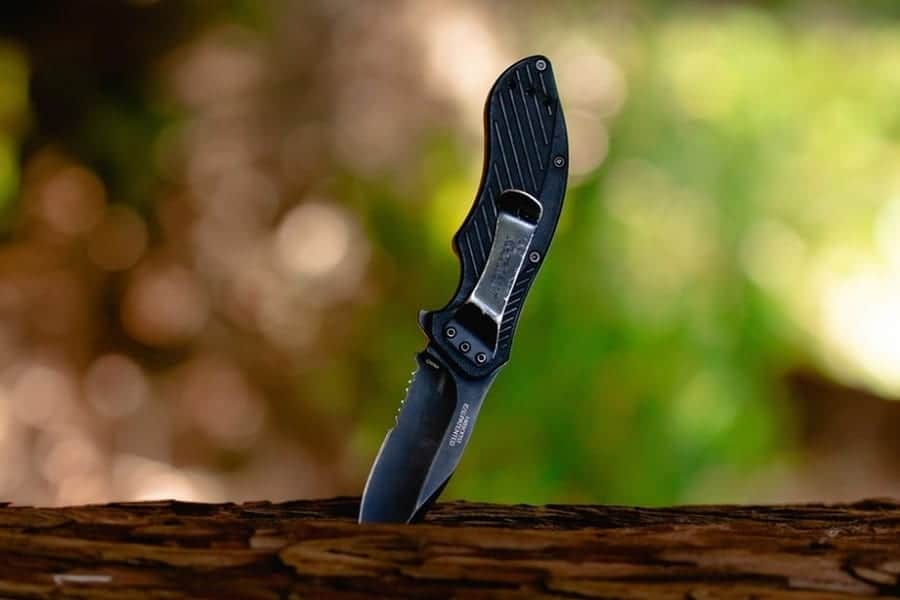
If you are here for the best throwing knives, you want a blade that flies straight, sticks on repetition, and survives the misses that teach you the most. This guide sorts the real 2026 field into knives that reward beginners with forgiving rotation and knives that reward experienced throwers with mass and penetration, so you buy for the thrower you actually are.
This guide compares throwing knives using manufacturer specifications, independent tests and reports from experienced throwers. It covers what holds up, what bends, and which knife suits a first-timer versus a competitor.
Best Throwing Knives at a Glance (2026)
| Model | Single / Set | Steel | Overall Length | Weight (each) | Balance | Best For | Verdict |
|---|---|---|---|---|---|---|---|
| Smith & Wesson SWTK8BCP | Set of 3 (also sold as 6) | 2Cr13 stainless | 8 in | ~4.1 oz | Center | Beginners, high-volume practice | The easiest entry point that still throws honestly |
| SOG F041TN-CP | Set of 3 | 420 stainless | 10 in | ~6.5 oz | Center | All-rounders wanting durability | Takes abuse and keeps a consistent rotation |
| Perfect Point RC-595-3 Thunder Bolt | Set of 3 | 440 stainless | 5.5 in | ~1.1 oz | Center | Close-range and no-spin practice | Tiny, cheap, and best kept close to the target |
| Cold Steel True Flight Thrower | Single | 1055 carbon | 12 in | ~9.7 oz | Blade-forward | Buy-in-quantity practice throwers | A workhorse single you can build a matched set from |
| United Cutlery Gil Hibben GenX Pro (Large) | Set of 3 | AUS-6 stainless | 11 in | ~6 oz | Center | Intermediate throwers, display buyers | Balanced, good-looking, one-piece build |
| Cold Steel Pro Flight Sport | Single | 1055 carbon | 13.5 in | ~14 oz | Center | Competition-style long throws | Heavy, deliberate, sticks with authority |
| Boker Magnum Bailey Ziel | Set of 3 | 420J2 stainless | 13.25 in | ~14 oz | Center | Serious hobbyists, both-end throwing | Thick, tough, forgiving of grip errors |
How We Evaluate Throwing Knives
Every knife on this page was judged on manufacturer specifications, independent tests and owner reports, not a spec sheet copy job. Here is what we score and why it matters.
- Balance point. Where the true balance point sits, as published by the maker or measured in independent reviews. Center-balanced knives let you throw from either end, which is what most people should learn on. Blade-heavy and handle-heavy knives dictate grip, and we note which.
- Rotation consistency. A good throwing knife rotates the same way every time from a fixed distance. We look at owner and reviewer reports of how consistently each knife sticks from a fixed distance.
- Steel and edge behavior. Throwing knives are not cutting knives. The steel should flex instead of snapping and a point that survives target-to-target impacts without rolling over.
- Tip and tang durability. Misses hit concrete, rocks, and each other. We look for reports of bent tips, cracked handles, and any separation on full-tang or one-piece builds.
- Grip in the hand. Bare steel, cord wrap, and paracord all release differently. We note which handles stay predictable when your palm is sweaty.
The Best Throwing Knives, Reviewed
Smith & Wesson SWTK8BCP
This is the set we recommend to beginners without a second thought. At 8 inches and roughly 4 ounces each, the knives are light enough to throw all afternoon and center-balanced enough that grip mistakes forgive themselves. The 2Cr13 stainless is nothing exotic, but it flexes rather than chips, and the black-coated blades hide practice scars. Available in three-piece and six-piece packs, so you can keep throwing while a few are stuck in the target.
- Pros: Light and forgiving, center balance, low cost per knife, easy to buy in bulk.
- Cons: Thin coating wears fast, points can roll on hard misses.
- Who it is for: First-time throwers and anyone building repetition without babying the blades.
SOG F041TN-CP
The SOG set is the one to pick when you want durability over delicacy. At 10 inches and about 6.5 ounces each, these carry more mass than the Smith & Wesson, which steadies the rotation once you dial in distance. The 420 stainless and paracord-wrapped handles took repeated stump throws and edge-to-edge collisions without loosening. Quality control between the three knives is tight, which matters more than any single spec because a matched set throws the same.
- Pros: Rugged, consistent set-to-set, comfortable paracord grip, honest center balance.
- Cons: Heavier release takes practice, paracord can slip when wet.
- Who it is for: All-rounders who want one set to grow into and abuse.
Perfect Point RC-595-3 Thunder Bolt
These are small. At 5.5 inches overall and barely over an ounce each, the Thunder Bolt set is more of a close-range and no-spin trainer than a long-throw knife. Up close the 440 stainless daggers stick fine and cost almost nothing, which makes them a low-risk way to learn grip and release. Step back and the light mass gives up to wind and inconsistent rotation quickly.
- Pros: Very affordable, good for tight spaces and no-spin drills, easy to carry.
- Cons: Too light for distance, thin steel bends, small handles crowd larger hands.
- Who it is for: Close-range practice and anyone testing the hobby before spending more.
Cold Steel True Flight Thrower
Sold as a single, the True Flight is the knife we recommend when you want to build a matched practice set from a proven design. The 1055 carbon steel blade at 12 inches and roughly 9.7 ounces carries real momentum, and the cord-wrapped handle gives a clean, repeatable release. It runs slightly blade-forward, so it is best thrown from the handle, letting the mass do the work. Carbon steel means you have to dry and oil it, but it takes a beating that stainless sets flinch at.
- Pros: Tough carbon steel, strong momentum, buy several for a matched set, sticks deep.
- Cons: Needs rust care, blade-forward balance dictates grip, single knife per purchase.
- Who it is for: Throwers who want a durable workhorse and do not mind maintenance.
United Cutlery Gil Hibben GenX Pro (Large)
The GenX Pro Large is the intermediate step between a beginner set and a competition knife. One-piece AUS-6 stainless construction at 11 inches and about 6 ounces gives you a center-balanced knife that throws from either end and looks the part on a wall. The three knives match well, and the build has no handle scales to loosen. It is a satisfying set to progress on once your rotation is repeatable.
- Pros: Center balance, one-piece durability, matched set, throws from blade or handle.
- Cons: Bare-steel handles get slick, priced above entry sets, points need touch-ups.
- Who it is for: Intermediate throwers ready to leave the beginner set behind.
Cold Steel Pro Flight Sport
This is a heavy, deliberate knife for people who want to throw the way competition rules encourage: long distance, full rotation, hard stick. At 13.5 inches and around 14 ounces of 1055 carbon steel, the Pro Flight Sport punishes a lazy release but rewards a committed one with a stick that buries the point. It is not a knife for a beginner, but for a thrower with a grooved motion it is one of the most satisfying in the lineup.
- Pros: Heavy and stable, sticks with authority, tough carbon steel, competition-scale length.
- Cons: Demands technique, tiring over long sessions, needs rust care.
- Who it is for: Experienced throwers chasing distance and penetration.
Boker Magnum Bailey Ziel
Designed by John Bailey, the Ziel set is thick, tough, and built to be thrown from either end. Each knife runs 13.25 inches and about 14 ounces in quarter-inch 420J2 stainless, which shrugs off the impacts that thinner knives fear. The center balance is genuine, so blade throws and handle throws both work, and the mass covers small grip errors that would send a lighter knife wobbling. This is a serious-hobbyist set that will outlast a lot of throwers.
- Pros: Very durable quarter-inch steel, true center balance, forgiving of grip errors, matched set.
- Cons: Heavy for beginners, tiring in long sessions, availability varies by year.
- Who it is for: Committed hobbyists who want one rugged set for both-end throwing.
Throwing Knife Balance Explained (and How Beginners Should Choose)
Balance is the single most useful concept for picking your first knife, and it is simpler than the marketing makes it sound. Find the point where the knife rests level on a finger or a rod. That balance point tells you how to throw it.
- Center-balanced. The balance point sits in the middle. You can grip the blade or the handle and the rotation stays predictable. This is what most beginners should buy, because it forgives grip choices while you learn.
- Blade-heavy. The balance point sits toward the tip. You throw these from the handle, and they favor a specific distance. Good once you have a repeatable motion.
- Handle-heavy. The balance point sits toward the handle. You throw these from the blade. Less common and less beginner-friendly.
For a first set, choose center-balanced, in the 8 to 12 inch range, and 4 to 8 ounces per knife. That combination rotates slowly enough to read and carries enough mass to fly straight in a light breeze. Buy at least three matched knives so you can throw a full round without walking to the target after every throw. Skip the ultra-light novelty sets for anything past close range, and skip the heaviest competition knives until your rotation is consistent. Weight buys stability, but only after your release is repeatable.
Safety and Technique Basics
Throwing knives are simple to start and easy to do dangerously. A few rules keep the hobby fun.
- Set a real backstop. Throw into an end-grain wood target or a dedicated stump. Never throw at a wall, a tree with people behind it, or anything a knife can skip off.
- Clear the area behind and beside the target. Deflections happen. Keep bystanders well back and never let anyone retrieve knives while someone is throwing.
- Start at three steps. Most center-balanced knives make one rotation at roughly three of your steps from the target. If the handle hits first, step in slightly. If the tip hits at an angle before rotating fully, step back.
- Grip lightly and follow through. Pinch the knife without strangling it, throw with a straight overhead motion, and let it slide out of your hand. Snapping the wrist adds unwanted spin.
- Retrieve safely and inspect often. Pull knives straight out, check for bent tips and cracked handles after every session, and retire anything that has started to crack.
Once your one-rotation throw is consistent, work through the fundamentals in our throwing knife technique guide before you experiment with no-spin styles.
Frequently Asked Questions
What is the best throwing knife for a complete beginner?
A center-balanced set in the 8 to 10 inch range, like the Smith & Wesson SWTK8BCP. It is light, forgiving, and cheap enough to buy in a set of six so you can practice without constant walking to the target.
What steel is best for throwing knives?
You want steel that flexes rather than snaps, not the hardest steel available. Softer stainless like 2Cr13, 420, and 420J2 absorbs impact well, while 1055 carbon steel offers toughness at the cost of needing rust care. Hard, brittle blade steels are the wrong choice because throwing knives take impacts a cutting knife never sees.
How heavy should a throwing knife be?
For general practice, 4 to 8 ounces per knife suits most throwers. Lighter knives are harder to keep straight at distance, and heavier competition-scale knives near 14 ounces demand a grooved technique before they pay off. Match weight to your skill level, not to the biggest knife on the shelf.
Do throwing knives need to be sharp?
No. A sharp cutting edge is unnecessary and dangerous to handle repeatedly. What matters is a durable point that survives target impacts. Keep the tip in decent shape and leave the edges dull.
How far should I stand from the target?
Start around three of your own steps for a single-rotation throw with a center-balanced knife, then adjust. If the handle strikes first, move in a bit. If the tip hits before the knife has fully rotated, move back. Distance, not force, controls whether the point sticks.
Are throwing knives legal to own?
In most places you can own and practice with throwing knives on private property, but laws on carrying them vary widely by state and locality. Check your local statutes before buying, and never carry them concealed in public without confirming the rules where you live.
Final Thoughts
The best throwing knife is the one matched to your current skill, not the heaviest or the most aggressive-looking. Beginners should start center-balanced and light with the Smith & Wesson or SOG sets, intermediates can graduate to the Gil Hibben GenX Pro, and experienced throwers will get the most out of the Cold Steel Pro Flight Sport or the Boker Ziel. Buy matched knives, set a proper backstop, and let repetition do the teaching.
If throwing is one piece of a broader kit, our companion guides cover the best survival knife, the best tactical knife, and the best machete with the same evidence-based approach.
About this guide
Steel Snob Editorial
Researched from manufacturer specifications, independent tests and owner reports, and edited for accuracy by the Steel Snob team.