
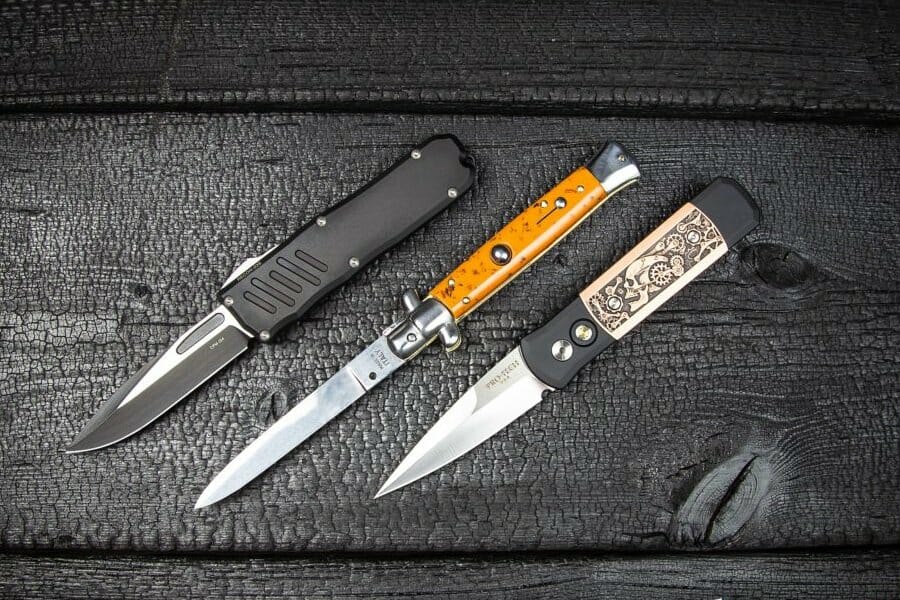
How Does A Switchblade Work? Complete 2026 Mechanism Guide
Switchblades represent one of the most ingenious yet controversial knife mechanisms ever developed. From their ancient origins to modern precision manufacturing, automatic knives showcase sophisticated engineering that enables instant one-handed deployment. Our comprehensive 2026 guide explores the mechanics, history, and legal landscape of these fascinating but heavily regulated tools.
🎯 Quick Navigation
- What Is a Switchblade?
- Mechanism Types & Operation
- Engineering & Manufacturing
- Historical Evolution
- 2026 Legal Status
- Identification Guide
- Safety & Operation
🔍 What Is a Switchblade? (2026 Definition)
Technical Definition:
A switchblade is an automatic knife where the blade deploys automatically via spring mechanism when activated by a button, lever, or switch. The defining characteristic is automatic deployment without manual pressure applied to the blade itself.
Federal Legal Definition (15 U.S.C. §1241):
“Any knife having a blade which opens automatically by hand pressure applied to a button or other device in the handle of the knife, or any knife having a blade which opens automatically by operation of inertia, gravity, or both.”
Key Characteristics:
- Automatic Deployment: Blade opens with button/switch activation
- Spring-Powered: Internal spring mechanism provides opening force
- One-Handed Operation: No manual pressure on blade required
- Locking Mechanism: Blade locks open for safety
- Compact Design: Typically designed for concealed carry
Legal Distinction from Similar Knives:
| Knife Type | Opening Method | Legal Status | Regulation |
|---|---|---|---|
| Switchblade | Button/switch automatic | ❌ Federally restricted | Federal Switchblade Act |
| Spring-Assist | Manual start, spring finish | ✅ Generally legal | State/local only |
| Gravity Knife | Gravity/inertia deployment | ❌ Federally restricted | Federal Switchblade Act |
| Manual Folder | Manual pressure required | ✅ Generally legal | State/local only |
⚚ Mechanism Types & Operation
1. Side-Opening Switchblades
Traditional Italian Stiletto Style:
Operation: Blade pivots from side of handle, similar to traditional folding knife but spring-powered.
Key Components:
- Pivot Pin: Blade rotates on precision bearing
- Coil Spring: Compressed spring stores opening energy
- Release Button: Disengages blade catch mechanism
- Blade Catch: Holds blade in closed position
- Lock Mechanism: Secures blade in open position
- Safety: Prevents accidental deployment
Advantages:
- Traditional design with proven reliability
- Simple mechanism with fewer failure points
- Easier to manufacture and maintain
- Strong lock-up when properly made
Disadvantages:
- Wider profile when blade is open
- Spring tension can weaken over time
- More complex pivot mechanism
2. Out-The-Front (OTF) Switchblades
Linear Action Deployment:
Operation: Blade slides straight out from front of handle in linear motion.
Single-Action OTF:
- Deployment: Spring-powered extension
- Retraction: Manual push-back required
- Simplicity: Fewer moving parts
- Reliability: Less prone to mechanism failure
Double-Action OTF:
- Deployment: Spring-powered extension
- Retraction: Spring-powered retraction
- Complexity: More sophisticated mechanism
- Convenience: Complete one-button operation
Key Components:
- Slide Mechanism: Linear guide system for blade
- Firing Button: Controls deployment and retraction
- Internal Springs: Provide deployment/retraction force
- Carrier Block: Connects blade to mechanism
- Safety Lock: Prevents accidental activation
3. Lever-Lock Mechanisms
European Lock-Back Style:
Operation: Lever release combined with spring deployment for enhanced safety.
- Safety Integration: Prevents accidental opening
- Legal Advantage: Some jurisdictions treat differently
- Precise Control: More deliberate activation required
- Professional Use: Preferred for work applications
🔧 Engineering & Manufacturing (2026)
Modern Manufacturing Advances
- CNC Precision: Computer-controlled machining for tight tolerances
- Advanced Materials: Titanium, carbon fiber, and exotic alloys
- Spring Technology: Improved metallurgy for longer life
- Surface Treatments: Coatings for corrosion resistance
- Quality Control: Statistical process control and testing
Critical Tolerances and Measurements
| Component | Tolerance Range | Critical Function |
|---|---|---|
| Pivot Pin | ±0.0005″ | Smooth blade rotation |
| Spring Tension | ±5% force | Consistent deployment |
| Button Travel | ±0.002″ | Reliable activation |
| Lock Engagement | ±0.001″ | Blade security |
Common Failure Modes and Prevention
- Spring Fatigue: Metal fatigue from repeated cycling
- Button Wear: Mechanical wear from activation
- Lock Failure: Insufficient engagement force
- Pivot Wear: Blade wobble from bearing wear
- Debris Jamming: Foreign matter in mechanism
📚 Historical Evolution
Ancient Origins to Modern Times
| Period | Development | Key Features | Cultural Impact |
|---|---|---|---|
| 1500s-1600s | Spanish Navajas | Crude spring mechanisms | Personal protection |
| 1700s-1800s | Italian Stilettos | Refined side-opening | Aristocratic carry |
| 1900s-1940s | American Production | Mass manufacturing | Working class adoption |
| 1950s-1970s | Moral Panic Era | Federal prohibition | Cultural stigmatization |
| 2000s-2026 | Modern Renaissance | Precision engineering | Collector appreciation |
The Federal Switchblade Act Impact
The 1958 Federal Switchblade Act fundamentally changed the American knife industry, driving innovation toward assisted-opening mechanisms and creating the modern legal framework that persists in 2026.
⚖️ 2026 Legal Status
Federal Regulations
Federal Switchblade Act (15 U.S.C. §1241-1245):
- Interstate Commerce Prohibition: Cannot ship across state lines
- Manufacturing Restrictions: Limited production for specific markets
- Import/Export Ban: Prohibited international trade
- Exceptions: Military, law enforcement, one-armed individuals
State Legal Status (2026 Update)
| Legal Category | States | Restrictions |
|---|---|---|
| Legal | TX, FL, AZ, TN, KS, NH, etc. | Age limits, carry restrictions |
| Restricted | CO, MN, WI, etc. | Length limits, permit requirements |
| Illegal | CA, NY, MA, IL, etc. | Complete prohibition |
Penalties and Consequences
- Federal Violations: Up to $2,000 fine
- State Felonies: 1-5 years imprisonment
- Misdemeanor Charges: Fines and confiscation
- Civil Forfeiture: Property seizure
- Enhanced Penalties: School zones, government buildings
🔍 Identification Guide
How to Identify a True Switchblade
✅ Switchblade Characteristics:
- Button, lever, or switch activation (no manual blade pressure)
- Blade deploys automatically when activated
- Spring-powered opening mechanism
- Blade locks in open position
- Cannot open by inertia alone when button is pressed
Common Misidentifications
| Often Confused With | Key Difference | Legal Status |
|---|---|---|
| Spring-Assisted Knife | Requires manual pressure to start | Generally legal |
| Butterfly Knife | Manual manipulation required | Varies by state |
| OTF Manual Knife | Thumb pressure required | Generally legal |
🛡️ Safety & Operation
Safe Operation Practices
⚠️ Essential Safety Rules:
- Never point toward yourself or others when activating
- Ensure clear deployment path before activation
- Keep fingers away from blade path
- Engage safety mechanisms when not in use
- Regular maintenance to prevent malfunction
- Proper storage to prevent accidental activation
Maintenance Requirements
- Cleaning: Remove debris from mechanism regularly
- Lubrication: Apply appropriate lubricant to moving parts
- Spring Inspection: Check for fatigue or damage
- Lock Function: Verify proper blade lock engagement
- Professional Service: Annual inspection for critical use knives
Common Safety Issues
- Accidental Deployment: Worn or damaged safety mechanisms
- Blade Projection: Mechanism failure causing dangerous deployment
- Lock Failure: Blade closing unexpectedly during use
- Spring Breakage: Sudden release of stored energy
- Button Sticking: Inability to retract blade safely
Frequently Asked Questions
How can I tell if a knife is a switchblade?
A true switchblade opens automatically with button/switch activation without applying manual pressure to the blade. If you must push or pull the blade to start opening, it’s likely a spring-assist or manual knife.
Are switchblades illegal everywhere in the US?
No, many states have legalized switchblades in recent years. However, federal law still restricts interstate commerce, making them difficult to obtain legally even in states where possession is allowed.
What’s the difference between a switchblade and an OTF knife?
OTF (Out-The-Front) describes the deployment method, while switchblade describes the mechanism. Some OTF knives are switchblades (automatic), while others are manual or spring-assist.
Can I carry a switchblade if I’m military or law enforcement?
Federal law provides exceptions for military and law enforcement personnel, but you must check specific department policies and state laws, as they may have additional restrictions.
Why are switchblades illegal if spring-assist knives are legal?
The distinction lies in the activation method. Switchblades open automatically with button pressure alone, while spring-assist knives require manual pressure on the blade to initiate opening.
Conclusion
Switchblades represent a fascinating intersection of mechanical engineering and legal regulation. While their ingenious mechanisms demonstrate human innovation in tool design, their complex legal status requires careful consideration before acquisition or possession.
Understanding how switchblades work provides insight into precision manufacturing and mechanical design principles. However, the practical reality of federal restrictions and varying state laws makes them primarily of academic interest for most Americans in 2026.
For those legally authorized to possess switchblades, proper understanding of their mechanisms, safety requirements, and maintenance needs is essential for safe operation and long-term reliability.
Last Updated: February 2026 | Next Review: August 2026
About this guide
Steel Snob Editorial
Researched from manufacturer specifications, independent tests and owner reports, and edited for accuracy by the Steel Snob team.