
S30V Steel at a Glance
| Property | Rating |
|---|---|
| Hardness (HRC) | 58-61 |
| Edge Retention | 8/10 |
| Toughness | 6/10 |
| Corrosion Resistance | 7/10 |
| Ease of Sharpening | 4/10 |
CPM-S30V is one of the most iconic knife steels ever created. Developed by Crucible Industries with input from legendary knifemaker Chris Reeve, S30V was the first steel specifically designed from the ground up for the knife industry. Since its introduction in 2001, it has become the benchmark against which all other premium knife steels are measured.
In this 2026 guide, we’ll cover everything about S30V — its unique powder metallurgy composition, real-world cutting performance, the top knives that use it, and detailed comparisons with competing steels like S35VN, D2, and M390.
What is S30V Steel?
CPM-S30V (Crucible Particle Metallurgy S30V) is a martensitic stainless steel manufactured using powder metallurgy. The CPM process involves atomizing molten steel into a fine powder, then compacting it under extreme pressure and temperature. This creates an exceptionally uniform distribution of carbides throughout the steel — far more even than what conventional ingot metallurgy can achieve.
The result is a steel that maximizes the beneficial properties of its alloying elements. S30V’s vanadium carbides are extremely hard (roughly 2800 Vickers hardness), providing outstanding abrasive wear resistance and edge retention. Unlike chromium carbides found in steels like D2 and 440C, vanadium carbides are smaller and more evenly distributed, which contributes to a finer, more consistent cutting edge.
S30V was revolutionary when it launched because it achieved something that was previously very difficult: combining the edge retention of a high-wear-resistance tool steel with the corrosion resistance of a true stainless steel. Before S30V, knife users had to choose between corrosion resistance (440C, ATS-34) or edge retention (D2, A2). S30V delivered both.
Chemical Composition of S30V Steel
| Element | Percentage | Role |
|---|---|---|
| Carbon (C) | 1.45% | Very high carbon forms abundant hard carbides. This is a primary driver of S30V’s excellent edge retention. |
| Chromium (Cr) | 14.00% | Provides corrosion resistance and forms chromium carbides. Exceeds the stainless threshold. |
| Vanadium (V) | 4.00% | The highest vanadium content among mainstream knife steels. Forms extremely hard VC carbides that are key to S30V’s edge holding. |
| Molybdenum (Mo) | 2.00% | Enhances strength, hardenability, and resistance to pitting corrosion. |
| Manganese (Mn) | 0.50% | Aids hardenability and deoxidation. |
| Silicon (Si) | 0.50% | Deoxidizer, increases strength. |
The most notable aspect of S30V’s composition is the 4% vanadium content. This is significantly higher than most other stainless knife steels and is responsible for the dense network of vanadium carbides that give S30V its legendary edge retention. By comparison, S35VN reduces the vanadium to 3% and adds 0.5% niobium to improve toughness.
S30V Steel Performance Breakdown
Hardness and Edge Retention
S30V is typically heat treated to 58-61 HRC, with most production knives falling in the 59-61 range. At this hardness, the abundant vanadium carbides provide exceptional edge retention that we rate at 8/10.
In standardized CATRA cutting tests, S30V consistently outperforms conventional stainless steels by a wide margin. It holds an edge roughly 2-3 times longer than AUS-8 and approximately 1.5 times longer than 154CM. In practical use, a well-sharpened S30V blade can handle a full day of heavy cutting — breaking down cardboard, processing food, whittling wood — and still maintain a usable edge.
The quality of the edge that S30V takes is also notable. The fine, uniformly distributed vanadium carbides allow for a keen, toothy edge that excels at slicing through fibrous materials. This “toothy” edge is part of why S30V feels like it cuts well even after some wear — the micro-serrations created by the exposed carbides continue to grip and cut material.
Toughness
Toughness is S30V’s relative weakness, rated at 6/10. The high volume of very hard vanadium carbides, while excellent for edge retention, creates potential stress points in the steel matrix where micro-cracks can initiate. This means S30V blades can chip if subjected to significant lateral stress, hard impacts, or aggressive cutting into bone or frozen food.
This was the primary motivation for developing S35VN, which replaced some vanadium with niobium to produce rounder, less stress-inducing carbides. If toughness is a major concern for your use case, S35VN (7/10) or carbon steels like 5160 (9/10) are better choices.
That said, S30V’s toughness is more than adequate for normal EDC use. The chipping issue primarily surfaces in hard-use scenarios or with very thin edge geometries. Most users will never encounter toughness problems with S30V in everyday applications.
Corrosion Resistance
With 14% chromium, S30V is a true stainless steel with corrosion resistance rated at 7/10. It handles the demands of everyday carry admirably — pocket lint, occasional sweat, light rain, and food prep won’t cause issues with basic maintenance.
The caveat is that some of S30V’s chromium is bound up in chromium carbides, which technically reduces the free chromium available in the steel matrix for corrosion resistance. This means S30V isn’t quite as corrosion-resistant as the raw chromium percentage might suggest. In salt-fog testing, it performs slightly below steels like VG10 or N690 that have higher chromium content.
For most environments, S30V’s corrosion resistance is perfectly adequate. Just rinse and dry the blade after exposure to salt, acids, or prolonged moisture.
Ease of Sharpening
This is S30V’s biggest drawback, rated at just 4/10 for sharpening ease. The extremely hard vanadium carbides that give S30V its incredible edge retention also make it resistant to abrasion from sharpening media. Standard aluminum oxide or silicon carbide stones will struggle to cut through S30V efficiently.
Diamond or CBN (cubic boron nitride) abrasives are strongly recommended for sharpening S30V. These materials are harder than vanadium carbides and cut through the steel much more efficiently. A guided sharpening system like the KME or Wicked Edge with diamond stones makes the process manageable even for beginners.
The difficulty of sharpening S30V is one reason why S35VN has surpassed it in popularity — S35VN offers essentially the same edge retention with easier sharpening and better toughness.
What is S30V Steel Used For?
- Premium EDC Folders: S30V’s original and still primary application. Brands like Benchmade, Spyderco, and Zero Tolerance use S30V extensively.
- Tactical Knives: Military and law enforcement knives benefit from S30V’s corrosion resistance and edge retention.
- Hunting Knives: The edge holds up well through field dressing, though the moderate toughness means avoiding bone contact.
- Custom Knives: Still popular with custom makers who value proven performance, though S35VN has become more common.
Best Knives in S30V Steel
1. Spyderco Paramilitary 2
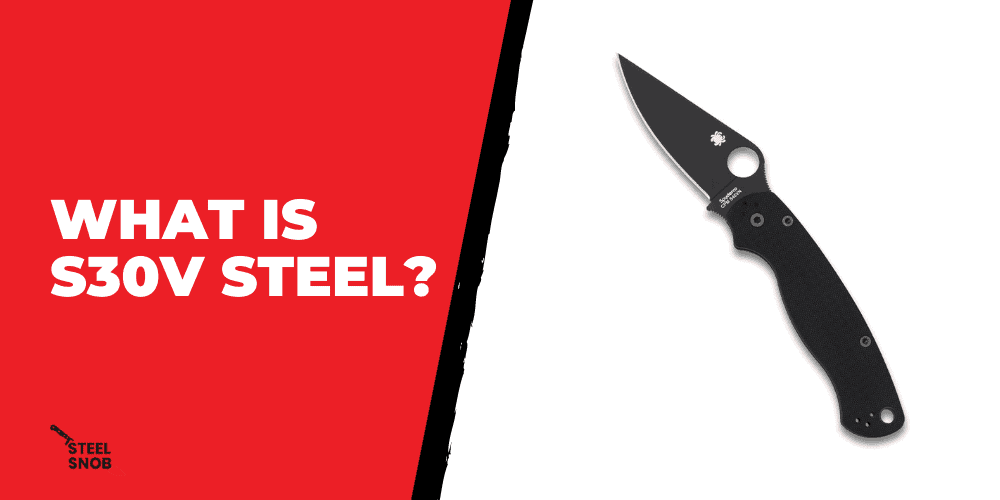
The PM2 is one of the most beloved EDC knives of all time, and the S30V version is its most popular configuration. The full-flat-ground blade provides excellent cutting geometry, the compression lock is secure and easy to operate, and the G10 handles offer a comfortable, grippy surface. The PM2 showcases everything that makes S30V great — long-lasting edge, decent corrosion resistance, and proven reliability across millions of units sold.
Check Price on Amazon
2. Benchmade 940 Osborne
The 940 Osborne is another iconic EDC design that has stood the test of time. Its reverse-tanto blade shape in S30V is both distinctive and highly functional, providing a strong tip and plenty of belly for slicing. The AXIS lock, aluminum handles, and slim profile make this a gentleman’s EDC that’s equally at home in a boardroom or on a trail.
Check Price on Amazon
3. Benchmade Griptilian 551
The Griptilian is Benchmade’s workhorse folder — affordable, reliable, and available in S30V. It’s a no-nonsense design with a drop-point blade, glass-filled nylon handles, and the famous AXIS lock mechanism. This is the knife you carry when you need to get work done without worrying about damaging an expensive blade. An excellent first premium steel knife for anyone stepping up from budget options.
Check Price on Amazon
How S30V Compares to Other Knife Steels
S30V vs S35VN
This is the comparison every knife enthusiast makes. S35VN was designed to improve on S30V, and it succeeds — it’s tougher (7/10 vs 6/10), easier to sharpen (5/10 vs 4/10), and easier for manufacturers to work with. Edge retention is essentially equal. S35VN is the better all-around choice for most users. S30V’s slightly higher vanadium content gives it a marginal edge in pure abrasive wear resistance, but the difference is negligible in real-world use.
S30V vs D2
D2 steel offers comparable edge retention (7/10) to S30V (8/10) at a significantly lower price point. However, D2’s corrosion resistance (4/10) is far inferior — it’s only semi-stainless. S30V is also tougher (6/10 vs 5/10) and takes a finer cutting edge. The real question is whether the corrosion resistance upgrade is worth the price premium. For pocket carry in humid environments, absolutely. For dry-environment fixed blades, D2’s value proposition is strong.
S30V vs VG10
VG10 is a Japanese stainless steel that offers better corrosion resistance (8/10 vs 7/10) and easier sharpening (6/10 vs 4/10) than S30V. However, S30V wins in edge retention (8/10 vs 7/10) and provides slightly better toughness. VG10 is the preferred choice for kitchen knives where corrosion resistance and ease of sharpening matter most. S30V dominates the EDC folder market where edge retention is king.
S30V Steel: Pros and Cons
Pros
- Industry-leading edge retention among mainstream stainless steels
- True stainless corrosion resistance
- Proven track record spanning over two decades
- Fine, toothy edge that excels at slicing
- Massive selection of available knives across all categories
- CPM process ensures consistent quality
Cons
- Difficult to sharpen — requires diamond or CBN abrasives
- Moderate toughness — can chip under hard use
- Largely superseded by S35VN for most applications
- Premium pricing compared to budget alternatives
- Edge retention surpassed by newer supersteels like M390
Heat Treatment of S30V
Proper heat treatment is critical for S30V performance. The standard process:
- Austenitizing: 1065°C (1950°F) with a 20-30 minute hold to dissolve carbides into the austenite matrix.
- Quenching: Air or plate quench. The CPM microstructure responds well to air quenching, which reduces distortion.
- Cryogenic Treatment: Sub-zero treatment to -73°C (-100°F) or deeper to -196°C (-320°F) to convert retained austenite. This improves dimensional stability and maximum hardness.
- Double Tempering: Two temper cycles at 315°C (600°F) for 2 hours each. This achieves the optimal balance of hardness (59-61 HRC) and toughness.
Production knife makers like Spyderco and Benchmade have refined their S30V heat treatment over years of production, consistently delivering blades at 59-61 HRC. Budget manufacturers may not achieve the same quality of heat treatment, which can significantly impact performance.
S30V in 2026: Legacy and Relevance
While S35VN has become the more popular choice for new knife designs, S30V remains deeply relevant in 2026. Many of the knife world’s most iconic models — the Spyderco PM2, Benchmade 940, and numerous Kershaw and ZT designs — continue to be offered in S30V.
S30V also has the advantage of being one of the most thoroughly tested and documented knife steels in existence. Twenty-plus years of production data, independent testing, and user reports mean that S30V’s performance envelope is extremely well understood. There are no surprises with this steel.
For new purchases in 2026, we generally recommend S35VN over S30V when given the choice, simply because S35VN offers better toughness and sharpening ease with no meaningful sacrifice in edge retention. But if you find a knife you love in S30V, you’re getting an outstanding steel that will serve you well for years. Check our Best Knife Steel 2026 guide for a complete ranking.
Explore More Knife Steels
- What is S35VN Steel? — S30V’s improved successor
- What is M390 Steel? — The supersteel benchmark
- What is VG10 Steel? — Japan’s top kitchen knife steel
- What is D2 Steel? — Budget semi-stainless workhorse
- What is N690 Steel? — Austrian premium stainless
- What is AUS-8 Steel? — Affordable Japanese stainless
- What is 52100 Steel? — Carbon steel for purists
- What is 5160 Steel? — Ultimate toughness
- What is 1095 Steel? — Classic carbon steel
- What is 420HC Steel? — Budget stainless done right
- What is Damascus Steel? — Art meets engineering
Comparison guides:
- S30V vs S35VN – Complete Comparison
- D2 vs S30V – Detailed Comparison
- MagnaCut vs M390 Comparison
- 440C vs VG-10 Comparison
- Best Knife Steel 2026 – Ultimate Guide
Is S30V good for knives?
Is S30V stainless steel?
What is S30V steel equivalent to?
About this guide
Steel Snob Editorial
Researched from manufacturer specifications, independent tests and owner reports, and edited for accuracy by the Steel Snob team.