Zwilling and Henckels are not two rival companies. They are one company: Zwilling J.A. Henckels, founded in Solingen, Germany in 1731, sells forged German knives under the Zwilling name and a broader, mostly lower-priced range under the Henckels name. The confusion is almost always a logo problem, so start there before you compare a single blade.
The logo is the whole story: TWIN vs the single man
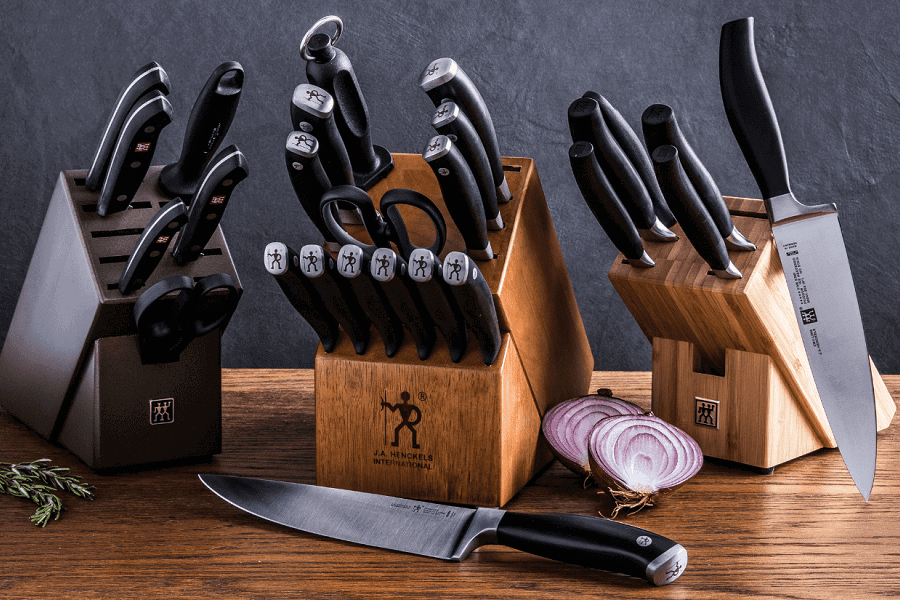
Look at the stamp on the blade. If you see two little figures standing side by side (the “twins”), you are holding a Zwilling. If you see a single figure, you are holding a Henckels. The word “Zwilling” means “twin” in German, which is why the flagship line gets two men and the value line gets one. That single detail settles more buying disputes than any spec sheet.
It gets muddier because of the older “J.A. Henckels International” branding. For years the value line was sold in North America as J.A. Henckels International with the single-man mark, while the premium line was Zwilling J.A. Henckels with the twins. The company has since simplified most packaging to just Zwilling and Henckels, but you will still find both marks in the wild, in old sets, and on the resale market. So the rule holds: two figures means the premium tier, one figure means the value tier, and both come from the same parent in Solingen.
Why does one parent run two brands? The same reason Toyota runs Lexus. Zwilling is the halo: forged, German-made, lifetime-warrantied, priced accordingly. Henckels is the volume play: a mix of forged and stamped knives made across several countries, aimed at buyers who want the name and the German-steel heritage without the flagship price. Neither is a knockoff of the other. They are two deliberate tiers of one house.
Zwilling vs Henckels at a glance
| Zwilling (the twins) | Henckels / Henckels International (single man) | |
|---|---|---|
| Steel | Proprietary high-carbon stainless, ice-hardened (FRIODUR) | High-carbon stainless, ice-hardened on the better lines |
| Typical hardness | About 57 HRC across most lines | About 55 to 57 HRC; softer on the cheapest stamped sets |
| Construction | Forged, full tang, most lines one-piece | Mix of forged and stamped, depending on line |
| Made in | Germany and Japan | Spain, China, India, Thailand (varies by line) |
| Price tier | Premium | Entry to mid |
| Warranty | Lifetime | Lifetime on forged lines, limited on some stamped |
| Best for | Cooks who want a lifetime German forged knife | First real set, budget upgrades, secondary knives |
| Verdict | The better knife, and priced like it | The better value, and honest about what it is |
Steel and edge: closer than the price gap suggests
Both brands use high-carbon stainless steel, and on the forged lines the gap in raw metallurgy is smaller than the price difference implies. Zwilling runs a proprietary steel formula and finishes most blades with its FRIODUR ice-hardening process, a controlled sub-zero step during heat treatment that improves edge retention, corrosion resistance, and hardness consistency. Henckels ice-hardens its better lines too, using the same underlying idea.
Hardness lands around 57 HRC on most Zwilling knives, which is the mainstream German target: hard enough to hold a working edge, soft enough to sharpen easily and survive a busy kitchen without chipping. Henckels forged lines sit in the same 55 to 57 range. The cheapest Henckels stamped sets run softer, and you feel it: the edge dulls faster and rolls sooner.
Two honest caveats. First, this is German steel, not Japanese. Do not expect a 61 HRC hair-splitting edge out of the box. Expect a durable, forgiving edge that you maintain with a honing steel and touch up on a whetstone or pull-through. Second, out-of-box sharpness varies more on Henckels than on Zwilling, simply because the range is wider and the factory sources differ. A forged Henckels can arrive nearly as sharp as a Zwilling. A budget stamped one usually will not.
Forged vs stamped: where the money actually goes
This is the real dividing line, and it matters more than the badge. A forged knife is pressed and shaped from a single bar of heated steel. It typically has a bolster (the thick collar between blade and handle), a full tang running the length of the handle, more heft, and better balance. A stamped knife is cut from a rolled sheet like a cookie from dough, then ground and finished. It is lighter, thinner, cheaper to make, and usually has no bolster.
Zwilling is forged across essentially its whole catalog. Henckels is split: its forged lines compete directly with entry Zwilling, while its stamped lines are the true budget product. This is why “Zwilling vs Henckels” is the wrong question at the checkout. The right question is “forged or stamped,” because a forged Henckels and an entry Zwilling are far more alike than a forged Henckels and a stamped Henckels from the same brand.
Forged is not automatically better for everyone. Stamped knives are lighter, which some cooks prefer for speed and long prep sessions, and they cost a fraction as much. But if you want the classic German feel of a heavy, bolstered, balanced knife that lasts decades, forged is what you are paying for, and Zwilling gives it to you consistently.
The lines, decoded
The names cause as much confusion as the logos. Here is how the main lines stack up, from flagship down.
Zwilling Pro
The modern flagship. Forged, ice-hardened, with a curved bolster that leaves the full edge usable for a pinch grip and comfortable rock chopping. If someone asks for one Zwilling chef’s knife to keep for life, this is usually it.
Zwilling Professional S
The traditional line, in production for decades. Forged, full bolster, classic three-rivet handle. Slightly more old-school in feel than Pro, with a heavier bolster that some cooks love and some find gets in the way of sharpening the heel. A safe, proven workhorse.
Zwilling Four Star and Twin lines
Four Star uses a seamless one-piece polymer handle for a hygienic, comfortable grip and comes in lighter than the riveted lines. The various Twin lines (Twin Signature, Twin Four Star, and others) fill out the range at different price and construction points. Read the individual line before buying, because “Twin” alone tells you the brand, not the build.
Henckels forged lines (Classic, Forged Premio, Forged Accent)
These are the knives that make Henckels worth taking seriously. Forged, full tang, often ice-hardened, and priced well below comparable Zwilling. A Henckels Classic or Forged Premio chef’s knife is a legitimate lifetime knife for most home cooks. This tier is where the value argument is strongest.
Henckels International stamped lines (Everedge, Silvercap, Statement)
The single-man budget tier. Stamped, lighter, cheaper, and the source of most “is Henckels any good” doubt. They cut fine when new and are a reasonable first set or a knife-block filler, but they will not hold an edge like the forged lines and they are not what people mean when they praise German knives.
Which to buy, by buyer
- You want one knife for life and price is secondary. Zwilling Pro or Professional S chef’s knife. Forged, German-made, lifetime warranty, and it will outlast the kitchen you buy it for.
- You want German forged quality on a real budget. A forged Henckels line: Classic or Forged Premio. This is the smartest-value pick in the whole comparison. Same construction principle, same heritage, much lower price.
- You are buying your first-ever set and want it to look and feel legit. A forged Henckels block set. Skip the cheapest stamped sets even if the piece count is tempting; five good knives beat fifteen soft ones.
- You want the lightest possible knife or a cheap secondary. A stamped Henckels International. Know what it is, use it accordingly, and do not expect flagship edge retention.
- You are torn between Zwilling and a competitor. If the competitor is Wusthof, that is a genuinely close German-vs-German call worth its own read; see the guide linked below.
My blunt take as a reviewer: most home cooks are better served by a forged Henckels than by a stamped anything, and better served by a single Zwilling Pro than by a big cheap block. Buy construction and steel, not badge and piece count.
Care that closes the gap
Both brands reward the same habits and punish the same neglect. Hand wash and dry immediately; the dishwasher dulls edges and loosens riveted handles over time. Hone with a steel before or after each session to keep the edge straight. Sharpen on a whetstone or a decent pull-through a few times a year. Store on a magnetic strip or in a block, never loose in a drawer. Done consistently, a well-kept forged Henckels will out-cut a neglected Zwilling. Steel quality sets the ceiling; maintenance decides where you actually live under it.
FAQ
Are Zwilling and Henckels the same company?
Yes. Both are owned and made by Zwilling J.A. Henckels of Solingen, Germany, founded in 1731. Zwilling is the premium forged line (two-figure logo) and Henckels is the broader value line (single-figure logo). Same parent, two deliberate tiers.
Which is better, Zwilling or Henckels?
Zwilling is the better knife: forged across the range, German-made, lifetime warranty. Henckels is the better value, especially its forged lines. If budget is no object, Zwilling. If you want the most quality per dollar, a forged Henckels wins.
Is Henckels International lower quality?
Henckels International is the value badge, and its stamped lines are genuinely lower-end: lighter, softer, cheaper. But its forged lines (Classic, Forged Premio, Forged Accent) are legitimate lifetime knives. So “Henckels International” is not one quality level; check whether the specific knife is forged or stamped before judging it.
Is it real German steel?
Zwilling uses proprietary high-carbon German stainless, ice-hardened via its FRIODUR process, on knives made in Germany and Japan. Henckels uses similar high-carbon stainless, but its knives are made across several countries (Spain, China, India, Thailand) depending on line. The steel formula and heat treatment are German-derived; the country of manufacture varies with the tier.
Are they worth it?
A forged knife from either brand is worth it for anyone who cooks regularly and will maintain it. Zwilling is worth it if you value a German-made lifetime knife and will keep it forever. A forged Henckels is worth it as the value pick. The cheapest stamped sets are worth it only as a starter or a spare, not as your main knife.
What is the difference between the two logos?
Two figures side by side (the twins) is Zwilling, the premium forged line. A single figure is Henckels or Henckels International, the value line. It is the fastest way to tell which tier you are holding without reading a spec sheet.
Bottom line
Zwilling vs Henckels is really one company offering you two price tiers of the same German knife-making tradition. Zwilling is the forged flagship you buy once and keep for life. Henckels is the value range, best in its forged lines and honestly budget in its stamped ones. Check the logo to know the tier, then check forged versus stamped to know the knife, and you will never get this comparison wrong again. For where these fit against the wider field, see our guides to the best German kitchen knives, the head-to-head on Wusthof vs Henckels, how to choose the best chef knife, and the pick of the best kitchen knife set.
About this guide
Steel Snob Editorial
Researched from manufacturer specifications, independent tests and owner reports, and edited for accuracy by the Steel Snob team.