
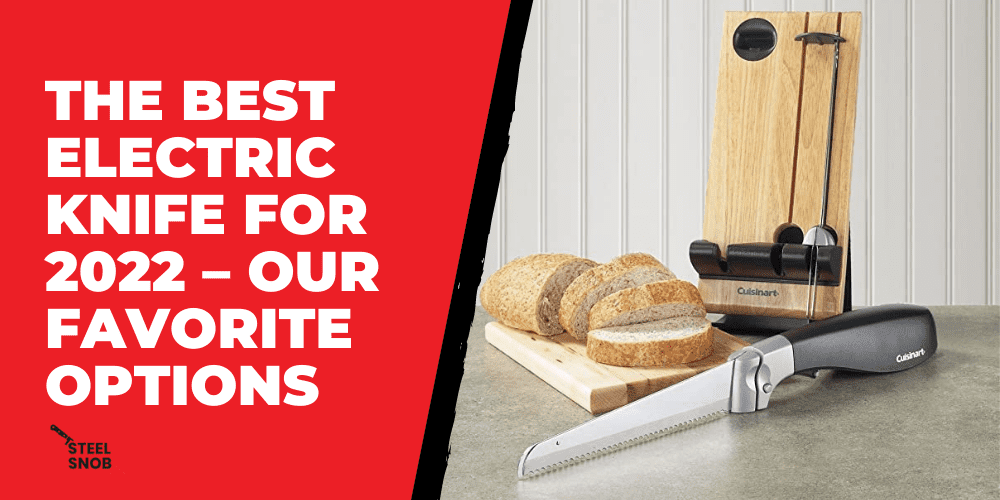
An electric knife is a corded or battery-powered carving tool with two serrated blades that reciprocate against each other, letting you slice roast meat, poultry, dense loaves, and fish with almost no downward pressure. If you carve a turkey once or twice a year, fillet your own catch, or struggle to cut clean slices of brisket without shredding it, a good electric knife does the one job it exists for better than any chef’s knife you own. This guide covers the models that actually earn a spot in a drawer, how we evaluate them, and how to match one to what you cook.
With electric knives, the marketing is mostly noise and the real differences come down to a few boring details: blade quality, motor steadiness, grip security when your hands are greasy, and whether it is corded or cordless. Below is the honest version, based on manufacturer specifications, independent tests and owner reports.
The best electric knives at a glance
Seven models worth considering, grouped by what they’re good at. Where a manufacturer publishes a spec we’ve used it; where we couldn’t confirm a hard number, we’ve described the category honestly rather than inventing one. All are corded unless the table says otherwise.
| Model | Best for | Blade / reach | Power | Cord or battery | Our verdict |
|---|---|---|---|---|---|
| Cuisinart CEK-41 | Best overall carving knife | Universal micro-serrated blade | 130W handle | Corded | Smoothest, most controlled slicing; comes with a bamboo board and fork |
| BLACK+DECKER EK500B | Best value | 9 in reach (approx. 7.5 in serrated) | Not published | Corded | Quiet, low-vibration, secure grip for the money |
| Cuisinart CEK-40 | Best for versatility | Interchangeable carving + bread blades | Not published | Corded | Comfortable and capable; a touch louder than the CEK-41 |
| Hamilton Beach 74250R | Best for occasional holiday use | ~7.5 in blade, 5 ft cord | Not published | Corded | Case and fork included; grip gets slippery when wet |
| Rapala Lithium Ion Cordless Combo | Best for fish and filleting | 6 in and 7.5 in reciprocating blades | Not published | Cordless (~80 min runtime) | Two batteries; the standard for anyone who fillets their own catch |
| Bubba Lithium-Ion Cordless | Best for large roasts and brisket | Blade set up to ~12 in | Not published | Cordless | Long-reach blades and a rugged grip; overkill for a small kitchen |
| Avantco cordless carving knife | Best cordless for the table | Bread + carving blades | Not published | Cordless (~70 min runtime) | Untethered carving at the table; check runtime before a big crowd |
If you want the short answer: buy the Cuisinart CEK-41 for holiday and everyday carving, the BLACK+DECKER EK500B if you want to spend less, and a Rapala Lithium Ion Cordless if you fillet fish. Everything else in the table is a good fit for a narrower use case, explained below.
How we evaluate and what actually matters
Electric knives are simple machines, so the differences between a good one and a frustrating one are subtle. These are the things we weigh, in roughly the order they matter.
Blade quality and cut edge
The blade is the whole product. The useful test, and the one owner reports describe most, is unforgiving: carve a rotisserie chicken, then slice a crusty baguette, a soft brioche, and a block of hard cheddar. A good blade leaves smooth faces on the meat and a clean crumb on the bread; a mediocre one crushes the brioche and leaves the chicken looking chewed. Micro-serrated edges (like Cuisinart’s universal blade) tend to handle both crust and soft interior better than aggressive coarse serrations.
Motor power and steadiness
Wattage gets quoted a lot and matters less than you’d think; what matters is whether the motor holds its speed under load. A weak or cheaply geared motor bogs down the moment it hits a dense turkey thigh or the crust of a country loaf, and you feel it as a stutter. Cuisinart publishes 130W on the CEK-41 handle; many brands publish nothing, which is why how a knife behaves under load on the cutting board, as owners describe it, tells you more than the spec sheet.
Ergonomics and grip security
You’ll be holding this with greasy, wet hands over a hot bird. The most common failure in cheaper knives is a smooth plastic handle that turns slippery the moment fat gets on it, so we look at what owners report about grip with greasy hands, and note whether the trigger is a squeeze-and-hold (safer) or a slide lock. Ambidextrous handles matter if anyone in the house is left-handed.
Corded versus cordless
The biggest real decision, covered in its own section below. Short version: corded models are steadier and cheaper; cordless buys freedom of movement and no dangling cord over a hot pan, at the cost of runtime and price.
Cleaning and storage
Blades should pop off with a release button (not a screw) and go in the dishwasher; the motor handle never should. We check whether owners report the release trapping food gunk, whether the blades store safely, and whether a case is included. A knife that’s annoying to clean is a knife you’ll stop using.
Noise and vibration
Dismissed as a vanity metric, but you’re often carving at the table in front of guests, and a knife that sounds like a power tool and buzzes your hand numb is genuinely worse to live with. The quietest models (the BLACK+DECKER is a standout) feel more like a knife and less like an appliance.
The reviews
Cuisinart CEK-41: best overall
The CEK-41 is the one we recommend to anyone who wants a single recommendation. Its 130W handle drives a universal micro-serrated blade that slices roast, poultry, and bread cleanly without the tearing coarser blades cause, and it stays composed hitting a dense thigh joint. The handle is comfortable and ambidextrous, the blade release is quick, and the kit includes a bamboo cutting board and carving fork, so it’s a complete table setup out of the box.
- Pros: Clean, consistent cuts across meat and bread; published motor power; ambidextrous grip; safety lock; useful included accessories.
- Cons: Corded, so you’re tethered near an outlet; a single universal blade rather than a swap-out bread/carving pair.
Who should buy it: Anyone who wants one knife for the turkey, the roast, and the weekend loaf, and doesn’t want to think about it.
BLACK+DECKER EK500B: best value
The EK500B is a legitimately good knife, not just a cheap one. It carves poultry and slices bread well, the grip stays secure, and it’s noticeably quiet with minimal vibration, which matters more at the table than the price suggests. The “9-inch” figure is total reach; the serrated cutting portion is closer to 7.5 inches with a tang before the plastic.
- Pros: Excellent value; quiet; low vibration; secure comfort grip; safety lock button; dishwasher-safe blades.
- Cons: No published wattage; fewer accessories than the Cuisinart kits; single blade type.
Who should buy it: Someone who carves a few times a year and wants a reliable, quiet knife without paying for a bundle.
Cuisinart CEK-40: best for versatility
The CEK-40 is the CEK-41’s older sibling and trades a little refinement for flexibility: interchangeable carving and bread blades let you match the edge to the task. Owners report it carves comfortably and handles the same jobs well; it just runs a touch louder and feels slightly less polished.
- Pros: Interchangeable carving and bread blades; comfortable handle; strong all-round performance.
- Cons: Louder than the CEK-41; corded.
Who should buy it: Someone who slices a lot of bread as well as meat and wants a dedicated blade for each.
Hamilton Beach 74250R: best for occasional holiday use
If the knife lives in a cupboard for eleven months and comes out for Thanksgiving, the Hamilton Beach is a sensible, inexpensive choice. It ships with a storage case and serving fork, the ~7.5-inch blades carve a turkey fine, and the 5-foot cord gives you room to work. The catch is the handle: comfortable dry, but slippery once fat and juices are on your hands.
- Pros: Inexpensive; storage case and fork included; enough cord length; fine for once-a-year carving.
- Cons: Grip gets slippery when wet; not a knife for frequent use.
Who should buy it: The holiday-only carver who wants a tidy case-and-fork set that stores away cleanly.
Rapala Lithium Ion Cordless Combo: best for fish and filleting
If you fillet your own catch, this is the category standard and a different animal from the kitchen knives above. The lithium-ion combo runs roughly 80 minutes per charge (a full charge takes under two hours), ships with two batteries, and includes 6-inch and 7.5-inch blades plus a padded case. The cordless design is the point: no cord to drag through fish slime at the dock.
- Pros: Genuinely cordless with strong runtime; two batteries; multiple blade lengths; built for messy, mobile work.
- Cons: Specialized for filleting; more expensive than a corded kitchen knife; blades are tuned for fish, not bread.
Who should buy it: Anglers and anyone who processes fish regularly. For a broader look at dedicated blades, see our guide to the best fillet knives.
Bubba Lithium-Ion Cordless: best for large roasts and brisket
Bubba built its name on fish, but the long-reach blades make its cordless lithium knives a strong pick for big carving jobs: a 15-pound ham, a full brisket, a large turkey. Blade options run up to around 12 inches, letting you take one clean pass through a wide cut instead of sawing. It’s rugged and grippy, exactly what you want when a cut is heavy and slick.
- Pros: Long blade reach for wide cuts; cordless freedom; durable, secure grip.
- Cons: Overkill for small kitchens and everyday slicing; a premium price for the capability.
Who should buy it: Big-batch cooks, smokers, and anyone regularly carving briskets or large hams.
Avantco cordless carving knife: best cordless for the table
If your objection to corded knives is the cord dangling across a hot pan or a crowded table, this set solves it without going full fishing-knife. It comes with a motorized handle, interchangeable bread and carving blades, a charger, and a case, with a runtime around 70 minutes that recharges in under 90. Confirm the runtime covers your event; a slow carver working a full holiday spread can outlast a single charge.
- Pros: Cordless carving at the table; bread and carving blades included; quick recharge.
- Cons: Runtime is finite, so plan around it; less refined than the top corded Cuisinart.
Who should buy it: The host who carves at the table and doesn’t want a cord anywhere near the guests or the gravy.
Corded vs cordless: how to actually choose
Choose corded if you carve near an outlet and want the steadiest motor for the money with nothing to charge. Corded knives take the “best overall” and “best value” spots because the power is constant, they’re cheaper, and there’s no battery to degrade in a drawer.
Choose cordless if you carve away from an outlet (the table, a dock, a cleaning station), hate a cord near hot pans, or fillet fish where a trailing cord is a genuine hazard. The tradeoffs are real: cordless costs more, runs on a finite charge, and its lithium battery loses capacity over the years, so buy a model with two batteries or a fast charger if you carve for a crowd. Cordless isn’t automatically better for being newer; it earns its premium only when the cord is a real problem for how you work.
Buyer’s guide: how to choose an electric knife
Match the blade to your food and cut size
A universal micro-serrated blade (Cuisinart’s approach) is the best single-blade choice because it handles both crusty bread and roast meat. If you slice a lot of both, swap-out carving and bread blades give a cleaner result on each; filleting fish is its own category, so use a dedicated fish blade like Rapala’s. On length, a 7-to-8-inch serrated blade covers everyday poultry and roasts, while a longer blade (up to ~12 inches on the Bubba) lets you take one clean pass through a wide brisket or ham instead of sawing.
Grip, weight, and safety
A textured or contoured grip beats smooth plastic every time, especially when it’s greasy. Look for a squeeze-to-run trigger and a separate safety lock; you don’t want a knife that can start on its own when you set it down. Left-handed? Confirm the handle is ambidextrous.
Cord, runtime, cleaning, and extras
For corded models, 5 feet of cord is the practical minimum from outlet to carving station; for cordless, check runtime against your longest session and prefer a spare battery or a sub-two-hour charge. Confirm the blades detach with a button and are dishwasher-safe while the motor handle stays easy to wipe. A storage case and an included fork or cutting board (as with the Cuisinart CEK-41) are real conveniences for a tool that’s sharp and used occasionally.
Common mistakes and care
- Pushing down. The knife does the work. Press and you’ll tear the food and stress the motor; let the reciprocating blades pull themselves through with light guidance.
- Carving straight off the heat. Let roasts and poultry rest so the juices redistribute; slicing too early makes a mess and a drier result regardless of the knife.
- Submerging the handle. The motor handle is not waterproof. Detach and wash the blades, wipe the handle down. Water in the motor kills these knives faster than anything else.
- Ignoring the safety lock. Engage it before changing blades or setting the knife down. These blades are aggressive and start instantly.
- Storing blades loose. Use the case or a blade guard; loose blades in a drawer are a cut waiting to happen and dull from banging around.
- Letting a cordless battery sit dead. Lithium batteries last longer if you don’t store them fully drained. Top it up before it goes back in the cupboard.
Frequently asked questions
Are electric knives worth it?
For carving roasts, poultry, dense bread, and fish, yes. They produce cleaner, more even slices with far less effort than a chef’s knife, especially if you lack the knife skills or wrist strength for long, precise strokes. They won’t replace your kitchen knife set; they’re a specialist tool that earns its drawer space at the holidays and any time you carve something large.
Corded or cordless, which should I get?
Corded for most people: steadier power, lower price, no charging. Cordless if you carve at the table, away from an outlet, or fillet fish where a cord is a hazard. Cordless costs more and runs on a finite charge, so if you go that route, get a model with two batteries or a fast charger.
What’s the best electric knife for turkey and brisket?
For a standard turkey, the Cuisinart CEK-41 or BLACK+DECKER EK500B carve beautifully with a 7-to-8-inch blade. For a whole brisket or large ham, a longer blade helps enormously; the Bubba cordless (blades up to ~12 inches) takes one clean pass across the wide cut instead of sawing.
Can an electric knife slice bread?
Yes, and it’s one of the best uses for one. The reciprocating serrated blades cut crusty and soft loaves cleanly without crushing them. A universal micro-serrated blade handles both crust and crumb; if you slice bread constantly, a dedicated bread blade (as on the CEK-40) is even better. For the classic hand tool, see our best bread knife guide.
How do I clean an electric knife?
Detach the blades using the release button and wash them by hand or in the dishwasher if they’re rated for it. Never submerge or run water into the motor handle, wipe it down with a damp cloth instead. Dry everything before storing, and keep the blades in their case or a guard so they don’t dull or become a hazard in the drawer.
Can electric knives cut through bone?
No, and you shouldn’t try. Electric carving knives are built to slice meat, poultry, bread, and fish, not to cut through bone or frozen food. Hitting bone damages the blade edge, strains the motor, and can cause the knife to jump. Carve around joints and bones the way you would with any carving knife. For sharpening the hand tools you do own, see our knife sharpener guide.
The bottom line
Most people are best served by a corded knife: the Cuisinart CEK-41 for the cleanest cuts and a complete kit, or the BLACK+DECKER EK500B for a quiet, reliable knife for less. Choose the Cuisinart CEK-40 for dedicated bread and carving blades, and go cordless with the Rapala for fish, the Bubba for big briskets and hams, or the Avantco to lose the cord at the table. Match the blade and power source to what you cook, keep water out of the motor, and let the knife do the work.
About this guide
Steel Snob Editorial
Researched from manufacturer specifications, independent tests and owner reports, and edited for accuracy by the Steel Snob team.