
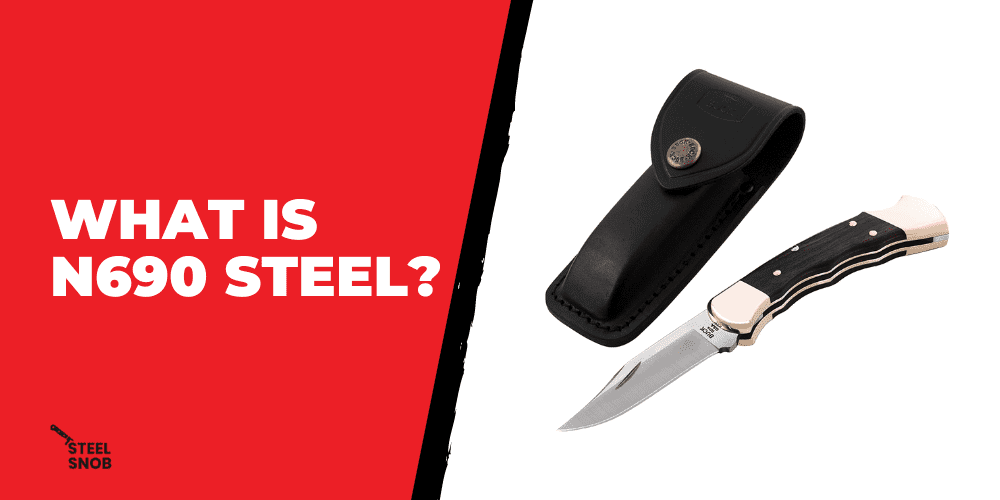
N690 Steel at a Glance
| Property | Rating |
|---|---|
| Hardness (HRC) | 58-60 |
| Edge Retention | 6/10 |
| Toughness | 6/10 |
| Corrosion Resistance | 8/10 |
| Ease of Sharpening | 7/10 |
N690 is a premium stainless steel manufactured by Bohler-Uddeholm in Austria. Often called the European equivalent of Japan’s VG10, N690 delivers an impressive combination of corrosion resistance, edge retention, and ease of sharpening that has made it a favorite among European knife manufacturers and increasingly popular worldwide.
In this 2026 guide, we cover N690’s chemical composition, performance characteristics, the best knives available in this steel, and detailed comparisons with popular alternatives like VG10, AUS-8, and 440C.
What is N690 Steel?
N690 (also known as N690Co or Bohler N690) is a high-carbon cobalt stainless steel produced by Bohler-Uddeholm, one of the world’s leading specialty steel manufacturers based in Austria. The steel was originally developed for industrial cutting applications, surgical instruments, and high-quality cutlery, but it has found widespread adoption in the knife industry.
The inclusion of cobalt in N690’s formula is one of its defining characteristics. Cobalt strengthens the steel matrix, improves hot hardness, and enables higher working hardness without excessive brittleness. This is the same approach used by Takefu Special Steel in VG10, which is why the two steels are frequently compared.
N690 stands out for its exceptionally high chromium content — 17% — which is significantly higher than most other knife steels. This makes N690 one of the most corrosion-resistant knife steels available, ideal for marine environments, kitchen use, and any application where moisture exposure is common.
Chemical Composition of N690 Steel
| Element | Percentage | Role |
|---|---|---|
| Carbon (C) | 1.07% | High carbon content provides excellent hardness and edge retention. |
| Chromium (Cr) | 17.00% | Very high chromium delivers outstanding corrosion resistance — among the highest in knife steels. |
| Cobalt (Co) | 1.00% | Strengthens the steel matrix, improves hot hardness, and enables higher working hardness. |
| Molybdenum (Mo) | 1.10% | Enhances hardenability, strength, and pitting corrosion resistance. |
| Vanadium (V) | 0.10% | Forms hard carbides and refines grain structure for a keener edge. |
| Manganese (Mn) | 0.40% | Improves hardenability and tensile strength. |
| Silicon (Si) | 0.40% | Deoxidizer, increases strength. |
The standout feature of N690’s composition is the 17% chromium, which is notably higher than S30V (14%), S35VN (14%), and even VG10 (15.5%). This gives N690 superior corrosion resistance compared to most premium knife steels.
N690 Steel Performance Breakdown
Hardness and Edge Retention
N690 achieves 58-60 HRC with standard heat treatment, placing it in the mid-premium range. Some manufacturers push N690 to 61 HRC with optimized heat treatment, though this is less common. At these hardness levels, N690 provides solid edge retention rated at 6/10.
While N690’s edge retention doesn’t match the levels of higher-tier steels like S30V (8/10) or M390 (9/10), it’s perfectly adequate for most knife applications. A well-sharpened N690 blade will maintain its working edge through a full day of moderate use. The steel also takes a very keen edge thanks to its fine carbide structure, making it excellent for tasks that demand precision cutting.
Toughness
N690 rates 6/10 for toughness, placing it solidly in the middle range. It’s tougher than high-hardness, high-carbide steels like M390 (5/10) but doesn’t approach the toughness of carbon steels like 5160 (9/10) or 52100 (7/10).
The balanced toughness makes N690 suitable for a wide range of tasks. It can handle moderate impact, light batoning, and normal knife work without chipping concerns. European knife makers particularly value this balance, as it allows for both thin kitchen knife geometries and robust field knife designs.
Corrosion Resistance
This is N690’s strongest attribute. With 17% chromium, N690 offers corrosion resistance rated at 8/10 — among the best available in knife steels. Only steels with even higher chromium content, like M390 (20% Cr), or nitrogen steels like LC200N surpass it.
N690 blades can handle extended exposure to water, salt spray, acidic foods, and humid environments with minimal risk of corrosion. This makes N690 an outstanding choice for diving knives, marine knives, kitchen cutlery, and any knife that will see regular wet use. The Extrema Ratio brand, which specializes in military and diving knives, chose N690 specifically for this reason.
Ease of Sharpening
N690 earns a 7/10 for ease of sharpening, making it one of the more user-friendly premium steels. It responds well to standard sharpening methods — Japanese water stones, ceramic rods, and even quality pull-through sharpeners can produce a keen edge without excessive effort.
The relatively low vanadium content (0.10%) means N690 doesn’t have the extremely hard vanadium carbides that make steels like S30V and S35VN difficult to sharpen. This is a significant practical advantage for users who sharpen their own knives and don’t want to invest in specialized diamond equipment.
What is N690 Steel Used For?
- European Kitchen Knives: N690’s excellent corrosion resistance and ease of sharpening make it well-suited for kitchen applications, especially in professional environments where knives are exposed to water and acidic foods constantly.
- Military and Tactical Knives: Brands like Extrema Ratio use N690 in their military-grade knives due to its corrosion resistance and balanced performance.
- Diving Knives: The outstanding corrosion resistance makes N690 one of the best steels for saltwater exposure.
- EDC Folders: European makers like Maniago and several Italian brands use N690 in everyday carry designs.
- Hunting and Outdoor Knives: N690 handles field conditions well without the maintenance demands of carbon steels.
Best Knives in N690 Steel
1. Extrema Ratio MF1
Extrema Ratio is perhaps the most well-known user of N690 steel. The MF1 is a full-size military folder that showcases N690 at its best — the blade handles rough field conditions, maintains its edge through demanding use, and shrugs off corrosion from sweat, rain, and salt exposure. Italian craftsmanship meets Austrian steel engineering in a formidable combination.
Check Price on Amazon
2. Boker Plus Kihon
The Boker Plus Kihon is a sleek, modern EDC folder designed by Lucas Burnley. The N690 blade offers excellent everyday performance in a slim, lightweight package. The flipper deployment is smooth and fast, and the blade steel handles pocket carry conditions without any corrosion issues. At its price point, it’s one of the best values in the N690 category.
Check Price on Amazon
3. Manly Patriot
The Manly Patriot is a fixed-blade knife from a Bulgarian company that has earned a strong reputation for quality. The N690 blade is thick and robust, with a Scandi grind that’s perfect for bushcraft and outdoor tasks. This knife demonstrates that N690 can perform admirably in tough, outdoor-focused applications, not just in the kitchen or as an EDC option.
Check Price on Amazon
How N690 Compares to Other Knife Steels
N690 vs VG10
VG10 is the closest comparison to N690. Both steels contain cobalt, share similar hardness ranges (58-62 HRC), and target similar applications. VG10 has slightly better edge retention (7/10 vs 6/10) due to its higher carbon and vanadium content, while N690 has marginally better corrosion resistance (8/10 vs 8/10, with N690’s higher Cr giving it a practical advantage in extreme conditions) and is easier to sharpen (7/10 vs 6/10). The choice often comes down to geography — Japanese and American makers prefer VG10; European makers use N690.
N690 vs 440C
440C was once the premium stainless choice before modern steels emerged. N690 outperforms 440C in virtually every category — better edge retention, similar corrosion resistance, better toughness, and a finer grain structure that takes a keener edge. N690 is the clear upgrade from 440C, though 440C remains available at lower price points. For a detailed look at 440C performance, check our 440C vs VG-10 comparison.
N690 vs AUS-8
AUS-8 is softer (57-59 HRC) and has lower edge retention (5/10) than N690, but it’s easier to sharpen (8/10 vs 7/10) and slightly tougher (6/10 vs 6/10). N690 is the clear upgrade for users willing to accept marginally more sharpening effort in exchange for better edge retention and hardness.
N690 Steel: Pros and Cons
Pros
- Outstanding corrosion resistance — one of the best among knife steels
- Relatively easy to sharpen compared to premium competitors
- Good balance of hardness, edge retention, and toughness
- Takes a very fine, keen edge
- Manufactured by Bohler-Uddeholm — consistent quality guaranteed
- Excellent value compared to higher-priced supersteels
Cons
- Edge retention doesn’t match premium steels like S30V or M390
- Less widely available in American knife brands
- Performance ceiling lower than newer powder metallurgy steels
- Moderate toughness — not ideal for heavy-duty chopping
Heat Treatment for N690
N690’s heat treatment follows conventional martensitic stainless steel protocols:
- Austenitizing: 1030-1080°C (1886-1976°F) depending on desired hardness level.
- Quenching: Oil or air quench. N690 has good hardenability and responds well to both methods.
- Sub-zero Treatment: Optional cryogenic treatment improves hardness and dimensional stability.
- Tempering: 150-200°C (300-390°F) to optimize hardness-toughness balance. Most makers target 58-60 HRC.
Bohler-Uddeholm provides detailed heat treatment guidelines for N690, and manufacturers like Extrema Ratio have optimized their processes over many years. This consistency is one of N690’s strengths — you know what to expect from a well-made N690 blade.
N690 in 2026: A Balanced Performer
In the 2026 knife market, N690 occupies a unique position. It doesn’t claim to be a supersteel — it doesn’t have the extreme edge retention of M390 or the revolutionary toughness-to-corrosion ratio of MagnaCut. Instead, N690 offers a highly practical, well-balanced package that excels in real-world use.
For users who prioritize corrosion resistance and easy maintenance over absolute edge retention, N690 remains one of the best choices available. It’s particularly strong in applications where the knife will be exposed to moisture, salt, or acidic materials — diving, marine, kitchen, and food processing.
N690 also represents excellent value. Knives in N690 are typically priced well below comparable S30V or S35VN models, making it an accessible option for knife enthusiasts who want premium-level performance without the premium price tag. For our complete steel rankings, see the Best Knife Steel 2026 guide.
Explore More Knife Steels
- What is VG10 Steel? — N690’s Japanese counterpart
- What is S35VN Steel? — America’s top EDC steel
- What is S30V Steel? — The premium benchmark
- What is M390 Steel? — Bohler’s supersteel offering
- What is D2 Steel? — Semi-stainless tool steel
- What is AUS-8 Steel? — Budget Japanese stainless
- What is 52100 Steel? — Premium carbon steel
- What is 5160 Steel? — Toughest blade steel
- What is 1095 Steel? — Classic high-carbon
- What is 420HC Steel? — Entry-level stainless
- What is Damascus Steel? — Layered steel artistry
Comparison guides:
- S30V vs S35VN Comparison
- MagnaCut vs M390 Comparison
- D2 vs S30V Comparison
- 440C vs VG-10 Comparison
- Best Knife Steel 2026
Is N690 good for knives?
Is N690 stainless steel?
What is N690 steel equivalent to?
About this guide
Steel Snob Editorial
Researched from manufacturer specifications, independent tests and owner reports, and edited for accuracy by the Steel Snob team.