
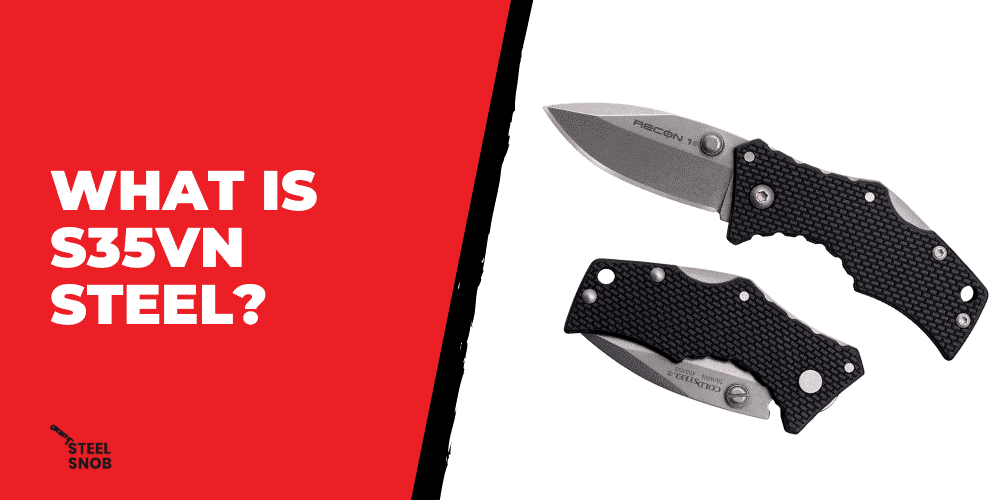
S35VN Steel at a Glance
| Property | Rating |
|---|---|
| Hardness (HRC) | 58-61 |
| Edge Retention | 8/10 |
| Toughness | 7/10 |
| Corrosion Resistance | 7/10 |
| Ease of Sharpening | 5/10 |
CPM-S35VN has become one of the most widely used premium knife steels in the world since its introduction in 2009. Developed by Crucible Industries in collaboration with legendary knifemaker Chris Reeve, S35VN was designed as a direct improvement over the already-excellent S30V steel. The result is a steel that offers better toughness, improved machinability for knife makers, and edge retention that rivals the best in the industry.
In this 2026 guide, we’ll break down everything you need to know about S35VN steel — its composition, real-world performance, the best knives made with it, and how it compares to alternatives like M390, D2, and S30V.
What is S35VN Steel?
CPM-S35VN (often shortened to S35VN) is a martensitic stainless steel produced by Crucible Industries using their proprietary Crucible Particle Metallurgy (CPM) process. This powder metallurgy technique produces a more uniform distribution of carbides compared to conventional steelmaking, resulting in a blade steel with more consistent performance, better toughness, and improved grindability.
The key innovation of S35VN was the partial replacement of vanadium with niobium (columbium) in the alloy formula. While S30V relies entirely on vanadium carbides for wear resistance, S35VN uses a mix of vanadium and niobium carbides. Niobium carbides are less angular and more rounded than vanadium carbides, which means they don’t create stress points in the steel matrix. The result? S35VN is approximately 15-20% tougher than S30V while maintaining essentially the same edge retention.
This improved toughness also makes S35VN easier for knife makers to machine, grind, and polish — which has contributed to its rapid adoption across the industry. Today, S35VN is used by virtually every major knife brand, from Chris Reeve Knives and Benchmade to Zero Tolerance and Spyderco.
Chemical Composition of S35VN Steel
| Element | Percentage | Role |
|---|---|---|
| Carbon (C) | 1.34% | High carbon content creates hard carbides that provide excellent edge retention and overall hardness. |
| Chromium (Cr) | 14.00% | Provides stainless properties and corrosion resistance. Exceeds the 13% threshold for stainless classification. |
| Vanadium (V) | 3.00% | Forms extremely hard vanadium carbides (VC) that resist abrasive wear, maintaining the cutting edge. |
| Molybdenum (Mo) | 2.00% | Enhances strength, hardenability, and resistance to pitting corrosion. |
| Niobium (Nb) | 0.50% | S35VN’s signature addition. Forms rounded carbides that improve toughness over S30V’s angular vanadium carbides. |
| Manganese (Mn) | 0.50% | Improves hardenability and tensile strength during heat treatment. |
| Silicon (Si) | 0.50% | Deoxidizer that increases strength. |
S35VN Steel Performance Breakdown
Hardness and Edge Retention
S35VN typically runs between 58-61 HRC depending on the heat treatment applied by each manufacturer. Most premium knife makers target the 60-61 HRC range, which provides an ideal balance between hardness (for edge retention) and toughness (for durability).
The edge retention on S35VN is outstanding — we rate it 8/10, putting it in the upper tier alongside steels like S30V and just below supersteels like M390 (9/10). In practical terms, an S35VN blade will handle weeks of moderate EDC use before needing a touch-up on a strop or fine sharpening stone.
What makes S35VN’s edge retention impressive is not just how long the edge lasts, but how it dulls. Unlike some steels that suddenly go from sharp to dull, S35VN tends to degrade gradually, maintaining usable sharpness even as the keen edge fades. This predictable wear pattern is valued by both knife users and knife reviewers.
Toughness
This is where S35VN truly shines compared to its predecessor S30V. With a toughness rating of 7/10, S35VN can handle tasks that would make many premium stainless steels nervous — moderate batoning, tip work on hard materials, and accidental drops or impacts.
The niobium carbides in S35VN are rounder and more evenly distributed than the angular vanadium carbides found in S30V. This means fewer weak points in the steel matrix where cracks can initiate and propagate. Real-world testing by knife makers and users consistently confirms that S35VN blades are significantly less prone to chipping than S30V blades, especially at thinner edge geometries.
That said, S35VN is still a hard stainless steel, not a tough carbon steel. For maximum toughness, steels like 5160 (9/10 toughness) or 52100 (7/10 toughness) remain superior choices.
Corrosion Resistance
With 14% chromium, S35VN qualifies as stainless steel and provides good corrosion resistance rated at 7/10. It handles normal EDC conditions well — pocket carry, occasional exposure to rain, cutting food, and routine use won’t cause rust issues as long as you practice basic knife care.
However, S35VN doesn’t match the corrosion resistance of steels with higher chromium content like VG10 (8/10) or N690 (8/10). If you’re in a marine environment or regularly expose your knife to saltwater, you’ll want to give S35VN a bit more maintenance attention. LC200N (Cronidur 30) or H1 steel would be better choices for extreme corrosion environments.
Ease of Sharpening
S35VN rates 5/10 for sharpening ease, which is moderate. It’s easier to sharpen than its predecessor S30V (4/10) thanks to the niobium carbides being less abrasion-resistant than pure vanadium carbides. However, it’s still significantly harder to sharpen than softer steels like AUS-8 (8/10) or 420HC (9/10).
For sharpening S35VN, we recommend diamond or ceramic stones. Standard aluminum oxide stones will work but progress slowly. A Spyderco Sharpmaker or Worksharp Precision Adjust with diamond plates makes quick work of S35VN maintenance. Field sharpening with a small diamond rod is perfectly feasible.
What is S35VN Steel Used For?
- EDC Folding Knives: This is S35VN’s primary domain. Its combination of edge retention, toughness, and corrosion resistance makes it arguably the best all-around EDC steel available.
- Tactical Knives: The improved toughness over S30V makes S35VN well-suited for harder-use tactical applications where chipping is a concern.
- Fixed Blade Knives: S35VN works well in fixed blades for hunting, camping, and outdoor use where a balance of corrosion resistance and performance is needed.
- Custom Knives: Many custom knife makers favor S35VN because it machines and grinds more easily than S30V, allowing for more intricate blade designs.
Best Knives in S35VN Steel
1. Chris Reeve Sebenza 31
The Sebenza is the knife that S35VN was literally designed for. Chris Reeve collaborated with Crucible to create S35VN as an improvement over the S30V used in earlier Sebenza models. The Sebenza 31 features flawless fit and finish, a titanium frame lock, and impeccable S35VN heat treatment. It’s a benchmark knife that every serious knife enthusiast should experience at least once.
Check Price on Amazon
2. Benchmade Bugout 535
The Bugout has become one of the best-selling EDC knives of the past decade, and for good reason. Weighing under 2 ounces with an S35VN blade (on the 535-3 model), it’s an ultralight performer that doesn’t sacrifice cutting ability. The AXIS lock provides smooth, ambidextrous operation, and the blade geometry is optimized for everyday cutting tasks. An excellent way to experience S35VN at a reasonable price point.
Check Price on Amazon
3. Zero Tolerance 0350
For those who prefer a more robust, overbuilt EDC option, the ZT 0350 delivers S35VN performance in a tank-like package. The assisted opening with SpeedSafe technology provides lightning-fast deployment, while the G10 handle scales offer a grippy, secure hold. This knife is built to handle harder EDC tasks without breaking a sweat.
Check Price on Amazon
How S35VN Compares to Other Knife Steels
S35VN vs S30V
This is the most common comparison, and for good reason — S35VN was literally designed to improve on S30V. The key differences: S35VN is approximately 15-20% tougher (7/10 vs 6/10), slightly easier to sharpen (5/10 vs 4/10), and takes a better polish. Edge retention is essentially identical between the two (both 8/10). For most users, S35VN is the better choice. S30V only wins in niche situations where maximum abrasion resistance matters more than toughness.
S35VN vs M390
M390 outperforms S35VN in both edge retention (9/10 vs 8/10) and corrosion resistance (9/10 vs 7/10), making it the more premium option. However, S35VN is tougher (7/10 vs 5/10), much easier to sharpen (5/10 vs 3/10), and typically less expensive in finished knives. M390 is the better choice if maximum edge holding is your priority; S35VN wins for all-around usability and toughness. Check our MagnaCut vs M390 guide for more on supersteel comparisons.
S35VN vs D2
D2 is a semi-stainless tool steel that costs significantly less than S35VN. D2 has comparable edge retention (7/10 vs 8/10) but falls behind in corrosion resistance (4/10 vs 7/10) and toughness (5/10 vs 7/10). S35VN is the clear upgrade in virtually every category. D2’s main advantage is price — D2 knives typically cost 30-50% less than comparable S35VN models. See our D2 vs S30V comparison for more detail.
S35VN Steel: Pros and Cons
Pros
- Outstanding balance of edge retention, toughness, and corrosion resistance
- Improved toughness over S30V — less prone to chipping
- Easier for makers to machine and grind, leading to better fit and finish
- Widely available from top-tier knife brands
- Proven track record since 2009 with thousands of production models
- Takes a fine edge with proper sharpening technique
Cons
- Moderately difficult to sharpen — diamond or ceramic abrasives recommended
- Edge retention surpassed by newer supersteels like M390 and MagnaCut
- Corrosion resistance adequate but not exceptional in marine environments
- Premium pricing compared to budget steels
- Can still chip under extreme lateral stress or improper use
Heat Treatment for S35VN
S35VN’s performance is heavily dependent on heat treatment. The typical process includes:
- Austenitizing: 1065°C (1950°F) for approximately 30 minutes in a vacuum or protective atmosphere furnace.
- Quenching: Air quenching or plate quenching to form martensite. The CPM process makes S35VN very responsive to air quenching.
- Cryogenic Treatment: Many premium manufacturers cryo-treat S35VN to -196°C (-320°F) to convert retained austenite and maximize hardness.
- Tempering: Double temper at 315-370°C (600-700°F) depending on desired final hardness. Most manufacturers target 60-61 HRC for the optimal hardness-toughness balance.
Chris Reeve Knives, who helped develop S35VN, is considered the benchmark for S35VN heat treatment. Their blades consistently test at 59-60 HRC with exceptional consistency and performance. Benchmade, ZT, and Spyderco also produce excellent S35VN heat treatments.
S35VN in 2026: Still the King of EDC?
Despite the emergence of newer steels like MagnaCut, CPM-S45VN, and Vanax, S35VN remains arguably the most popular premium EDC steel in 2026. Why? Because it represents the sweet spot where performance, availability, price, and user-friendliness all converge.
MagnaCut may have better corrosion resistance and toughness-to-hardness ratio, and M390 may hold an edge longer, but S35VN is more widely available, better understood by manufacturers, and offers a more forgiving user experience. For the vast majority of EDC users, S35VN is more than enough steel.
The fact that Chris Reeve Knives — a company known for uncompromising quality — still uses S35VN as their standard steel in 2026 speaks volumes about its continued relevance.
Caring for S35VN Steel Knives
- Clean and dry after each use — especially if you’ve cut food or encountered moisture.
- Light oil the blade periodically with mineral oil or a dedicated knife oil like Tuf-Glide.
- Strop regularly — a loaded leather strop extends the time between full sharpenings significantly.
- Use diamond or ceramic stones for sharpening — they cut S35VN much more efficiently than natural or aluminum oxide stones.
- Avoid prying — while S35VN is tough, using any knife as a pry bar risks blade damage.
- Keep the pivot clean on folders — compressed air or a drop of oil keeps the action smooth.
Explore More Knife Steels
Expand your steel knowledge with our comprehensive guides:
- What is S30V Steel? — S35VN’s predecessor and still a top-tier option
- What is M390 Steel? — Premium supersteel with incredible edge retention
- What is VG10 Steel? — Japan’s premier kitchen knife steel
- What is D2 Steel? — The budget-friendly semi-stainless workhorse
- What is N690 Steel? — Europe’s answer to VG10
- What is AUS-8 Steel? — Reliable Japanese budget steel
- What is 52100 Steel? — Carbon steel excellence
- What is 5160 Steel? — Maximum toughness for big blades
- What is 1095 Steel? — The classic survival knife steel
- What is 420HC Steel? — Entry-level stainless done right
- What is Damascus Steel? — Legendary layered steel
Steel comparison guides:
- S30V vs S35VN Steel Comparison
- MagnaCut vs M390 Comparison
- D2 vs S30V Comparison
- 440C vs VG-10 Comparison
- Best Knife Steel 2026 – Ultimate Guide
Is S35VN good for knives?
Is S35VN stainless steel?
What is S35VN steel equivalent to?
Is S35VN better than S30V?
How do you sharpen S35VN steel?
About this guide
Steel Snob Editorial
Researched from manufacturer specifications, independent tests and owner reports, and edited for accuracy by the Steel Snob team.